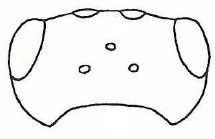
shapeHead roundly narrowing behind eyes, its width 1.8 times its length, 1.2 its height, 1.2 times mesonotum width. Length of base of ocellar triangle equal to distance from it to eye plus one ocellus diameter. POL 3 times ocellus diameter. Temples as long as transverse eye diameter. Longitudinal eye diameter 1.4 times transverse one, twice malar space height, 0.77 times face width. Face height 0.57 times its width, 1.2 times clypeus height [T9][T14].
sculptureVertex with fine transverse rugae behind ocelli, face with more sinuate concentric rugae. Clypeus nearly smooth, shining [T9].
color
antenna
shape ♀3rd segment 3 times, 8th twice, and apical segments 1.5-1.7 times as long as wide; segments nearly cylindrical [T9][T14].
shape ♂
color
mesosoma
shapeMesosoma length 1.7 times its height. Propodeum with delicate transverse carina and weak lateral processes [T9].
sculptureMesonotum transversely rugose in anterior half; with longitudinally reticulate, in front of scutellum with longitudinally reticulate, non-coarse sculpture. Scutellum with gentle sculpture in the middle, shining [T9][T14].
color
legs
shapeHind femur 3.7 times as long as wide. Hind tibia as long as hind tarsus. Inner spur of hind tibia 0.3 times as long as 1st segment of hind tarsus. 5th segment of hind tarsus as long as 3rd, considerably shorter than 2nd [T9]. Hind femur 4 times as long as wide [T14].
sculpture
colorApex of fore femur and entire fore tibia brownish yellow, middle tibia and all tarsi brown. Hind tibia light brown in basal half and brown in apical half [T9].
wings
shapeVein 1-R1 0.67 times as long as pterostigma. Marginal cell 1.5 times as large as 2nd submarginal cell. SR1 S-curved, 3 times as long as 3-SR; 3-SR 1.3 times as long as r, 0.59 times as long as 2-SR. 1-CU1 = 0.7 times cu-a [T9]. Marginal cell slightly larger than 2nd submarginal cell, 1-R1 noticeably shorter than pterostigma [T14].
colorTegulae and pterostigma brown [T14, key]
metasoma
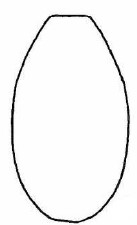
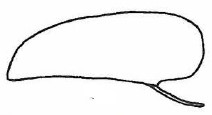
shapeMetasoma oval, bent downward apically along 0.25 of its length, twice as long as wide, 3 times as long as high [T9]. Metasoma oval, bent apically anteriorly 0.25 times its length, 1.8 times as long as wide [T14].
sculptureMetasoma with strongly sinuate and anastomosing longitudinal rugae extending as far as its posterior third [T9].
color
♀ ovipositorProtruding part of ovipositor sheaths as long as 1st segment of hind tarsus [T9].
♂ aperture
other info
distributionDE [T14].
remarksM. victorovi is closely related to the European C. fatigatusPapp, 1981 in the metasoma being rather strongly apically bent downward, and to C. atripes [T9].
Microchelonus victorovi Tobias, sp. n. (figure, 6-8).
Material. Holotype ♀, region of Lower Volga River, Kamyshin, on Euphorbiaceae, 10.VI.1949 (G. Viktorov).
Description. Female. Head roundly narrowing be-hind eyes, its width 1.8 times its length, 1.2 its height, 1.2 times mesonotum width. Length of base of ocellar triangle equal to distance from it to eye plus ocellus diameter. Distance between posterior ocelli 3 times ocellus diameter. Temples as long as transverse eye diameter. Longitudinal eye diameter 1.4 times transverse one, twice gena height, 0.77 times face width. Face height 0.57 times its width, 1.2 times clypeus height. 1st flagellar segment 3 times, 6th twice, and apical segments 1.5-1.7 times as long as wide; segments nearly cylindrical. mesosoma length 1.7 times its height. Propodeum with delicate transverse Carina and weak lateral processes. Anterior margin of radial cell 0.67 times as long as pterostigma. Radial cell 1.5 times as large as 2nd radiomedial one. 3rd radial abscissa S-curved, 3 times as long as 2nd; 2nd radial abscissa 1.3 times as long as 1st, 0.59 times as long as 1st radiomedial vein. Nervulus at distance equal to 0.7 of its own length from basal vein. Hind femur 3.7 times as long as wide. Hind tibia as long as hind tarsus. Inner spur of hind tibia 0.3 times as long as Ist segment of hind tarsus. 5th segment of hind tarsus as long as 3rd, con-siderably shorter than 2nd. Abdominal carapace oval, bent downward apically along 0.25 of its length, twice as long as wide, 3 times as long as high. Protruding part of ovipositor sheaths as long as 1st segment of hind tarsus.
Vertex with fine transverse rugae behind ocelli, face with more sinuate concentric rugae. Clypeus nearly smooth, shining. Mesonotum transversely rugose in anterior half; with longitudinally reticulate, not coarse sculpture in posterior one. Scutellum with gentle sculpture in the middle, shining. metasoma with strongly sinuate and anastomosing longitudinal rugae extending as far as its posterior third.
Body black. Apex of fore femur and entire fore tibia brownish yellow, middle tibia and all tarsi brown. Hind tibia light brown in basal half and brown in apical half.
Body length 3 mm.
Differential diagnosis.M. victorovi is closely related to the European M. fatigatus Papp, 1981 in the metasoma rather strongly apically bent downward; differing from it in the characters shown in the key. Among Far Eastern species, it can be related to M. irrugator Tobias, 1994; differing, in addition to the much more strongly apically bent abdominal carapace, in the shorter apical antennal segments, head more strongly narrowing behind eyes, and darker antennae and legs. According to the key to Mongolian species (Tobias, 1989), M. victorovi is closely related to the widespread M. atripes (= cunctator Papp); their distinctions are shown in the below key.
Data used in the multi-access key
These data are collected from the species descriptions and redescriptions, from published figures and photographs and from own measureements and observations. For a description of the different variables and value classes see this pdf.
morphology
basic information
female
male
body length (mm):
(2.6) 2.6 - 3.2 (3.4)
(2.6) 2.6 - 3.2 (3.4)
number of antennal segments:
16
---
head, dorsal view
Head width : length
narrow, wide
narrow, wide
Temples narrowing - widening
narrowing
narrowing
Eye length : temple length
0.75 - 1.0, 1.0 - 1.25
0.75 - 1.0, 1.0 - 1.25
Roundness temple
medium, weak
medium, weak
POL : OD
2 - 3, 3 - 4
2 - 3, 3 - 4
Ocellar triangle shape
narrow
narrow
Excavation of head
15 - 25%
15 - 25%
head, lateral view
Head height : length
---
---
Eye height : length
---
---
Temple length : eye length
---
---
head, frontal view
Head width : height
very narrow, narrow
very narrow, narrow
Face width : height
narrow
narrow
Eyes converging ventrally
---
---
EH : MSL
short
short
Clypeus width : height
---
---
Clypeus extending above bottom of eyes
---
---
Tentorial pits
---
---
Shape of lower margin clypeus
---
---
antennae
Antennal shape
---
filiform, not widened
Segment 3 length : width
medium
---
Penultimate segment length : width
medium
---
Length of antenna : length of body
---
---
mesosoma, lateral view
Length : height
long
long
transverse carina
weak, indistinct
weak, indistinct
lateral teeth
weak, small, short
weak, small, short
mesosoma, ventral view
Prepectal carina lamelliform
indistinct
indistinct
legs
Hind femur length : width ratio
medium, long
medium, long
Hind tibia length : hind tarsus length ratio
medium
medium
Hind tibia (longest) spur length : metatars length ratio
short
short
wings
Vein 1-R1 length : pterostigma length
short, medium
short, medium
Vein r length : vein 3-SR length
short
short
Shape vein SR1 (straight / concave / convex)
S-shape vein SR1
apically convex, apically convex
not S-shaped, apically convex
cell M : cell Sm2
Sm2 large
Sm2 large
Pterostigma length : width ratio
---
---
Angle between radial vein (r) : vein 1-R1
---
---
metasoma, dorsal view
Length : width ratio of metasoma
short, medium
short, medium
Shape of metasoma
widest towards apex
widest towards apex
metasoma, lateral view
Length : height ratio of metasoma
medium
medium
posterior : anterior height ratio of metasoma
small, medium
small, medium
Position of maximum height
medium, medium-posterior
medium-posterior
metasoma, ventral view
Metasoma posteriorly curved forwards
(distinctly) incurved
(distinctly) incurved
male apical aperture
Aperture width : metasoma width
no aperture
small, medium, large
Aperture shape
n. a.
(nearly) round, oval, elongate - slit
Median process shape
n. a.
---
sculpture
head
general coarseness
fine
fine
clypeus
coarseness punctation
smooth to uneven
smooth to uneven
density punctation
---
---
face
sculpture type
rugose
rugose
sculpture direction
diagonal/concentric
diagonal/concentric
vertex and temple
sculpture type
transverse rugulose
transverse rugulose
mesonotum
sculpture type
---
---
scutellum
middle
---
---
lateral
---
---
metasoma
base - mid sculpture
longitudinally rugose / rugose-striate
longitudinally rugose / rugose-striate
sculpture at apex
rugulose
rugulose
coarse / fine boundary
apex (>70%)
apex (>70%)
color
head
mandibles color pattern
---
---
palpi, lightest color
---
---
antennae
scapus, lightest color
black, dark brown
black, dark brown
segment 3 and 4, lightest color
black, dark brown
black, dark brown
legs
fore coxae lightest colour
dark
dark
fore femur lightest colour
medium light
medium light
fore femur color pattern
tip light
tip light
hind femur lightest colour
dark
dark
hind femur color pattern
entirely dark
entirely dark
hind tibia lightest colour
medium dark, medium light
medium dark, medium light
hind tibia color pattern
narrow light base, wide light base
narrow light base, wide light base
hind basitarsus lightest colour
medium dark
medium dark
hind tarsus segment 2-3 lightest colour
medium dark
medium dark
wings
middle veins lightest colour
basal veins lightest colour
---
---
metasoma
metasoma colour pattern
entirely dark
entirely dark
metasoma lightest colour
dark
dark
metasoma base, colour pattern
entirely dark
entirely dark
metasoma base, light spots
n.a.
n.a.
metasoma base, light band
n.a.
n.a.
Chelonus victorovi in published keys
T9: Tobias 1999
Species of the Genus Microchelonus, Closely Related to M. atripes (Hymenoptera, Braconidae), from the Western Palaearctic.
T14: Tobias, 2010
Palearctic species of Microchelonus Szépligeti (Hymenoptera: Braconidae, Cheloninae): key to species.