shape♀ 3.8 - 4 mm (2sp), ♂ 3.2 mm (1 sp) [P8]. 4mm [Te1].
color
head
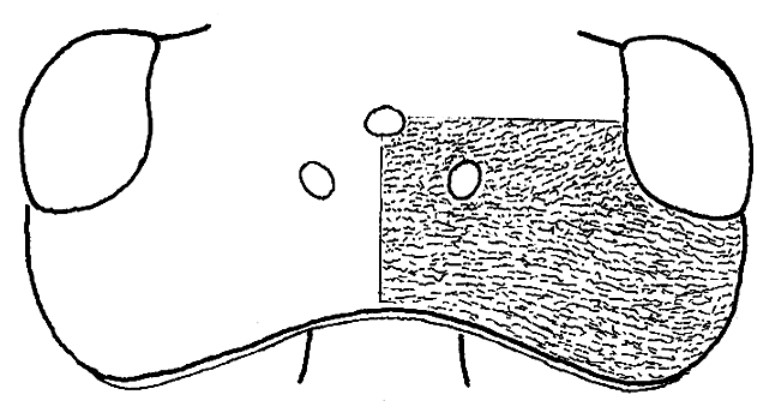
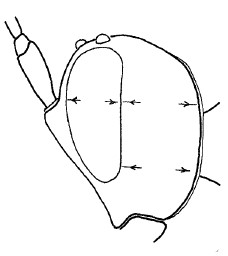
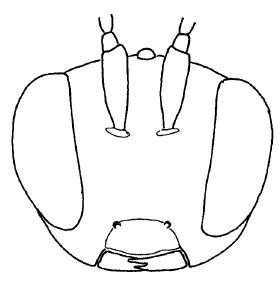
shapeHead in dorsal view 1.9 - 2.0 x as broad as long. Eye 1.0 - 1.1 x as long as temple, temple rounded and not protruding. Temple in lateral view 1.4 times as wide as eye (Fig. 76, see arrows). Malar space somewhat longer than basal width of mandible, inner margin of eyes converging ventrally (Fig. 5). OOL one-quarter longer than POL (Fig. 2) [P8].
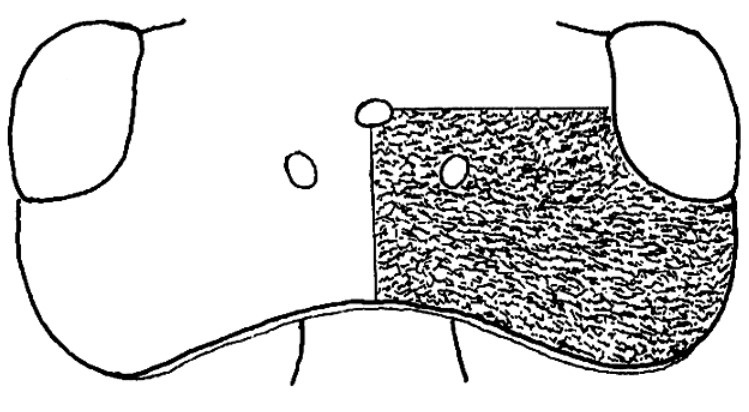
sculpture ♀ Head above (Fig. 2) and face with fine substriation, subshiny, ♂ strio-subrugulose (Fig. 3) [P8].
color
antenna
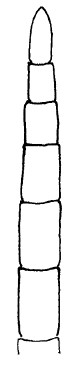
shape ♀Antenna short, as long as head and half of mesosoma combined and with 16 antennomeres. First flagellomere three times as long as broad, penultimate six flagellomeres gradually shortening: 9th flagellomere 1.6 times, 10th flagellomere 1.5 times, 11th flagellomere 1.4 times , 12th flagellomere 1.25 times and 13th flagellomere 1.1 times as long as broad (Fig. 1) [P8].
shape ♂Antennae shorter and thicker [than C. sulcatus), apically clearly thinner, with 20 easy to distinct segments [H]. 20 segments [Te1].
color
mesosoma
shapePropodeum shorter than wide [H]. Mesosoma in lateral view 1.2 times as long as high. Transverse carina of propodeum distinct, ending laterally in a pair of tubercules (Fig. 6) [P8].
sculptureScutellum as coarse as rest of mesosoma. Propodeum matter, with finer sculpture, with weaker teeth [than C. sulcatus?][H]. Mesosoma scrobiculate to rugose. Scutellum laterally rugose to medially rugulose, dull [P8].
color
legs
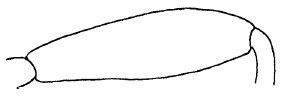
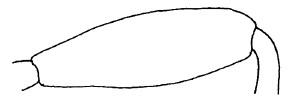
shapeHind femur 2.9 - 3.1 times as long as broad distally (Fig. 7, 10). Inner spur of hind tibia shorter than half basitarsus. Hind tibia and tarsus equal in length. Hind basitarsus as long as tarsomeres 2–4 combined [P8].
sculpture
colorTip of fore femur, fore tibia and inside[?] of mid tibia brownish-yellow [H].
wings
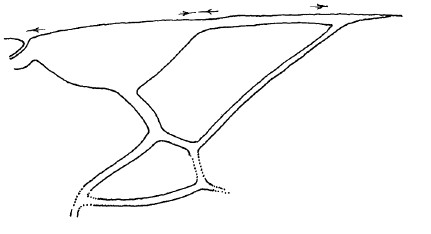
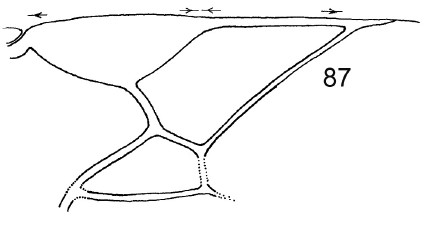
shapeFore wing one-fourth shorter than body. Pterostigma (Fig. 8) wide, 2.3 - 2.5 times as long as wide and issuing r distally from its middle, r one-third longer than 3–SR, 2–SR 3.3 times longer than 3–SR, SR1 straight and twice as long as 2–SR ; 1–R1 short, 0.75 times as long as (♀) or just shorter than (♂) pterostigma [P8].
color
metasoma
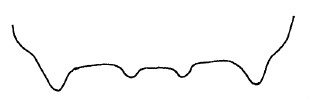
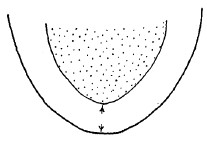
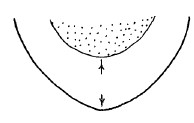
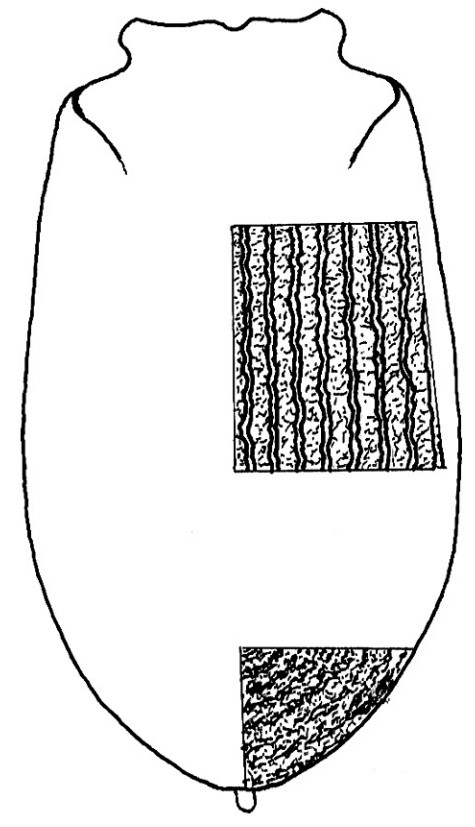
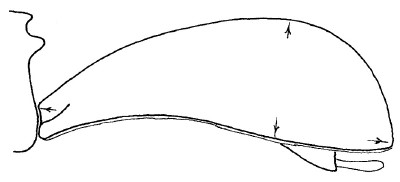
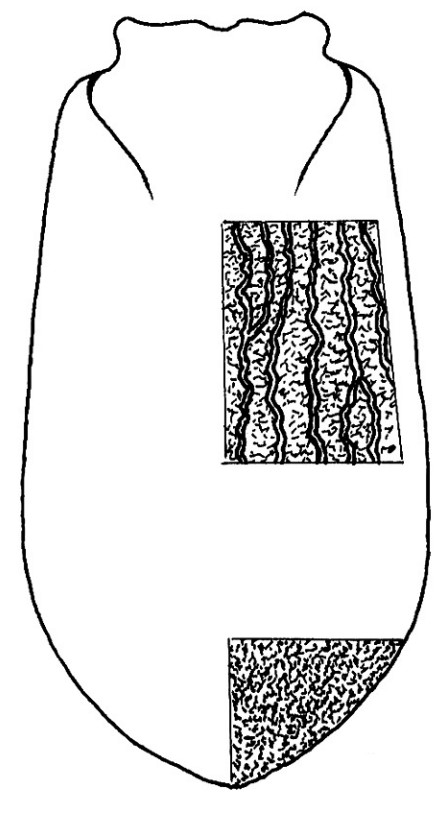
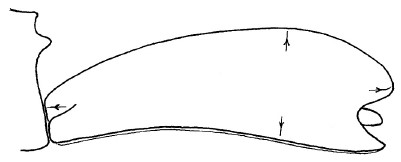
shapeMetasoma mostly same width, at apex somewhat narrower, suddenly ending in a blunt point, not rounded [H].Unlike sulcatus, apico-ventrally only a weak impression without borders [H]. Carapace in dorsal view (Fig. 13) 1.7 (♀) to 2.0 (♂) times as long as broad slightly posteriorly, apically faintly pointed. Carapace in lateral view 3 (♀) to 2.9 (♂) x as long as high (Fig. 86, see arrows). ♀ Carapace apico-ventrally somewhat incurved, i.e. cavity of carapace nearly as long as carapace itself (Fig. 9, see arrows). ♂ Carapace apico-ventrally incurved, incurved part almost as long as hind basitarsus (Fig. 11). [P8].
An derselben Stelle wo bei Ch. sulcatus der tiefe Einschnitt ist, bemerkt man hier einen schwachen ungerandeten Eindruck. Die Fühler sind kürzer, dicker, am Ende deutlicher dunner, mit 20 eben so leicht zu unterscbeidenden Gliedern. Das Schildchen ist so rauh wie der übrige mesosoma, der Metamesosoma schmaler als dick, matter, feiner gcgittert, mit schwächeren Dornen, der HLeib gleichbreit, hinten fast schmaler, und plötzlich in eine stumpfe Spitze endend, nicht zugerundet. Spitze der VSchenkel und der VSchienen, dann die W der MSchienen rostgelb.
Data used in the multi-access key
These data are collected from the species descriptions and redescriptions, from published figures and photographs and from own measureements and observations. For a description of the different variables and value classes see this pdf.
morphology
basic information
female
male
body length (mm):
(3.2) 3.2 - 4 (4.2)
(3.2) 3.2 - 4 (4.2)
number of antennal segments:
16
(19) 19 (21)
head, dorsal view
Head width : length
wide
wide
Temples narrowing - widening
parallel
parallel
Eye length : temple length
0.75 - 1.0, 1.0 - 1.25
0.75 - 1.0, 1.0 - 1.25
Roundness temple
strong, medium
strong, medium
POL : OD
3 - 4, > 4
3 - 4, > 4
Ocellar triangle shape
narrow
narrow
Excavation of head
15 - 25%
15 - 25%
head, lateral view
Head height : length
very short, short
very short, short
Eye height : length
very long
very long
Temple length : eye length
short, long
short, long
head, frontal view
Head width : height
narrow
narrow
Face width : height
very narrow, narrow
very narrow, narrow
Eyes converging ventrally
distinctly converging
distinctly converging
EH : MSL
very long
very long
Clypeus width : height
transverse, very transverse
transverse, very transverse
Clypeus extending above bottom of eyes
far above
far above
Tentorial pits
small, large
small, large
Shape of lower margin clypeus
convex
convex
antennae
Antennal shape
---
filiform, not widened
Segment 3 length : width
medium
---
Penultimate segment length : width
short
---
Length of antenna : length of body
1: very short
---
mesosoma, lateral view
Length : height
short
short
transverse carina
---
---
lateral teeth
---
---
mesosoma, ventral view
Prepectal carina lamelliform
indistinct
indistinct
legs
Hind femur length : width ratio
short
short
Hind tibia length : hind tarsus length ratio
medium
medium
Hind tibia (longest) spur length : metatars length ratio
short
short
wings
Vein 1-R1 length : pterostigma length
medium, long
medium, long
Vein r length : vein 3-SR length
short
short
Shape vein SR1 (straight / concave / convex)
slightly concave, straight or S-shaped
slightly concave, straight or S-shaped
S-shape vein SR1
not S-shaped
not S-shaped
cell M : cell Sm2
Sm2 small
Sm2 small
Pterostigma length : width ratio
short, medium
short, medium
Angle between radial vein (r) : vein 1-R1
medium
medium
metasoma, dorsal view
Length : width ratio of metasoma
short, medium
medium
Shape of metasoma
widest in middle, widest towards apex
widest in middle, widest towards apex
metasoma, lateral view
Length : height ratio of metasoma
medium
medium
posterior : anterior height ratio of metasoma
medium
medium
Position of maximum height
medium, medium-posterior
medium-posterior
metasoma, ventral view
Metasoma posteriorly curved forwards
just/slightly incurved, (distinctly) incurved
just/slightly incurved, (distinctly) incurved
male apical aperture
Aperture width : metasoma width
no aperture
medium
Aperture shape
n. a.
(nearly) round, oval
Median process shape
n. a.
---
sculpture
head
general coarseness
fine
fine
clypeus
coarseness punctation
---
---
density punctation
---
---
face
sculpture type
striate, rugose
striate, rugose
sculpture direction
---
---
vertex and temple
sculpture type
striate-rugulose
striate-rugulose
mesonotum
sculpture type
notauli indistinct
notauli indistinct
scutellum
middle
rugulose
rugulose
lateral
rugose / striate
rugose / striate
metasoma
base - mid sculpture
(sulcate) / striate
(sulcate) / striate
sculpture at apex
rugose-striate, rugose, rugulose
rugose-striate, rugose, rugulose
coarse / fine boundary
mid (50 - 70%), apex (>70%)
mid (50 - 70%), apex (>70%)
color
head
mandibles color pattern
---
---
palpi, lightest color
---
---
antennae
scapus, lightest color
black, dark brown
black, dark brown
segment 3 and 4, lightest color
black, dark brown
black, dark brown
legs
fore coxae lightest colour
dark
dark
fore femur lightest colour
medium light
medium light
fore femur color pattern
tip light
tip light
hind femur lightest colour
dark
dark
hind femur color pattern
entirely dark
entirely dark
hind tibia lightest colour
dark
dark
hind tibia color pattern
entirely dark
entirely dark
hind basitarsus lightest colour
dark
dark
hind tarsus segment 2-3 lightest colour
dark
dark
wings
middle veins lightest colour
basal veins lightest colour
---
---
metasoma
metasoma colour pattern
entirely dark
entirely dark
metasoma lightest colour
dark
dark
metasoma base, colour pattern
entirely dark
entirely dark
metasoma base, light spots
n.a.
n.a.
metasoma base, light band
n.a.
n.a.
Chelonus subsulcatus in published keys
P8: Papp 2014a
Faunistic contributions to the Microchelonus szépligeti species of the palaearctic region, with descriptions of two new species (Hymenoptera: Braconidae: Cheloninae).