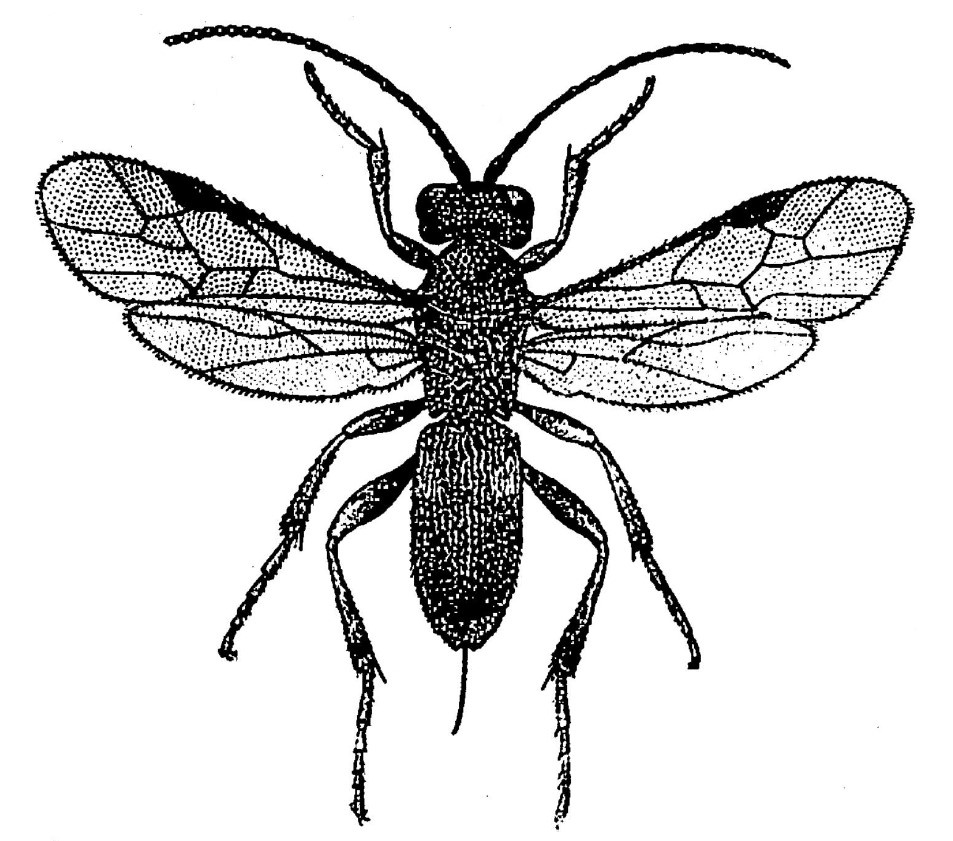
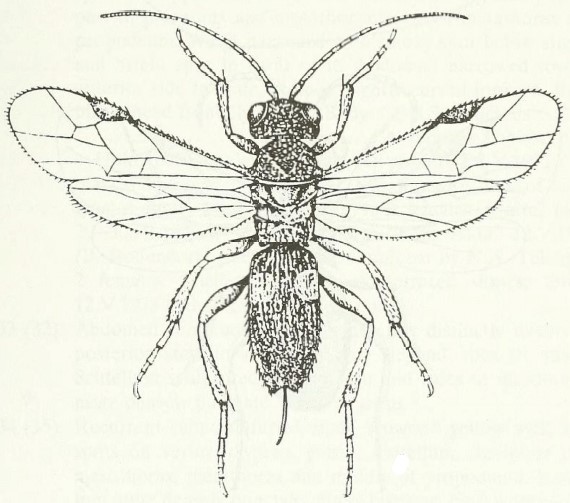
Chelonus submuticus
authorWesmael 1835
synonyms
body
shape2 1/2 li. (5.6 mm)[W]. ♀ Body 5.1 - 5.5 mm long, ♂ 5.5 - 6mm [P1]. 5.0 - 7.0 mm [T3][Te1]. 5.5-7.0 [T13].
colorGround colour of body black [P1].
head
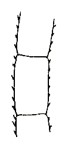
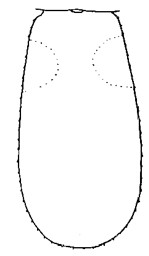
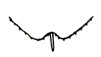
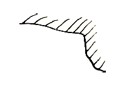
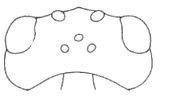
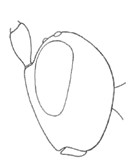
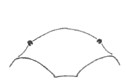
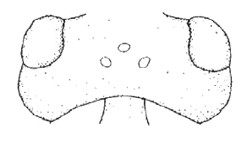
shapeHead in dorsal view (Fig. 8) transverse, twice as broad as long, eye as long as temple, latter slightly bulging, occiput excavated. Ocelli small and forming a rather low triangle. Distance between fore and a hind ocelli as long as longer diameter of fore ocellus, OOL slightly longer than POL. Eye in lateral view just more than twice as high as wide, behind eye temple broad, 1.26 times as wide as eye (Fig. 9). Malar space just longer than basal width of mandible. Face twice as wide as high. Clypeus twice wider than high, ventrally produced and medially truncate (Fig. 10) [P1]. Head 1.15 times as wide as mesoscutum, with straight temples roundly narrowed only in posterior part; width of head twice its length and 1.1 times its height. Length of temples equal to transverse diameter of eye. Base of ocellar triangle longer than OOL plus ocellus diameter; POL 3.0 times ocellus diameter. Longitudinal diameter of eye 1.8 times transverse one, twice height of malar space. Width of face twice its height. Proboscis not projecting. Length of maxillary palpi equal to height of face with clypeus [T3]. Temple in dorsal view slightly though distinctly bulged, i. e., head in dorsal view between temples a bit broader than between eyes (Fig. 22) [P2]. The head is transverse, not narrowed posteriorly. The malar space is equal to 1/2 of the longitudinal diameter of the eye; temples equal to the width of the eye. The face is almost twice as wide as high. The ocelli are small;OOL is 4 times OD [Te1]. Clypeus distinctly projecting forward [T4].
sculptureHead completely rugose, clypeus very finely punctated [W]. Head rugose, clypeus finely punctate, interspaces larger than punctures, temple rugo-striate [P1]. Vertex behind ocelli with rather delicate transverse rugae running downwards onto temples. Face densely rugose-punctate, with transverse rugae. Clypeus finely and rather densely punctate, lustrous [T3]. Head roughly wrinkled; temples and posterior margin of vertex rugose-striated. Clypeus densely, finely punctate, shining [Te1].
colorMandibles are yellowish towards the tip, the palpi are black [W]. Palpi brown [P1].
antenna
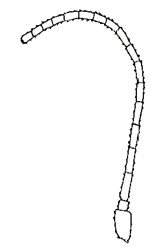
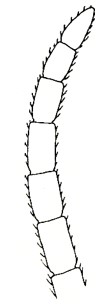
shape ♀The antennae are slender, as long as three quarters of the body, and the same shape for male and female. ♀ 27 segments. [W]. ♀ antenna not widened medially (fig. 3), the 16th segment is about 1.7 times its width [A1]. ♀ Third segment 3 - 3.6 times as long as broad. Flagellum faintly tapering distally. Middle segments 1.5 - 1.75 times as long as broad [P1]. Antennae slightly longer than head and mesosoma combined, setiform, with ~ 30 segments; length of third segment 3.0 times its width, segments in apical part of antennae ~ 1.5 times as long as wide [T3]. Those of the ♀ are as long as 3/4 of the body, 26 segments, setaceous, not dilated and compressed beyond the middle, nor suddenly attenuated at the apex.[M]. Antennae of ♀ equal to the length of the head and mesosoma, 21-segmented or more; segments of the flagellum are cylindrical; behind middle not compressed, slightly thinning towards apex [Te1]. 25-27 segments [S1]. Setaceous, 22-30 segments [T13].
shape ♂29 - 30 segments [W]. ♂ Antenna about as long as body, with 30 - 32 segments [P1]. Antennae equal to body length, 29 - 30-segmented [Te1]. 29-30 segments [S1].
colorThe antennae are black, setaceous, [W].
mesosoma
shapeMesonotum marked by two notauli which unite before the scutellum. The propodeum has only one very short and obtuse tooth on each side [W]. Mesosoma in lateral view one-third longer than high. Notauli weakly distinct. Propodeum with a mediotransverse keel ending laterally in a rather small tubercule [P1]. ♀ Length of mesosoma 1.4 times its height. Propodeum with distinct transverse carina and rather large, pointed lateral teeth [T3]. Propodeum with a transverse carina in the middle, with short obtuse teeth at the sides, without a sharply outlined field at the base [Te1]. Propodeum teeth very short, postscutellum with a low median tooth [M2, luteipes].
sculptureThe whole mesosoma is rugose, including, the surface of the scutellum [W]. Mesosoma rugose, scutellum rugo-rugulose [P1]. Mesosoma areolate-rugose, mesonotum coarsely rugose with transverse alveolation; scutellum coarsely rugose in anterior half, with strongly smoothened sculpture in posterior half [T3]. The mesosoma and propodeum are roughly wrinkled. The notauli are weak. The scutellum is smooth in the middle. Sides of mesosoma with weak, coarsely crenulated grooves [Te1]. Mesosternum tomentose, satin in appearance [M2, luteipes].
colorDark black [W]. Pronotum with a rusty tint [P1].
legs
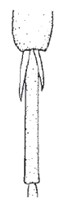
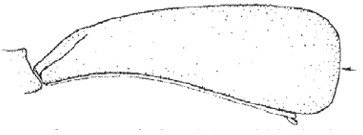
shapeFore femur three times, middle femur 3.42 times and hind femur 3.4 times as long as broad, hind femur broadest at its distal half (Fig. 13). Hind pair of tibial spurs unequal in length, inner spur shorter than half basitarsus (Fig. 21). Hind basitarsus as long as tarsal segments 2-4 and basal fourth of fifth segment combined [P1]. Length of hind femur 3.0 times its width. Hind tibia as long as hind tarsus, its inner spur 0.3 as long as 1st segment of hind tibia, 5th segment of hind tarsus as long as 3rd one [T3]. Inner spur of hind tibia shorter than half basitarsus (Fig. 23) [P2]. Spurs of hind tibia equal to 1/2 of the hind metatars [Te1].
sculptureHind coxae rugose-punctured dorsally [Te1].
colorThe coxae, trochanters and the extreme base of the femora are black. The femora and tibiae are brownish, the tarsi are black [W]. Legs reddish yellow, coxae and trochanters blackish brown, trochanters with reddish suffusion. Tarsi weakly brownish fumous [P1]. Legs mostly (except for dark coxae and trochanters) yellowish red, fore tibia brownish yellow, middle and hind tibiae yellowish brown. Tarsi brown, yellowish basally [T3]. Legs are red; coxae, trochanters, main half of femur, apex of hind tibia, hind tarsus, except for 1st segment, black [Te1]. Hind femora basally blackish [S1].
wings
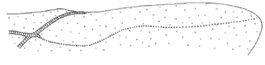
shapethe marginal cell of the hind wing is slender [A1]. Fore wing about one-seventh shorter than body. Pterostigma (Fig. 11) three times as long as wide, issuing radial vein distally from its middle; r just less than half as long as width of pterostigma, 3-SR twice as long as r, SR1 faintly S-like and ending far before tip of wing. 1-R1 shorter than length of pterostigma. Marginal cell of hind wing narrow (Fig. 12) [P1]. Marginal cell of fore wing twice as large as 2nd submarginal cell, 1-R1 as long as pterostigma; 3-SR as long as r, 0.25 times as long as SR1, and nearly half as long as 2-SR [T3]. The anal vein is fractured in the middle, with a small process directed towards the anal area. Vein r is noticeably shorter than 3-SR; 3-SR slightly longer than r-m and three times shorter than SR1. 1-R1 equal to length of pterostigma. 1-CU1 = 0.33 times 2-CU1. The radial vein of the hind wing is strongly curved at the base [Te1].
colorThe fore wings have a dark shade, darker from the stigma to the tip. Vein 1-1A is yellow-brown; the other veins are dark; the stigma is black. [W]. Tegula reddish yellow. Wings also weakly brownish fumous, pterostigma brown, veins yellowish to yellowish brownish [P1]. The wings are light, slightly smoky behind the pterostigma; tegulae and pterostigma black; M-CU1 and 1-M yellow [Te1].
metasoma
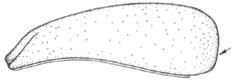
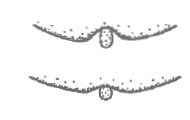
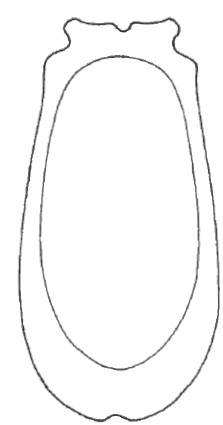
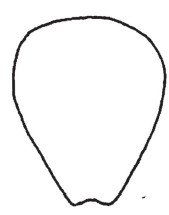
shapeA strong indentation in the lower end of the metasoma where the ovipositor exits the ventral cavity [W]. The carapace is medially about as high as apically. The emargination of the carapace ... varies considerably within the species [A1]. Carapace as long as head and mesosoma combined, in dorsal view (Fig. 14) moderately broadening and slightly less than twice as long as broad posteriorly (♂ 2.0 - 2.2 x, hardly broadening behind). Carapace apically variably emarginate (Fig. 19). Carapace in lateral view (Fig. 16) 2.6 - 3.3 times as long as high behind, its hind half nearly evenly high and its hind end characteristically declivous (fig. 16 see arrow). Carapace apically emarginate (Fig. 18), apico-ventrally somewhat incurved, i.e. ventral cavity of carapace nearly as long as carapace itself (Fig. 20) [P1]. Posterior part of metasomal carapace stretched downwards, carapace considerably incurved apically, usually with small emargination, its length 2.3 times its height (maximum in apical third) and twice its width (maximum medially). Male similar to female, but apex of its metasoma much less strongly stretched downwards. [T3]. Cylindrical carapace. Carapace in lateral view clearly posteriorly truncate (Fig. 24, see arrow) [P2]. Two faint basal carinae not reaching the pale spots [M]. The metasoma is noticeably longer than the mesosoma, ♀: at the apex narrowed and slightly compressed laterally and with a deep notch on the underside, forming a groove for the ovipositor [Te1]. Apex of carapace distinctly narrowed downward, with longitudinal groove on part curved forward (fig. 26, 27) [T4].
sculptureMetasoma rugose. Two sharp carinae at the base extend beyond the pale spots [W]. Carapace rugose, its posterior fourth subrugose (Fig. 14) [P1]. Metasoma with strongly undulate and anastomozing rugae reaching its apical third; carapace rather gently rugose-punctate in apical part [T3]. Metasoma irregularly wrinkled, with longitudinal rugae only at the very base [Te1].
colorDark black, at a short distance from the base a yellow-white spot on each side [W]. Carapace with a pair of basal straw yellow spots, lower margin of carapace opaque yellowish. Pair of basal straw yellow maculae can be small to very small, or even absent in ♂ [P1]. Base with 2 small triangular yellowish spots not touching the reflexed edges, which are also yellowish for a short distance [M]. Sometimes with small yellow spots at the base [Te1]. Metasoma with two large pale brownish-yellow patches at the base, sometimes completely black [M2, luteipes].
♀ ovipositorThe ovipositor protrudes without going beyond the end of the metasoma [W]. Ovipositor sheath short, about as long as half basitarsus [P1]. Ovipositor concealed, or its projecting part nearly half as long as metasoma [T3]. The ovipositor is thin, short [Te1]. Ovipositor strongly crescent-shaped [S1].
♂ aperturen.a.
other info
distributionBE, CH, DE, FR, GB, NL, PL, SE [FE].
remarksThis species can be distinguished from [inanitus and oculator] by the short propodeal teeth, two basal metasoma carinae and for ♀♀ the shape of the antennae and the posterior notch at the metasoma [W].
hostsHomoeosoma nebulellum (Den. et Schiff.) (Pyralidae) [T3]