shape♂: 3.9mm [P4]. 5 - 7mm [Te1]. 5 - 6 mm [M2]. Body large, 5 - 6. [T4]. ♀♂: (2.9-)3.5-4.0 mm [P3].
colorBlack [Th].
head
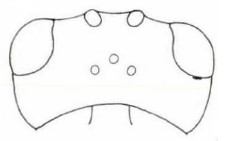
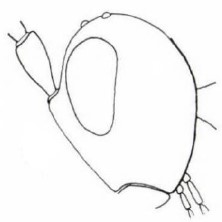
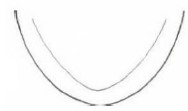
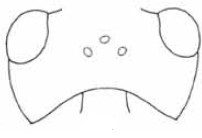
shapeGenae angularly widened [Th]. Head in dorsal view (Fig. 1) transverse, twice as broad as long, eye as long as temple, latter moderately rounded, occiput rather strongly excavated. Eye in lateral view twice as high as wide, widest at its upper third, temple broadening ventrally and clearly 1.6 times as broad as eye (Fig. 2). Ocelli small, distance between fore and a hind ocelli as long as distance between hind two ocelli almost three times greater than diameter of an ocellus; OOL somewhat longer than POL (Fig. 1). Face twice as wide as high, inner margin of eyes slightly diverging ventrally. Clypeus 1.6 times as wide below as high medially, its lower margin convex. Malar space 1.5 times as long as basal width of mandible. Maxillary palp one-third shorter than height of head [P4]. The head is almost semicircular, genae widened at base [Te1]. ♂: Head behind genae angularly broadened and here temples longer than eye (in lateral view) [T4]. Head in dorsal view 1.7-1.8 times (and not twice) as broad as long. Temple in dorsal view 1.2-1.3 times as long as eye (fig. 9, not fig 1) [correction] [P3].
sculptureHead rugose, above rather transversely rugose; clypeus above along its margin uneven, otherwise finely punctate to subpunctate and shiny [P4]. Head slightly rugose-punctate [P4].
colorMandible and palpi dark brown [P4]. Palpi brown to dark brown [P3].
antenna
shape ♀Penultimate segment almost twice as long as wide [Th]. Antennae 16-segmented, thickened in the middle, sharply narrowed towards apex [Te1]. Antennae rather thick [M2].
shape ♂Antenna about as long as body, with 21 segments. Third segment three times as long as broad, further segments gradually attenuating and shortening so that penultimate segment twice as long as broad [P4]. Antennae 22-segmented [Te1][T4].
colorAntenna brownish black [P4]. basal segment of antennae black [T4]. Scape dark brown to black [P3].
mesosoma
shapeMesosoma in lateral view 1.6 - 1.7 times as long as high. Mesonotum between tegulae somewhat less broad than head. Propodeum with a transverse and arched keel ending in a pair of small tubercles [P4]. The propodeum with 2 teeth on the sides [Te1]
sculptureMesonotum subrugose-punctate [Th]. Mesosoma rugose, scutellum rugulose [P4]. Mesonotum slightly rugose-punctate, shining. The propodeum is coarsely wrinkled [Te1].
color
legs
shapeHind femur three times as long as broad, widest at its middle; hind tibia and tarsus equal in length, hind basitarsus as long as hind tarsal joints 2 - 4 [P4]
sculpture
colorLegs for the largest part black. Fore tibiae completely, mid tibiae more than half and hind tibiae broadly in the middle yellowish [Th]. Legs brownish black, fore tibia yellow, middle tibia yellow and distally darkening, hind tibia basally dark yellow, distally blackish to black. Tarsi yellow(ish) with brownish pattern [P4]. Legs are black; fore tibia entirely and hind tibia yellowish in the middle [Te1]. Hind tibiae with yellowish ring in middle [T4].
wings
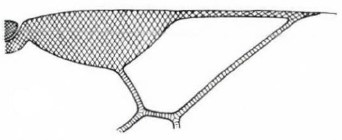
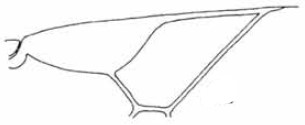
shapeFore wing shorter than body. Pterostigma (Fig. 3) 2.6 times as long as wide and somewhat longer than R1, length of 1-R1 one-fifth shorter than length of pterostigma, latter issuing radial vein distally from its middle; r clearly longer than 3-SR, SR1 straight, 2-SR twice as long as r [P4]. The radial vein of the hind wing is strongly curved [Te1, key 22]. SR1 straight. Marginal cell larger than pterostigma. The radial vein of the hind wing is almost straight [Te1]. Pterostigma one-fourth longer than 1-R1, r clearly longer than 3-SR, pterostigma relatively wide (Fig. 10) [P3].
colorTegula brown [P4]. The wings are slightly smoky; stigma black [Te1].
metasoma
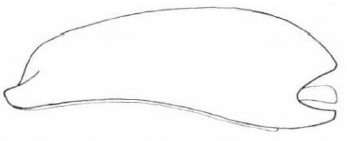
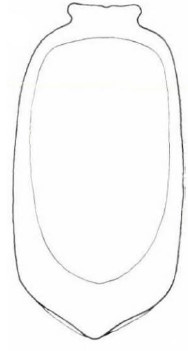
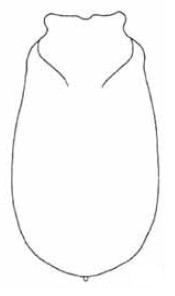
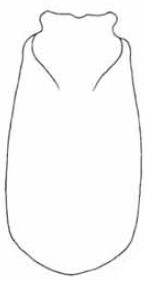
shape♂: Carapace nearly as long as head and mesosoma together, in dorsal view almost twice as long as broad about its middle, subparallel-sided, i.e. hardly broadening posteriorly, apically faintly pointed (Fig. 4); in lateral view gradually becoming higher posteriorly, apically incurved ventrally (Fig. 6), i.e. ventral cavity one-sixth shorter than carapace itself (Fig. 8). Basal pair of keels short and converging, merging into rugosity. ♀: In ventral view carapace apically less incurved (Fig. 7), i.e. ventral cavity somewhat shorter than carapace itself; in dorsal view carapace posteriorly more rounded (Fig. 5) [P4]. Metasoma in dorsal view 1.8- 2 times as long as broad (figs 11, 12) [P3].
sculptureCarapace anteriorly longitudinally strio-rugose, posteriorly rather longitudinally rugo-rugulose, interspaces rather transversely uneven-subrugulose [P4]. The metasoma is slightly reticulate-rugose, matte [P4].
color
♀ ovipositor
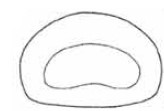
♂ apertureAperture wide [Th]. Apical aperture of carapace almost three times as wide as high [P4]. Aperture 2 times wider than height [Te1]. Apical foramen of male carapace 2.9-3.2 times as wide as high (fig. 13) [P3, in key]. (1.8-)2-2.2 times as wide as high (fig. 13) [P3, in taxonomic remark].
other info
distributionAT, CZ, SE [FE].
remarksThe name M. temporalis TOBIAS is a junior synonym of M. rugicollis (THOMSON, 1874) [P4,P3]. Thee characters of M. temporalis are not consistent with the synonym of this species and M. rugicollis [T1].
hostsOrneodes hexadactyla L. (Orneodidae).
figures
fig. 1: head in dorsal view (Papp 1990)
fig. 2: head in lateral view (Papp 1990)
fig. 3: distal part of right fore wing (Papp 1990)
fig. 4: ♂ carapace in dorsal view (Papp 1990)
fig. 5: ♀ carapace in dorsal view (Papp 1990)
fig. 6: ♂ carapace in lateral view (Papp 1990)
fig. 7: posterior end of female carapace in ventral view (Papp 1990)
fig. 8: carapace in ventral view (Papp 1990)
fig. 9: head in dorsal view (Papp 2004)
fig. 10: distal part of right fore wing (Papp 2004)
fig. 11: ♀ metasoma in dorsal view (Papp 2004)
fig. 12: ♂ metasoma in dorsal view (Papp 2004)
fig. 13: apical foramen of male carapace in facial view (Papp 2004)
25. C. rugicollis n. sp: Niger, pedibus maxima parte nigris, genis anguloso-dilatatis: femina antennis validiusculis; mas rima lata. Long 5—6 mill.
Praecedenti simillimus, pedibus obscurioribus, tibiis anticis totis, posticis medio late, intermediis ultra medium genubusque anticis luteo-flavis, radii abscissa 3:a poststigmate hand duplo longiore; femina antennis validioribus et longioribus, articulo penultimo crassitie sua fere duplo longiore, mesonoto subrugoso-punctato; mas rima abdominis majore et latiore discedens.
Sallsynt i Skane.
Data used in the multi-access key
These data are collected from the species descriptions and redescriptions, from published figures and photographs and from own measureements and observations. For a description of the different variables and value classes see this pdf.
morphology
basic information
female
male
body length (mm):
(3) 3 - 4 (4.2)
(3) 3 - 4 (4.2)
number of antennal segments:
16
21 - 22
head, dorsal view
Head width : length
narrow
narrow
Temples narrowing - widening
narrowing, parallel
narrowing, parallel
Eye length : temple length
0.75 - 1.0, 1.0 - 1.25, > 1.25
0.75 - 1.0, 1.0 - 1.25, > 1.25
Roundness temple
weak, very weak
weak, very weak
POL : OD
2 - 3, 3 - 4
2 - 3, 3 - 4
Ocellar triangle shape
narrow, wide
narrow, wide
Excavation of head
15 - 25%, 25 - 35%
15 - 25%, 25 - 35%
head, lateral view
Head height : length
very short, short
very short, short
Eye height : length
short, long
short, long
Temple length : eye length
very long
very long
head, frontal view
Head width : height
---
---
Face width : height
wide
wide
Eyes converging ventrally
about parallel, distinctly diverging
about parallel, distinctly diverging
EH : MSL
---
---
Clypeus width : height
semicircular
semicircular
Clypeus extending above bottom of eyes
---
---
Tentorial pits
---
---
Shape of lower margin clypeus
convex
convex
antennae
Antennal shape
clearly widened
filiform, not widened
Segment 3 length : width
---
medium
Penultimate segment length : width
long
long
Length of antenna : length of body
---
4: very long
mesosoma, lateral view
Length : height
medium, long
medium, long
transverse carina
present
present
lateral teeth
weak, small, short
weak, small, short
mesosoma, ventral view
Prepectal carina lamelliform
indistinct
indistinct
legs
Hind femur length : width ratio
short
short
Hind tibia length : hind tarsus length ratio
medium
medium
Hind tibia (longest) spur length : metatars length ratio