Chelonus risorius
authorReinhard, 1867
synonyms
body
shape5.5mm. [R2]. ♂ 4.0mm, ♀ 3.8mm [TL]. ♀ 4.2mm [P3]. 3.4 - 5.5 mm. [M]. ♂: 3.5 - 4.0mm [T4][T14]. 5-6 mm [Te1].
colorBlack [R2].
head
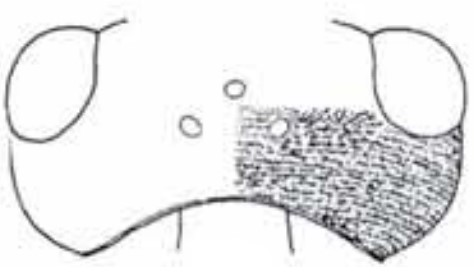
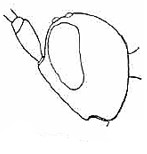
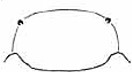
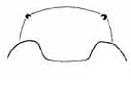
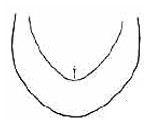
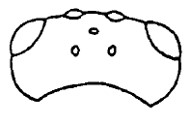
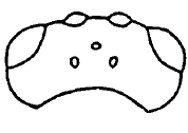
shapeHead in dorsal view (Fig. 2) transverse, twice as broad as long, eye a bit shorter than temple, temple rounded, occiput excavated. Ocelli far from each other, hind imaginary tangent to fore ocellus clearly before hind pair of ocelli, OOL 1.2-1.3 times as long as POL. Eye in lateral view clearly twice as high as wide, temple beyond eye one-third (1.4 times) wider than eye and ventrally somewhat narrowing (Fig. 3). Malar space 1.5 times as long as basal width of mandible. Face clearly twice as wide as high, inner margin of eyes parallel. Clypeus 1.7 times as wide below as high medially, its median lower margin truncate (Fig. 4) [P3]. ♂: Roundly narrowed behind eyes, twice as broad as long, in frontal view 1.2 times as broad as high, about as wide as mesosoma or little wider. Ocellar triangle shorter than OOL. POL 3 times longer than Od. Temples almost as long as transverse eye diameter (11:12). In frontal view eye 2.3 times as high as broad, twice as long as malar space. Face about twice as broad as high and 1.7 as broad as transversal diameter of eye, twice higher than clypeus. Maxillary palpi as long as height of face. ♀ Ocelli smaller, ocellar triangle as long as OOL. POL 4 times longer than Od. [TL][T14]. The head is transverse, sometimes almost cubic [Te1]. Head transverso-cubical, not contracted behind the eyes, cheeks subdilated [M].
sculptureHead finely striate (Fig. 2), clypeus uneven and shiny [P3]. Head finely pointed. Face fine and densely punctate with some longitudinal sculpture about eyes. Frons and temple finely longitudinally striate, vertex partially finely transversely striate. Clypeus finely punctate, weakly shining [TL]. Head finely aciculated, striolated on the cheeks and orbits, frontal fovea not shining [M]. Vertex behind ocelli very mildly transversely striate [T4]. Clypeus densely punctate. gena and temple striated [Te1].
colorPalpi brown [P3][TL]. Palpi black [M].
antenna
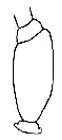
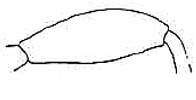
shape ♀Antenna somewhat longer than head + mesosoma combined and with 16 antennomeres. Scape 2.1 times as long as broad medially (Fig. 1), third segment three times and penultimate segment 1.3 times as long as broad, flagellum gradually attenuating [P3]. Antennae with 16 segments, as long as head and mesosoma combined, apical segments 1.5 times as long as wide [TL].
shape ♂Antennae shorter than body, with 18 segments [R2]. Antennae with 23 segments, shorter than body, reaching to about middle of carapace. Scape widened, about twice as wide as flagellum, twice as long as wide; third segment 3 times as long as wide, apical segments 1.5 - 2 times as long as wide [TL][T14]. Antennae with 20 segments [M]. Antennae 19-21-segmented [T4][T14, magnifissus]. Antennae 18-25-segmented, bristly-shaped [Te1].
colorAntenna black with very weak brownish tint [P3]. Scape dark-brownish [TL].
mesosoma
shapeMesosoma in lateral view 1.5 times as long as high. Transverse carina of propodeum medially with a pair of denticules, laterally ending in a tubercule [P3]. 1.3 times as long as high. Propodeum with well-developed transverse carina and lateral tubercles [TL][T14]. Propodeum acutely bidenticulate at the hind angles, and obtusely on each side of the base [M]. Propodeum with two longitudinal carinas ending at transverse carina (looking like two small teeth) [TL]. Propodeum with 4 teeth, of which 2 are medium-small [Te1].
sculptureMesonotum punctate-rugose, scutellum rugose, somewhat shining [R2]. Mesosoma areolate-rugose, mesoscutum behind with longitudinal striate elements, scutellum also striate [P3]. Mesonotum at front densely punctate, pre-scutellar depression strongly sculptured and area before it with longitudinal rugosity. Sides of mesonotum roughly punctate. Scutellum distinctly undulate sculptured. Propodeum areolate-rugulose with longitudinal elements [TL]. Mesonotum punctulato-rugulose, coarsely reticulated just before the scutellum, which is rugose. Propodeum reticulate [M]. Mesosoma quite coarsely rugose-punctate [T4]. Mesonotum and scutellum rugose [Te1]. The propodeum is coarsely reticulate-rugose [Te1].
color
legs
shape♀ Hind femur 2.9 times as long as broad medially (Fig. 5). Inner spur of hind tibia shorter than half basitarsus, hind basitarsus as long as tarsomeres 2-4 combined [P3]. ♀ Hind femur 3 times as long as broad. Outer spur of hind tibiae longer than inner, almost reaching 1/2 of 1st metatarsal segment; 5Ih segment as long as third one, 1.3 times longer than 4th and 1.2 times shorter than 2nd. ♂ Hind femur 4 times as long as broad. Outer and inner spurs of hind tibiae equal, reaching 1/2 of 1st metatarsal segment, 5th segment as long as 4th, 1.5 times shorter as 2nd [TL]
sculpture
colorTip of fore femora, and fore tibiae yellow-brown [R2]. Legs black with light colour pattern. Apex of fore and middle femora and entire fore tibia yellow; middle tibia yellowish, dorso-distally brownish; hind tibia dark brown with a yellow ring. Tarsi yellowish with brownish suffusion [P3]. Coxae dark-brown; fore femora dark-brown with yellow apex, tibiae yellowish, tarsi yellowish with brown apex; hind femora dark-brown, tibiae brown with dark third part, tarsi brown-yellowish with darker apex [TL]. Fore tibiae and tips of the fore femora yellow-brown; or all the tibiae like the tarsi, dark [M]. ♂ Hind tibiae brown [T14].
wings
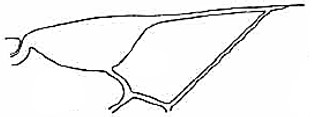
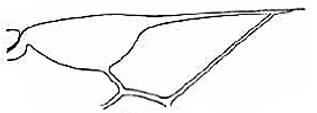
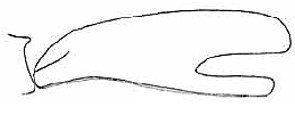
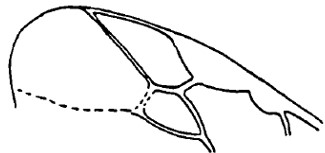
shapeFore wing shorter than body. Pterostigma (Fig. 6) 2.35 times as long as wide and issuing r somewhat distally from its middle, r curved and as long as 3-SR, SRI straight; 1-R1 somewhat shorter than length of pterostigma [P3].1-R1 as long as length of pterostigma. Cell M 1.5 times greater than Sm2. 3-SR 1.2 as long as r, 3.5 times shorter than SRI. 1-CU1 equal to (♂) or shorter than (♀) cu-a [TL]. Radius of hind wings straight except a slight basal curve. wings 7 - 11mm. [M]. SR1 straight, the radial vein of the hind wing is slightly curved [Te1].
colorWings subhyaline, pterostigma dark brown, basal veins yellow, otherwise veins brown. Tegula dark brown [P3]. Wings infuscate. Pterostigma and veins brown [TL]. Tegula black [M].
metasoma
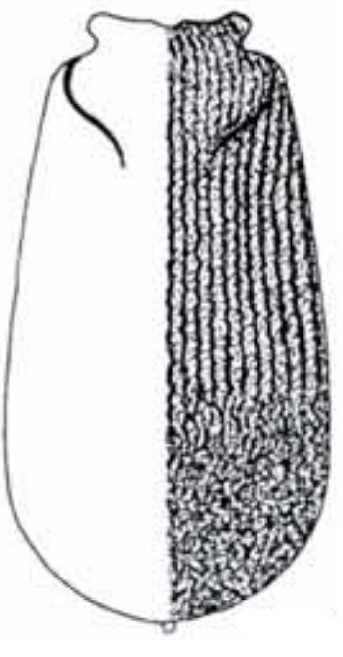
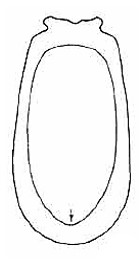
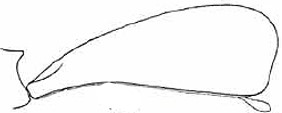
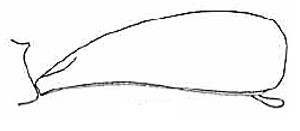
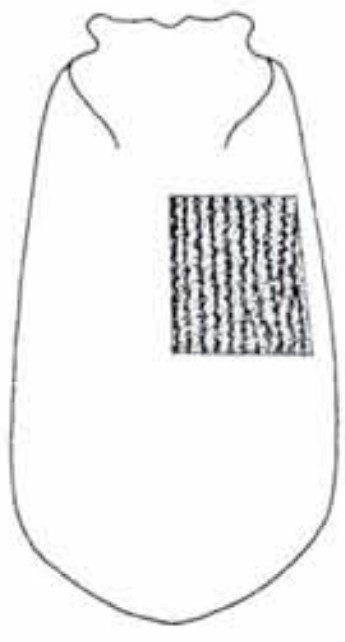
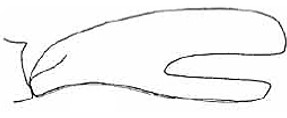
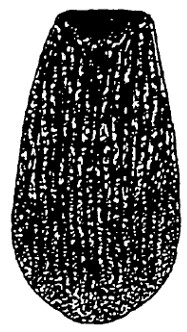
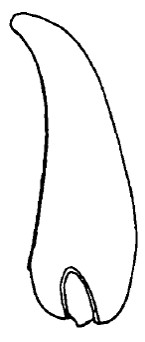
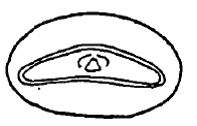
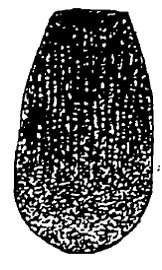
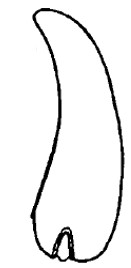
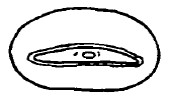
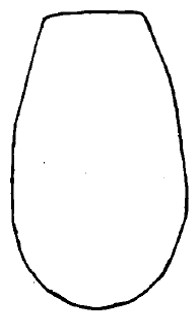
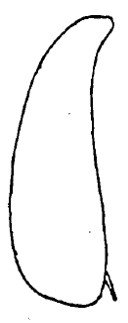
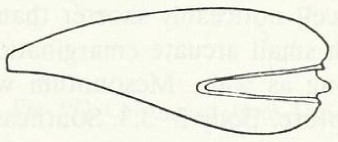
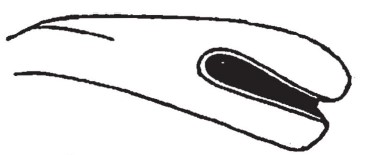
shape♀ Metasoma obovate-subcylindrical [R2]. Carapace in dorsal view (Fig. 7) 1.8 times as long as broad behind, moderately broadening posteriorly. Carapace in lateral view 2.6 times as long as high behind, apically truncate (Fig. 9). Ventral aperture of carapace slightly shorter than carapace itself, i.e. carapace apically slightly incurved (Fig. 8, see arrow) [P3]. ♀ Carapace oval, incurved on 0.25 height of apex, 1.7 times as long as maximal broad. In lateral view enlarged posteriorly, twice as high posteriorly as anteriorly. ♂ Carapace elongate-oviform, about twice as long as maximal broad, incurved on 0.3 posterior height. In lateral view enlarged posteriorly, 2.5 times as high posteriorly as anteriorly [TL]. Metasoma longer than the head and mesosoma, somewhat wider behind [M]. ♂♀ Metasoma 1.8–1.9 times as long as wide [T14, magnifissus]. ♂ Metasoma elongate-oval, twice as long as wide [T14].
sculptureLongitudinally rugose, apex rugulose-punctate [R2]. longitudinally striated, posteriorly rugose [P3]. Carapace strongly longitudinally rugulose with uniform-rectilinear undulations reaching its apex [TL]. Striato-rugose, the rugosity becoming gradually finer to the rounded aciculated apex [M]. Metasoma with coarse longitudinal rugae on basal half [T4]. Metasoma with sharp longitudinal rugae in the basal half [Te1].
colorMetasoma immaculate [M].
♀ ovipositorOvipositor sheath short, concealed [P3][TL].
♂ apertureAperture chink-formed and arcuated, 0.8 times as broad as carapace; in back view about 0.3 height and in lateral view about 0.25 length of carapace [TL]. Ten times broader than long, extending to some distance along the sides of the metasoma, its margins very smooth and shining [M]. Aperture occupies one third of the lateral surface of the metasoma [T14]. Apical aperture occupies almost half of the lateral surface of the metasomal carapace [T14, magnifissus]. The aperture is very large, reaching the middle of the abdomen [Te1].
other info
distributionDE, CZ, GB, NL [FE].
remarks
hostsBiorrhiza pallida Ol. [Te1].