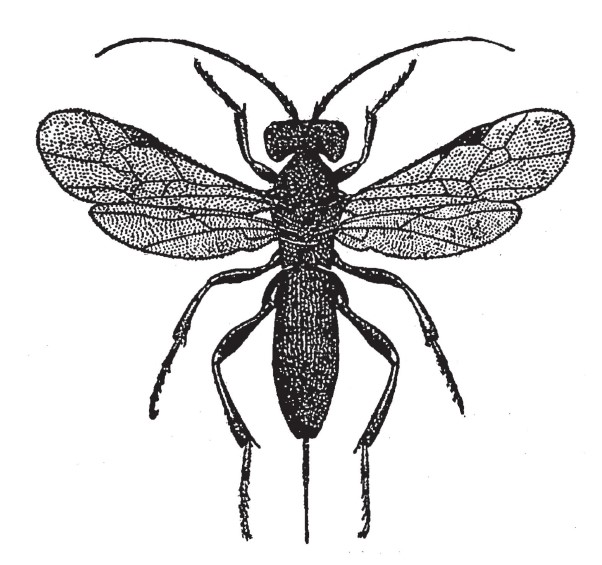
Chelonus retusus
authorNees, 1816
synonymscaudatus Thoms.
body
shapeLin. 1 3/4 (3.9 mm)[N]. 3.8 mm [P4]. ♂♀: 3.8 - 4.0 mm [P3]. 3 - 4 mm [T2][Te1][T4].
colorGrayish black, finely sculptured [N].
head
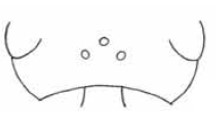
shapeHead in dorsal view transverse, twice as broad as long, eye one-third longer than temple, latter (Fig. 2) rather rounded constricted, occiput moderately excavated. Eye in lateral view twice as high as wide, one-fifth wider than temple, latter almost evenly wide, i.e. not narrowing ventrally (Fig. 5). Ocelli small, distance between fore and a hind ocelli just greater than diameter of an ocellus; OOL nearly twice as long as POL. Face almost twice as wide as high, inner margin of eyes parallel. Clypeus as wide between tentorial pits as high medially, its lower margin convex. Malar space slightly longer than basal width of mandible [P4]. Head almost rectilinearly narrowed behind eyes. OOL nearly twice POL, interval between anterior and posterior ocelli distinctly wider than diameter of ocellus. Width of face twice its height. Height of gena distinctly greater than basal width of mandible [T2]. The head is transverse, strongly roundly narrowed posteriorly. Malar space equal to 1/2 of the longitudinal diameter of the eye. The ocelli are small; the distance between them and the eyes is 5 times the diameter of the ocellus [Te1]. Head behind eyes distinctly or almost linearly narrowed (fig. 11) [T4].
sculptureFace rather transversely strio-rugose, subshiny; clypeus smooth and shiny, with very disperse subpunctates; head above rather transversely rugose, temple rugo-rugulose [P4]. Face and head dorsally transversely striate-rugose [T2]. Face, except for the clypeus, densely wrinkled-striated, matte [Te1].
colorMandibles black [N]. Mandible brown, at middle yellow. Palpi brown. Galea yellow, basally brownish yellow [P4].
antenna
shape ♀Thin [N]. 16 segments [T14]. About two-thirds as long as body. Third segment five times as long as broad, further segments gradually shortening so that penultimate segment 1.4 times as long as broad; flagellum not flattening distally [P4]. Segments in apical part of antennae as long as wide, or slightly longer than wide. Length of antennae equal to 2/3 of length of body; 3rd segment 5 times, apical one 1.4 times as long as wide [T2]. Antennae longer than head and mesosoma, filiform, 16-segmented; apical segments considerably longer than wide [Te1].
shape ♂thin, 23 segments, penultimate segment twice as long as wide [H2].
colorAntenna dark brown [P4].
mesosoma
shapePropodeum short, with small teeth [N]. Mesosoma in lateral view 1.4 times as long as high. Mesonotum between tegulae distinctly less broad than head [P4]. Length of mesosoma 1.4 times its width [T2]. Propodeum in the middle with a sharp transverse ridge, laterally with obtuse teeth [Te1]. Mesosoma 1.3 times as long as high [T4]
sculptureScutellum punctated, base smooth. Propodeum rugulose [N]. Mesosoma rugose, strongly rugose; scutellum smooth and shiny with very disperse subpunctates [P4]. Mesonotum rather regularly rugose-punctate [T2]. Mesonotum densely punctate anteriorly and laterally, rugose posteriorly. Notauli are inconspicuous. Scutellum is smooth and shiny in the middle. The pronotum, the sides of the mesonotum, and the propodeum are coarsely rugose [Te1].
color
legs
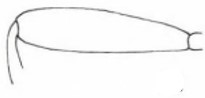
shapeHind femur (Fig. 8) 4.5 times as long as broad. Hind tibia slightly shorter than hind tarsus; basitarsus as long as tarsal joints 2 - 4 [P4]. Hind femora 4.5 - 5 times as long as wide [T4].
sculptureHind coxae slightly rugose [Te1]
colorFore tibiae and ring on hind tibiae brownish. Fore femora with dark red tip [N]. Legs blackish; femora apically and tibiae 1 - 2 entirely yellow; hind tibia yellow, its distal third blackish; tarsi dark fumous yellowish, hind basitarsus less fumous [P4]. Femora apically and fore and middle tibiae yellow, hind tibia yellow with darkened apical 1/3 [T2]. Legs are black; fore tibia entirely, middle and hind tibia reddish-yellow in the middle [Te1].
wings
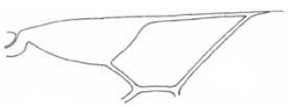
shapeFore wing about two-thirds as long as body. Pterostigma (Fig. 6) 2.5 times as long as wide and as long as R1, issuing radial vein distally from its middle; 1-R1 slightly shorter than length of pterostigma; r as long as 3-SR, SR1 straight, 2-SR somewhat more than twice as long as 3-SR [P4]. 1-R1 of fore wing one-fourth shorter than pterostigma (Fig. 3) [P3]. 1-R1 as long as pterostigma [T2][T14]. Vein r shorter than pterostigma width. 3-SR noticeably longer than r and r-m. SR1 curved, 2.5 times longer than 3-SR. 1-R1 is shorter than the pterostigma. 2-SR almost twice as long as 3-SR. 1-CU1 > 0.5 2-CU1 [Te1].
colorTegula dark brown. Wings subhyaline, pterostigma and veins opaque brownish [P4]. Wings slightly infuscate [T2]. The wings are light; tegulae and pterostigma black [Te1].
metasoma
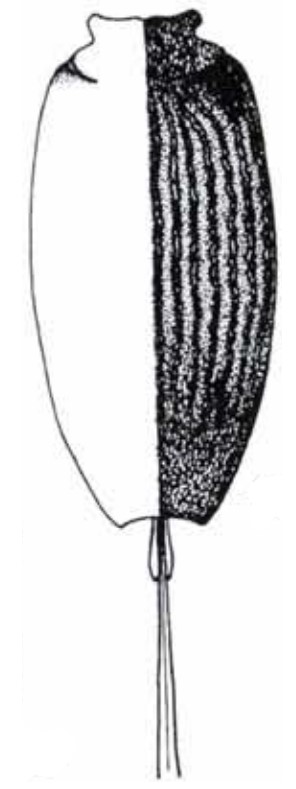
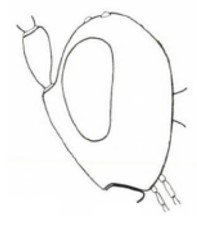
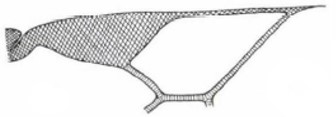
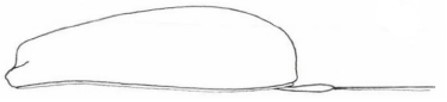
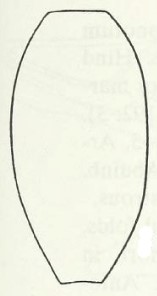
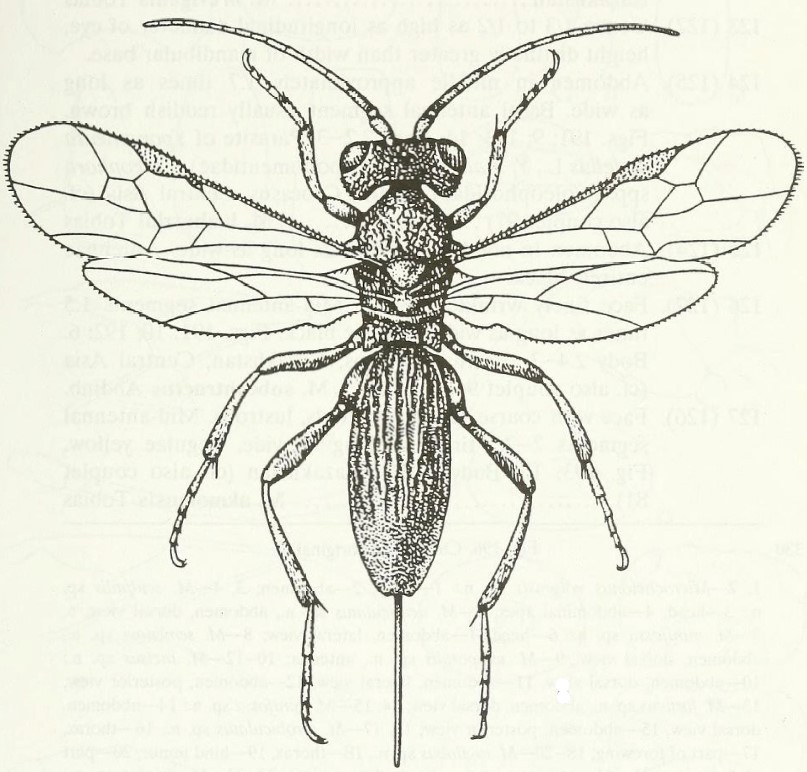
shapeMetasoma oval-subcylindrical, a little longer than head + mesosoma, apex blunt [N]. Carapace somewhat longer than head and mesosoma together, in dorsal view (Fig. 1) elongate oval and twice as long as broad, broadest at its middle; in lateral view (Fig. 7) distinctly one-third higher posteriorly than anteriorly; apically not incurved, truncate (Fig. 4) [P4]. The metasoma is elongate-ovate, slightly narrowed at apex, obtuse [Te1]. Metasoma widely emarginate at apex (fig 10) [T4].
sculptureLongitudinal striae, less parallel than sulcatus. Behind longitudinal substriate, rimulose [N]. Basal pair of keels short and converging. Carapace posteriorly with somewhat weakening rugostriation, its apical third rugose-rugulose, shiny (Fig. 1) [P4]. Metasoma with rather delicate longitudinal rugae projecting slightly beyond its middle. Male: metasoma with distinct longitudinal rugae reaching its posterior 1/3 [T2]. Longitudinally rugose in the basal half [Te1].
color
♀ ovipositorovipositor smooth, setaceous, extending far beyond apex [N]. Ovipositor sheath long, about as long as hind femur or about half as long beyond hypopygium as carapace (Figs 46 - 47) [P4]. Ovipositor sheath long, as long as hind tibia (Fig. 1) [P3].
♂ apertureAAO oval, occupying 0.25–0.30 of width of metasoma [T2]. Oval, hardly twice as wide as high [H2].
other info
distributionCH, DE, CZ, FR, NL, SE [FE].
remarksChelonus retusus is the only species in Europe which has a carapace with incised apex similar to M. erosus (Figs 1, 4); otherwise the two species are clearly different from each other [P3].
hostsOrneodes hexadactyla L. (Orneodidae)