Chelonus pilicornis
authorThomson 1874
synonyms
body
shape5 - 7 mill. (3.0-4.2 mm) [Th]. Somewhat elongated, 4 mm [P4]. 4mm [T14]. ♀: 4.0 - 4.2, ♂: 3.3mm [T10].
colorBlack [Th]. Body, including head and mesonotum, densely (♂: coarsely) uniformly alveolate, matte [T10].
head
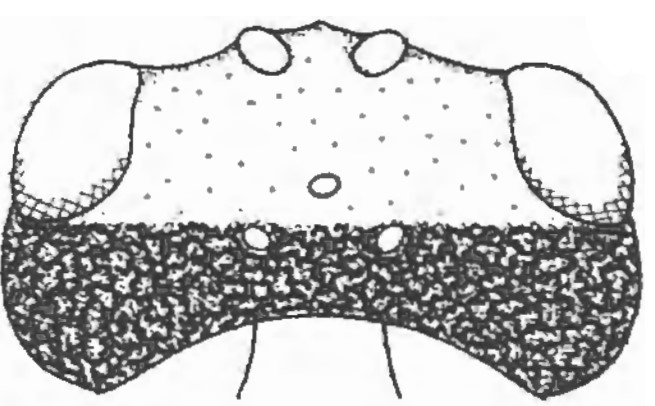
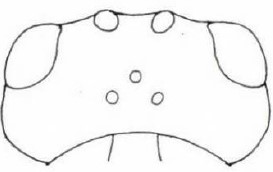
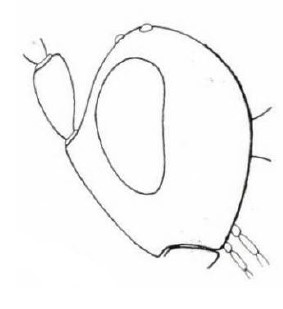
shapeHead in dorsal view (Fig. 1, 7) transverse, 1.9 times as broad as long, eye as long as temple, latter rounded, head between temples minutely broader than between eyes, occiput excavated. Eye in lateral view almost twice as high as wide; temple one-fifth broader than eye and broadest at its middle (Fig. 8). Ocelli small, distance between fore and a hind ocelli 1.5 times, whereas POL 2.5 times as long as diameter of an ocellus; OOL twice as long as POL (Fig. 7). Face about twice as wide as high, inner margin of eyes slightly converging. Clypeus 1.65 times as wide below as high medially, its lower margin convex. Malar space twice as long as basal width of mandible, and half as long as height of eye [P4]. Head widened behind eyes, 1.9 times as wide as long. The temples from above are equal in length to the eye. Distance from anterior to posterior ocellus 1.5 times the ocellus diameter, POL 2.5 times ocellus diameter and POL half as long as OOL. The width of the face is twice its height. The malar space is twice the basal width of the mandible [T14]. The ocelli are small, close together; POL is 4 times the diameter of the ocellus [Te1].
sculptureHead rugose, face rather transversely rugose, clypeus punctate to finely punctate, shiny [P4]. Clypeus more or less densely punctate at least along margins [T14].
colorBasal half of mandible brown, otherwise yellow. Palpi brown [P4].
antenna
shape ♀Antennae thin, 16 segments [Th]. Antenna thin, about as long as head and mesosoma together.Third segment four times as long as broad, further segments gradually shortening so that penultimate segment distinctly 1.5 times as long as broad [P4][T14]. Median antennal segments 2.5–3 times as long as wide [T14]. Antennae are shiny, unusually thin filiform, its third segment distinctly four times as long as broad apically ( ♀ ♂) [P1]. Antennae slender but short, not longer than head and mesosoma combined; 3rd segment 4 times as long as wide; ultimate segment 1.5 times as long as wide [T10].
shape ♂about 22 segments [Th]. Antennae 23-segmented; the length of the 3rd antennal segment is 3 times its width, the middle segments are slightly more than twice as long, the segments in its apical part are twice as long as wide [T14]. Antennae slightly shorter than body, 26-segmented [Te1].
color
mesosoma
shapeMesosoma in lateral view clearly 1.5 times as long as high. Mesonotum between tegulae one-fifth less broad than head [P4].
sculpturesubrugose [Th]. Mesosoma rugose similar to that of head, scutellum somewhat less rugose [P4]. ♂: Mesopleurae with coarse cellular sculpture [T14]. Notauli deep, coarsely rugose [Te1].
color
legs
shapeMiddle femur three to four times as long as broad, broadest at its middle. Hind tibia and tarsus equal in length; hind basitarsus as long as hind tarsal joints 2 - 4 + half of fifth joint together. [P4]. Hind femur 3.5-4.0 as long as wide [T10].
sculptureHind coxae dorsally smooth, shiny [Te1].
colorTop half of fore femora yellowish, … [Th]. ♀ Coxae and trochanters black, base of femora blackish, otherwise legs yellow. ♂ Hind femur rusty [P4]. ♀: Middle femora brownish, but yellow at apex [T14]. Legs black, apices of femora brownish yellow [T10].
wings
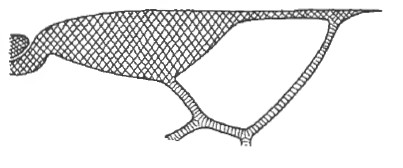
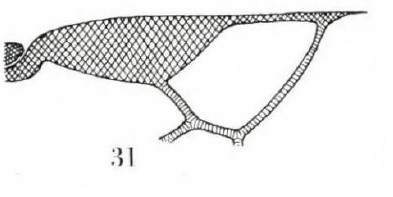
shapeFore wing shorter than body. Pterostigma (Fig. 3) 2.7 - 2.8 times as long as wide and distinctly longer than R1, 1-R1 half as long as that of pterostigma, latter issuing radial vein distally from its middle; r as long as 3-SR, SR1 straight and apically somewhat incurved, 2-SR clearly three times as long as 3-SR [P4]. 1-R1 at most half as long as pterostigma (Fig. 3) [P1]. SR1 4 times as long as 3-SR, slightly concave. 2-SR almost twice as long as 3-SR. 1=CU1 = 0.5 2-CU1. Marginal vein of hind wing curved [Te1], 1-R1 = 0.5 pterostigma length [T10].
color Wings subhyaline, pterostigma and veins opaque brownish [P4]. Tegulae black, the wings are almost light [T14]. wings infuscate [T10].
metasoma
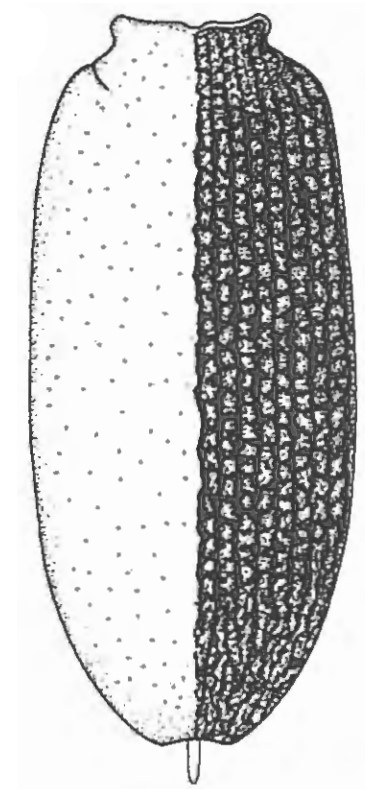
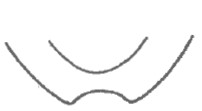
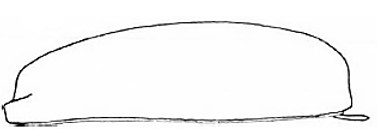
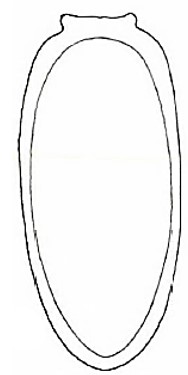
shapeCarapace one-sixth longer than mesosoma, somewhat shorter than head + mesosoma together, in dorsal view about twice as long as broad, subparallel-sided and broadest about its middle (Fig. 2); in lateral view less high, about three times as long as high, slightly higher posteriorly than anteriorly (Fig. 5); apically just incurved and somewhat excised (Fig. 4), its ventral cavity nearly as long as carapace itself (cf. Fig. 6). ♂ Carapace somewhat incurved ventrally, i.e. its ventral cavity nearly as long as carapace itself [P4]. Female carapace apically somewhat excised (Fig. 4) [P1]. Apex of carapace with emargination on under-side at apex [T10].
sculptureMore than half of the metasoma coarsely rimose [Th]. Basal pair of keels short, converging and merging into rugosity. Carapace antero-posteriorly with longitudinal rugosity, apically rather rugose (Fig. 2) [P4].
color
♀ ovipositorOvipositor a little protruding, distinct [Th]. Ovipositor sheath about as long as basitarsus of middle leg [P4].
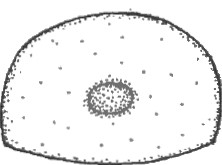
♂ apertureMale aperture small, roundish [Th]. ♂:aperture small and nearly round, i.e. at most 1.5 times as wide as high (Fig. 10). Aperture nearly round, 1.5 times as wide as high (Fig. 10) [P1]. The apical aperture is slit-like, occupying about a third of the metasomal width; the width of the apical aperture is 3.5 times its height [T14]. Aperture 2–3 times as long as wide [Te1].
other info
distributionNL, SE [FE].
remarks
hosts