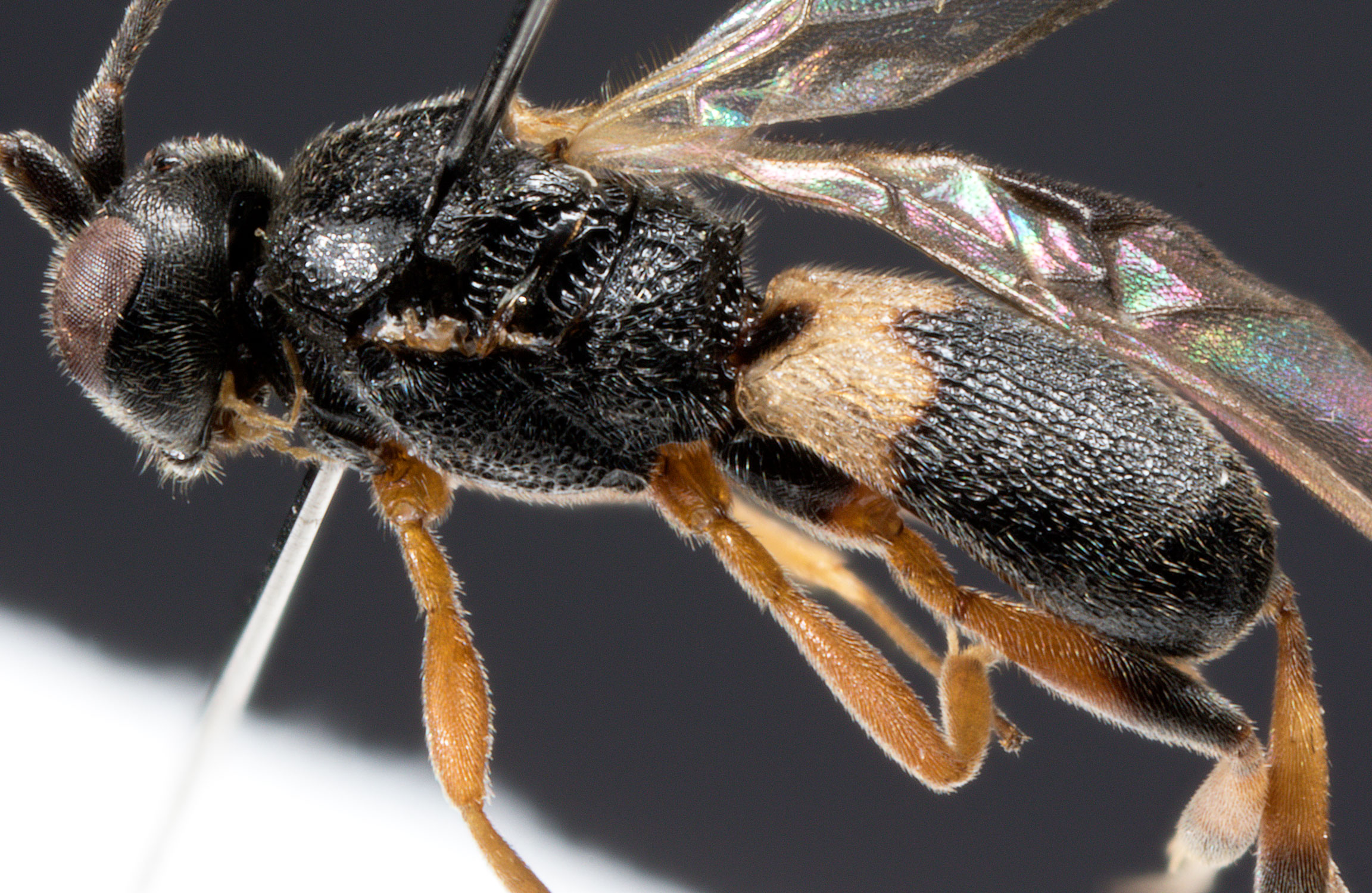
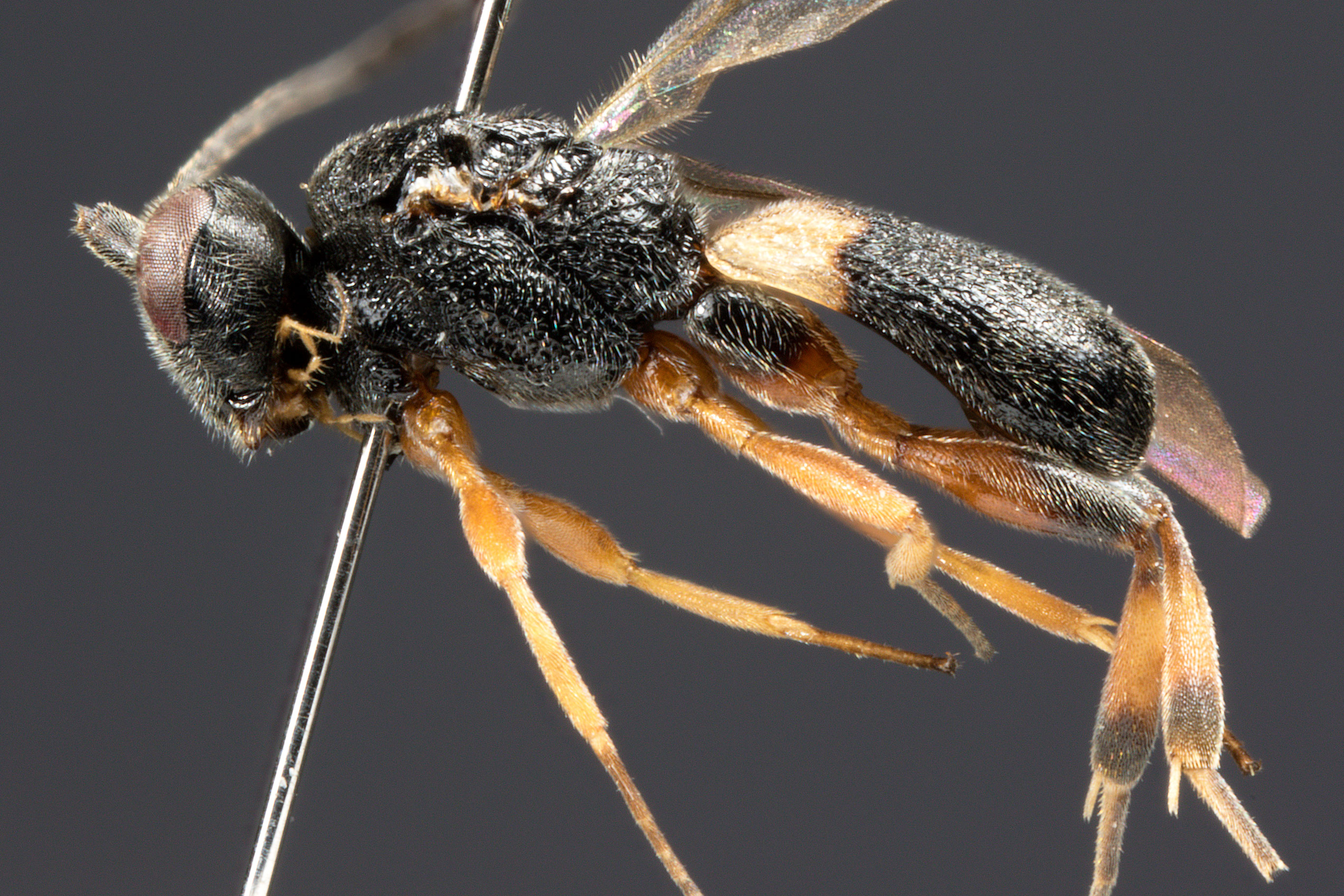
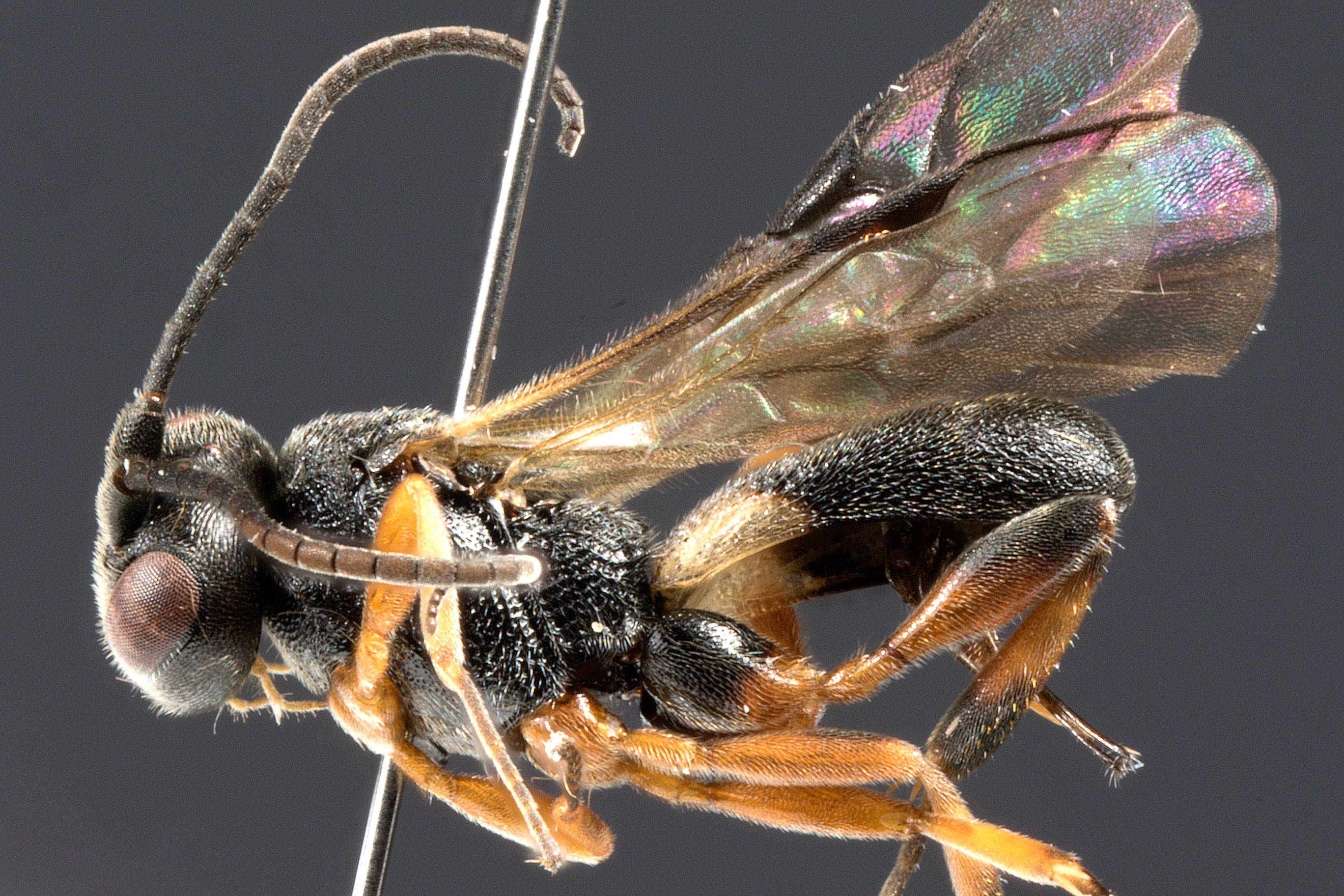
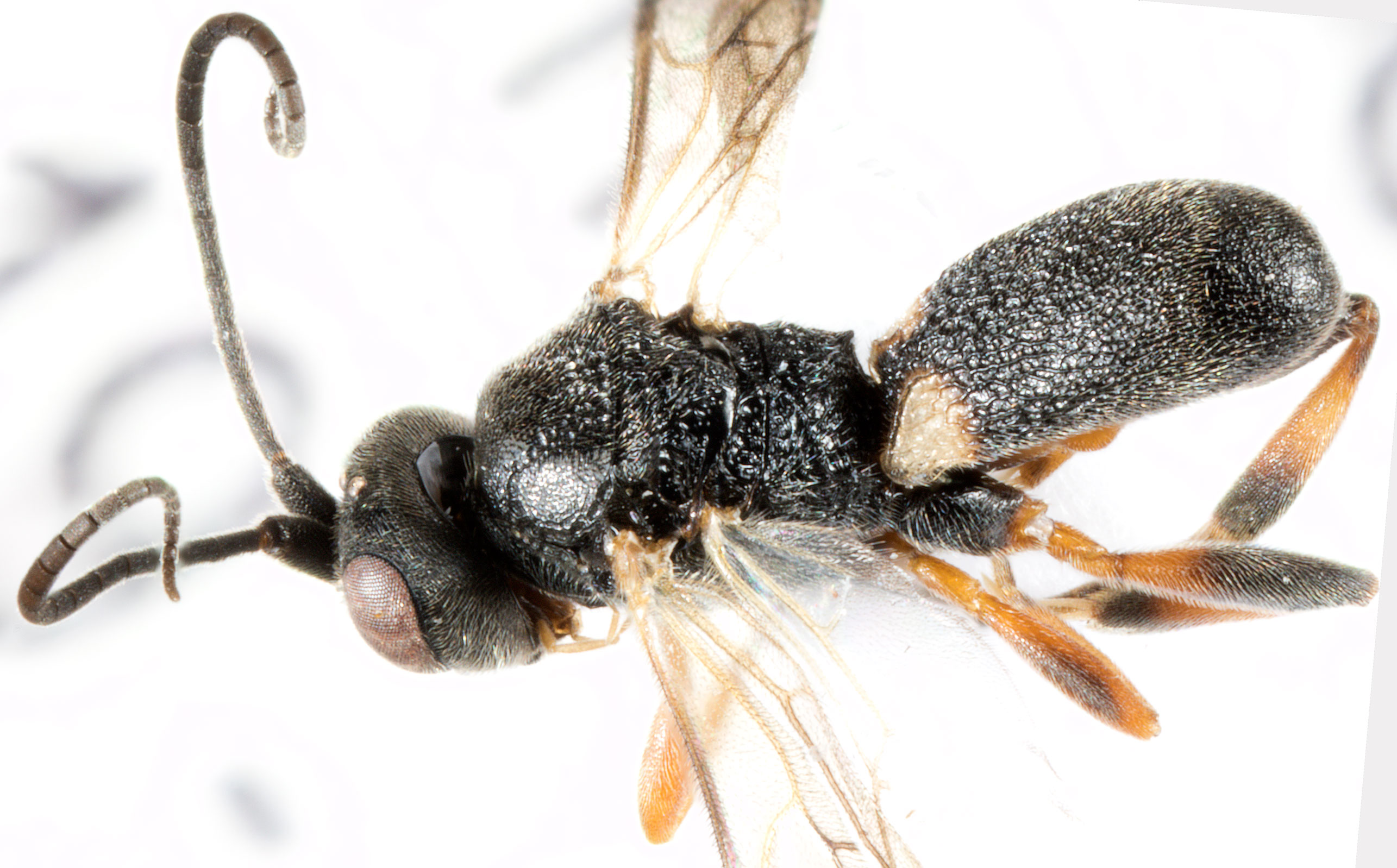
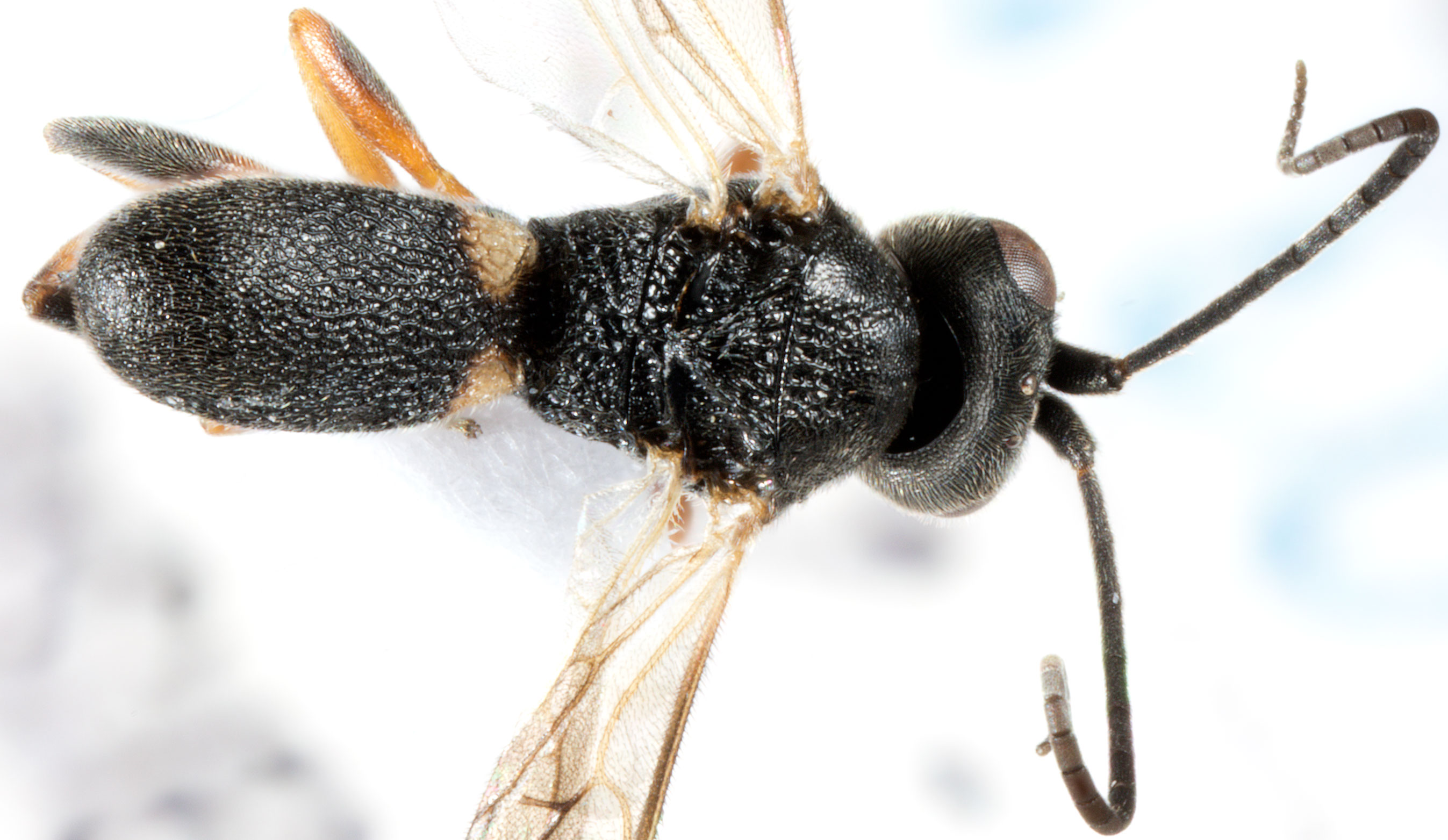
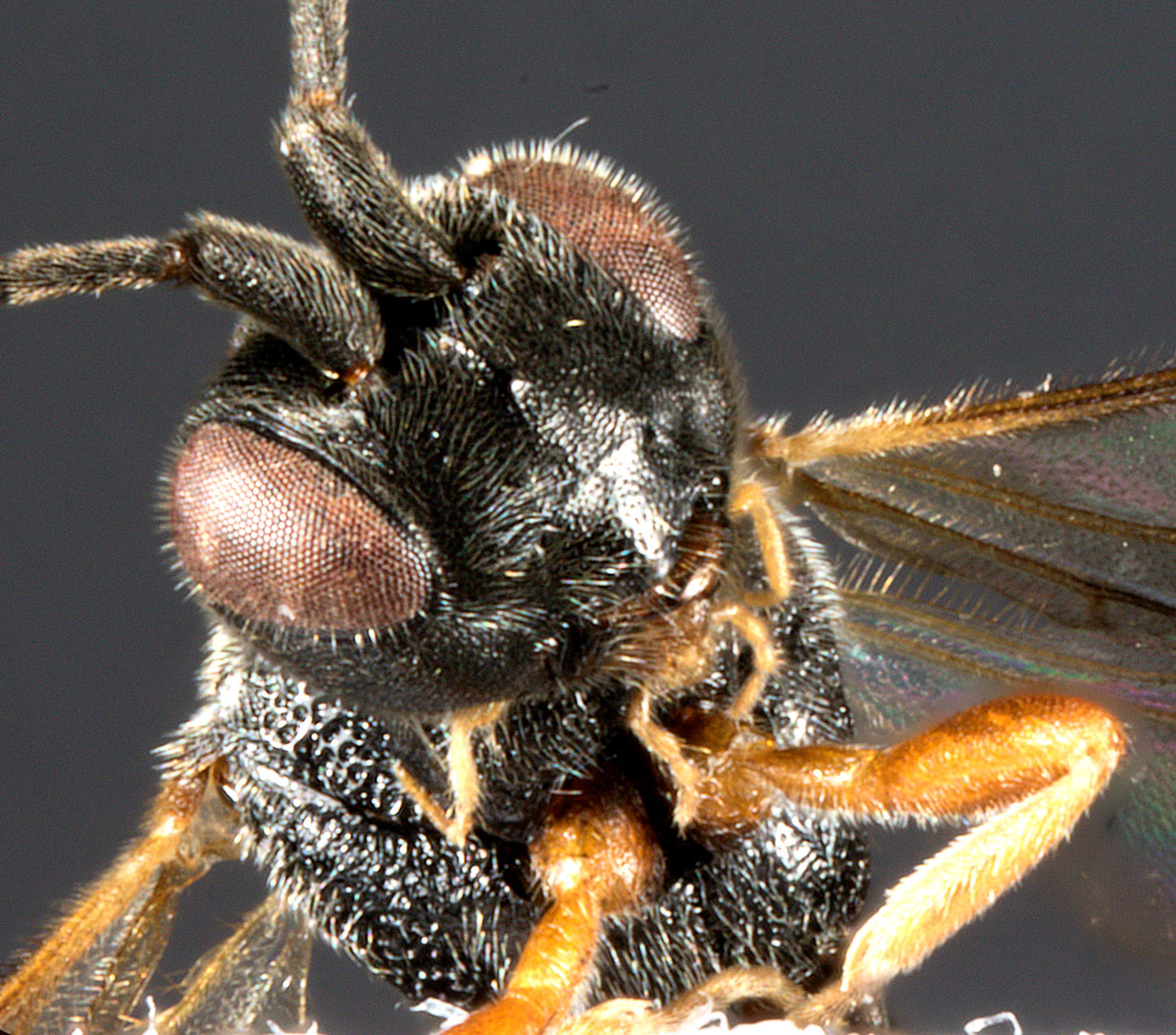
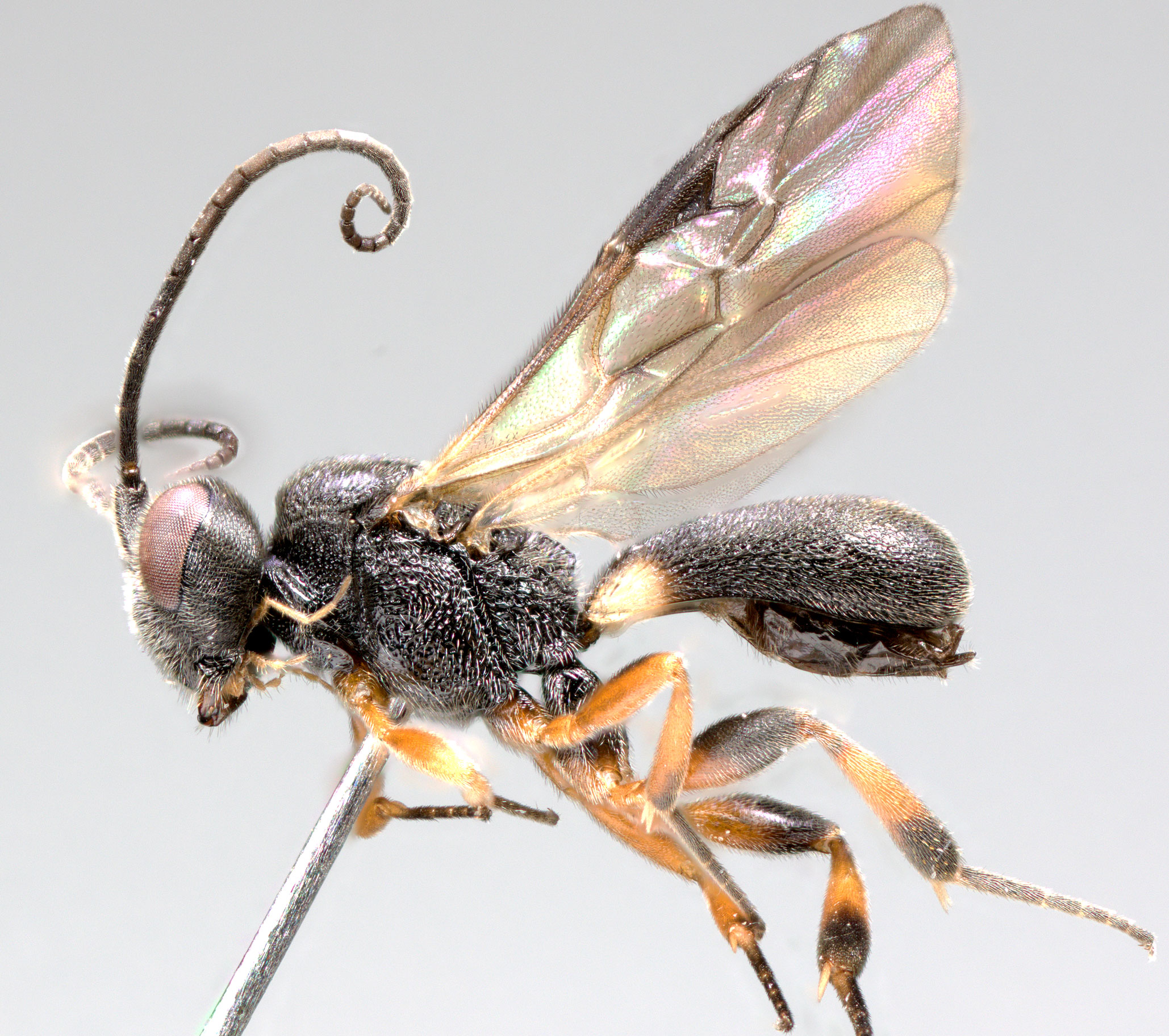
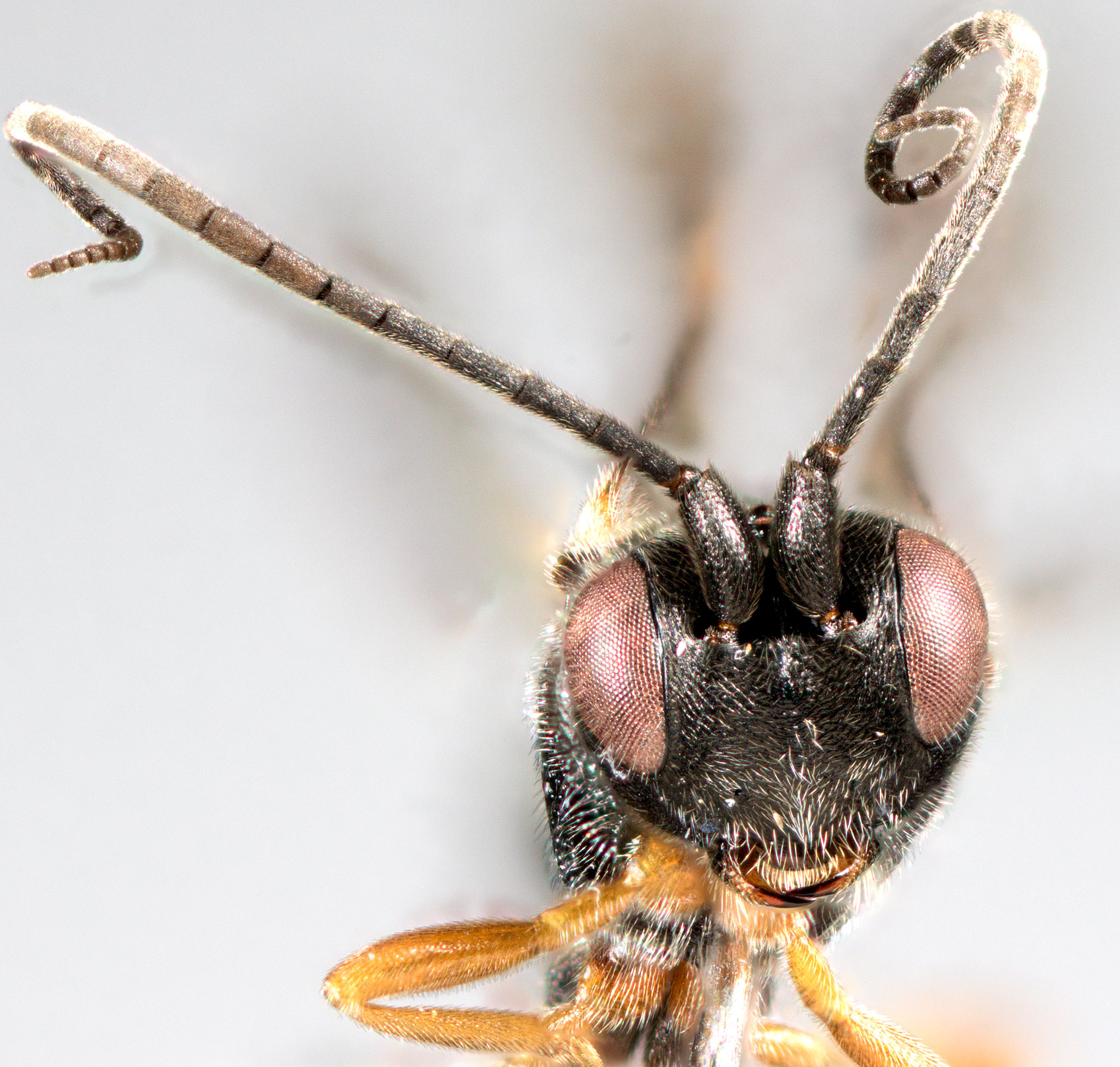
Chelonus pictipes
authorWesmael, 1838
synonyms
body
shape♀ 1 2/3 li. (3.8 mm) [W2]. ♀ 4mm [Te1].
colorBlack [W2]
head
shape
sculptureThe head is slightly rugose [Te1]. The head is very finely rugose [W2].
colorThe palpi are pale, the mandibles are black and more or less yellowish in the middle [W2]. Palpi are yellow [Te1].
antenna
shape ♀Antennae a little shorter than the body, with 28 segments, of which the last segments decrease rapidly in length and width [W2]. Antennae shorter than body, 28 segments [Te1]. Antennae with 28 segments [S4].
shape ♂
colorAntennae black [W2].
mesosoma
shapePropodeum with two fairly short teeth [W2].
sculptureMesosoma rugose, scutellum covered with rugae and punctures, shiny [W2].
color
legs
shape
sculpture
colorThe legs are yellowish-brown; the hind coxae are black with yellowish-brown tip; the top half of the hind femora is black above and on the sides; hind tibiae are slightly dark at the base, black in their top third. The four anterior tarsi are brownish; hind tarsi are entirely black [W2]. The leg is reddish; posterior coxae, apex of the hind femora, base and apex of the hind tibia and hind tarsi black [Te1]. Hind femur and hind tibia partly red [S4]. Hind tibiae black with brown base, hind tarsi black [S1].
wings
shape
colorThe wings have a very slight dark tint; the pterostigma and most of the veins are black; the parastigma is pale [W2]. The wings are slightly smoky; the pterostigma is black [Te1].
metasoma
shapeThe posterior edge of the carapace is weakly sinuated [W2]. Metasoma slightly notched ventrally at apex [Te1]. Metasoma as long as head and mesosoma [S1].
sculptureMetasoma rugose [W2][Te1].
colorMetasoma with the anterior third or quarter more or less yellowish; this pale band still has a black spot in the middle of the base; its posterior border is very rarely straight, almost always indented by the black color that protrudes in the middle, and which sometimes continues in a longitudinal line down to the base. Ventrally same color as dorsally [W2]. Metasoma with 2 yellow spots at the base [Te1]. Metasomal base yellow [S1].
♀ ovipositorOvipositor hidden, it has the shape of a small slender body, cylindrical, straight [W2]. The ovipositor is short and straight [Te1].
♂ aperture
other info
distributionBE, CH, DE, CZ, FR, NL [FE].
remarksThis species, the C. Gravenhorstii sensu Wesmael, differs slightly from C. Gravenhorstii, Nees. In the case of this difference Wesmael proposes the name C.pictipes [M].
hosts
type description
No 5 ter. Chelonus Gravenhorstii.
Niger, rugosus, palpis pallidis: pedibus rufis, coxis tarsisque posticis, femoribus tibiisque posticis apice, nigris; his (tibiis) summa basi tarsisque anterioribus fuscis; abdominis basi fascia lata albida , in medio plus minus interrupta ; metathorace bidentato, ♀. 1 2/3 li.
Chelonus Gravenhorstii. N. ab Es. Hym. Ich. Afrf. 1. 296. 20.
Les antennes sont noires, un peu plus courtes que le corps, de 28 articles, dont les derniers diminuent assez rapidement de longueur et d’épaisseur. Les palpes sont pâles. Les mandibules sont noires avec plus ou moins de fauve dans le milieu. La tête est noire, très-finement rugueuse. Le mesosoma est noir, rugueux; l’écusson est couvert de rides et de points enfoncés ; le métamesosoma est armé de deux dents assez courtes. L’metasoma est rugueux, noir, avec le tiers ou le quart antérieur d’un blanc plus ou moins nuancé de jaunâtre; cette bande pâle a toujours au milieu de la base une tache noire; son bord postérieur est trèsrarement droit, presque toujours échancré par la couleur noire qui s’avance au milieu, et qui se continue quelquefois en une ligne longitudinale jusqu’à la base. Le ventre est coloré comme le dos. Le bord anal de la carapace est faiblement sinué. La tarière est cachée ; réunie à ses valves, elle a la forme d'un petit corps grêle, cylindrique, droit. Les pieds sont fauves; les hanches de derrière sont noires avec l'ex trémité fauve; la moitié terminale des cuisses de derrière est noire audessus et sur les cotés; les jambes de derrière sont légèrement obscures à la base, noires dans leur tiers terminal. Les quatre tarses antérieurs sont d’un fauve obscur; ceux de derrière sont entièrement noirs. Les ailes ont une très-légère teinte sombre; le stigmate et la plupart des nervures sont noirs; le préstigmate est pâle.
Observation,— C’est une chose assez remarquable que ces sept îndividus aient tous 28 articles aux antennes ; et comme celles-ci ont d'ailleurs chez tous identiquement la même forme, et que chez un individu la tarière est accidentellement saillante, je crois que tous sept sont des femelles. Quant à la synonymie, elle ne me paraît pas tout-à-fait certaine, car 1° M. Nees ab Esenbcck ne parle pas de la couleur des palpes; 2° il ne donne pas le nombre d’articles des antennes; 3° il dit que l’écusson est terne, tandis que chez les miens il est luisant ; il dit que la bande blanchâtre de l’metasoma décrit une ligne droite en arrière, tandis que je I'ai trouvée presque toujours échancrée. Dans le cas où l'espèce que je viens de décrire ne serait pas réellement le C. Gravenhorstii, je proposerais de la nommer C. Pictipes.
J'ai pris sept individus de cette espèce aux environs de Bruxelles, pendant le mois de juillet.
Observation,— C’est une chose assez remarquable que ces sept îndividus aient tous 28 articles aux antennes ; et comme celles-ci ont d'ailleurs chez tous identiquement la même forme, et que chez un individu la tarière est accidentellement saillante, je crois que tous sept sont des femelles. Quant à la synonymie, elle ne me paraît pas tout-à-fait certaine, car 1° M. Nees ab Esenbeck ne parle pas de la couleur des palpes; 2° il ne donne pas le nombre d’articles des antennes; 3° il dit que l’écusson est terne, tandis que chez les miens il est luisant ; il dit que la bande blanchâtre de l’metasoma décrit une ligne droite en arrière, tandis que je I'ai trouvée presque toujours échancrée. Dans le cas où l'espèce que je viens de décrire ne serait pas réellement le C. Gravenhorstii, je proposerais de la nommer C. Pictipes.
Data used in the multi-access key
These data are collected from the species descriptions and redescriptions, from published figures and photographs and from own measureements and observations. For a description of the different variables and value classes see this
pdf.
| morphology |
| basic information | female | male |
| body length (mm): | (3.3) 3.3 - 3.9 (4.1) | (3.3) 3.3 - 3.9 (4.1) |
| number of antennal segments: | (25) 25 - 29 (30) | (27) 27 - 31 (32) |
| head, dorsal view |
| Head width : length | --- | --- |
| Temples narrowing - widening | --- | --- |
| Eye length : temple length | --- | --- |
| Roundness temple | --- | --- |
| POL : OD | --- | --- |
| Ocellar triangle shape | --- | --- |
| Excavation of head | --- | --- |
| head, lateral view |
| Head height : length | --- | --- |
| Eye height : length | --- | --- |
| Temple length : eye length | --- | --- |
| head, frontal view |
| Head width : height | --- | --- |
| Face width : height | --- | --- |
| Eyes converging ventrally | --- | --- |
| EH : MSL | --- | --- |
| Clypeus width : height | --- | --- |
| Clypeus extending above bottom of eyes | --- | --- |
| Tentorial pits | --- | --- |
| Shape of lower margin clypeus | --- | --- |
| antennae |
| Antennal shape | --- | filiform, not widened |
| Segment 3 length : width | --- | --- |
| Penultimate segment length : width | --- | --- |
| Length of antenna : length of body | 3: long, 4: very long | --- |
| mesosoma, lateral view |
| Length : height | --- | --- |
| transverse carina | --- | --- |
| lateral teeth | weak, small, short | weak, small, short |
| mesosoma, ventral view |
| Prepectal carina lamelliform | indistinct | indistinct |
| legs |
| Hind femur length : width ratio | --- | --- |
| Hind tibia length : hind tarsus length ratio | --- | --- |
| Hind tibia (longest) spur length : metatars length ratio | | |
| wings |
| Vein 1-R1 length : pterostigma length | --- | --- |
| Vein r length : vein 3-SR length | | |
| Shape vein SR1 (straight / concave / convex) | | |
| S-shape vein SR1 | --- | not S-shaped, apically convex |
| cell M : cell Sm2 | --- | --- |
| Pterostigma length : width ratio | --- | --- |
| Angle between radial vein (r) : vein 1-R1 | --- | --- |
| metasoma, dorsal view |
| Length : width ratio of metasoma | --- | --- |
| Shape of metasoma | --- | --- |
| metasoma, lateral view |
| Length : height ratio of metasoma | --- | --- |
| posterior : anterior height ratio of metasoma | medium | medium |
| Position of maximum height | medium-posterior | medium-posterior, posterior |
| metasoma, ventral view |
| Metasoma posteriorly curved forwards | --- | --- |
| male apical aperture |
| Aperture width : metasoma width | no aperture | no aperture |
| Aperture shape | n. a. | n. a. |
| Median process shape | n. a. | n. a. |
| sculpture |
| head |
| general coarseness | fine | fine |
| clypeus |
| coarseness punctation | --- | --- |
| density punctation | --- | --- |
| face |
| sculpture type | rugose | rugose |
| sculpture direction | diagonal/concentric | diagonal/concentric |
| vertex and temple |
| sculpture type | striate-rugulose, transverse rugulose | striate-rugulose, transverse rugulose |
| mesonotum |
| sculpture type | notauli distinct | notauli distinct |
| scutellum |
| middle | smooth, punctate | smooth, punctate |
| lateral | rugulose, rugose / striate | rugulose, rugose / striate |
| metasoma |
| base - mid sculpture | longitudinally rugose / rugose-striate | longitudinally rugose / rugose-striate |
| sculpture at apex | rugulose | rugulose |
| coarse / fine boundary | mid (50 - 70%) | mid (50 - 70%) |
| color |
| head |
| mandibles color pattern | dark tip | dark tip |
| palpi, lightest color | light brown, brownish yellow, yellow, ivory, white | light brown, brownish yellow, yellow, ivory, white |
| antennae |
| scapus, lightest color | black, dark brown | black, dark brown |
| segment 3 and 4, lightest color | black, dark brown | black, dark brown |
| legs |
| fore coxae lightest colour | medium light | medium light |
| fore femur lightest colour | medium light | medium light |
| fore femur color pattern | entirely light | entirely light |
| hind femur lightest colour | medium dark, medium light | medium dark, medium light |
| hind femur color pattern | base light | base light |
| hind tibia lightest colour | medium light | medium light |
| hind tibia color pattern | narrow light ring, wide light ring | narrow light ring, wide light ring |
| hind basitarsus lightest colour | dark | dark |
| hind tarsus segment 2-3 lightest colour | dark | dark |
| wings |
| middle veins lightest colour | dark, medium dark | dark, medium dark |
| basal veins lightest colour | medium light, light | medium light, light |
| metasoma |
| metasoma colour pattern | color only on basal third | color only on basal third |
| metasoma lightest colour | light | light |
| metasoma base, colour pattern | 1, 2 or 4 spots, light band | 1, 2 or 4 spots, light band |
| metasoma base, light spots | n.a., 2 anterior spots | n.a., 2 anterior spots |
| metasoma base, light band | irregular edge, corners light | irregular edge, corners light |
Chelonus pictipes in published keys