Chelonus pellucens
authorNees, 1816
synonymsalboannulatus (SZEPLIGETI, 1896), pulchricornis (SZEPLIGETI, 1898), nitens (Reinhard)
body
shape2 - 2 1/2 lin. (4.5-5.6 mm)[N]. ♀ (4.5-)5 - 6 mm, ♂ 4.5 - 6.0 mm [P3]. 4.5 - 6.0 mm [T16, alboannulatus], 5-6mm [T7].
colorBlack [N].
head
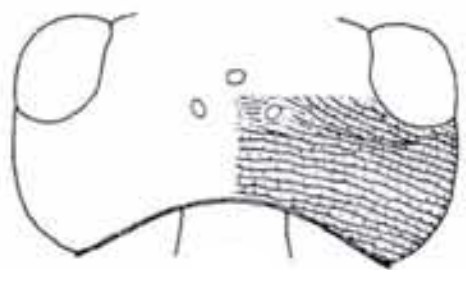
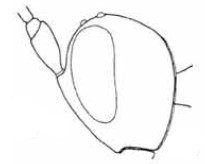
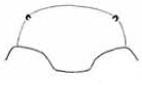
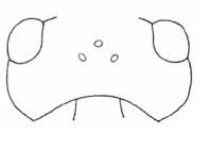
shapeHead in dorsal view (Fig. 1) transverse, 1.8 - 2.1 times as broad as long, rarely between temples a bit broader than between eyes (Fig. 9). Temple 1.3 times as long as eye, temple rounded, occiput excavated. Ocelli small and elliptic; hind imaginary tangent to fore ocellus before hind pair of ocelli; OOL almost twice as long as POL. Eye in lateral view 2.1 times as high as wide, temple beyond eye wide, i.e. 1.25 times as wide as eye, ventrally faintly narrowing (Fig. 2). Face 1.8 times as wide as high, inner margin of eyes parallel. Clypeus 1.8 times as wide as high, its lower median margin just convex (Fig. 3). ♂: Eye usually somewhat longer than temple or, less usually, eye as long as temple. Ocelli a bit greater [P3]. Temples 1.3 times as long as transverse eye diameter [T14]. The head is transverse, slightly widened and rounded posteriorly; the cheeks are widened [Te1]. Temples more than 1.5 times as long as eye [T4, alboannulatus].
sculptureHead above (Fig. 1) and temple striate, face strio-rugose; clypeus with dense punctation, i.e. interspaces shiny and shorter than punctures [P3]. The head is slightly wrinkled, only the pits on the forehead at the base of the antennae and temples are smoother [Te1].
colorPalpi dark [N]. Palpi dark rusty brown [P3].
antenna
shape ♀Antennae long [N]. Antenna somewhat longer than head + mesosoma combined and with ( 19-)20-22(-24) segments. Third segment 3.3 times and penultimate segment subcubic to 1.3-1.5 times as long as broad, flagellum proximo-distally attenuating [P3]. 22 segments [Zh1]. Preapical segment almost equal to its width [T14]. Antennae bristle-shaped, 16 segments [Te1]. 22 segments.The 10-22 segments are hollowed out on the outer side and each show a dimple, the middle segments are only somewhat flat [S4, pulchricornis]. Antenna with about 20 segments [T7].
shape ♂Antennae long, tapering towards the apex [N]. Antenna as long as head, mesosoma and half of carapace combined, with 24-27 segments. Flagellum attenuating, third segment 3.7 - 3.8 times and penultimate segment 1.7-1.8 times as long as broad [P3]. 22 - 27 segments [Zh1]. 27-28 segments, length of segments in apical part of flagellum no more than 1.5 times their width [T14]. 25 - 27 segments [Te1].
colorScape black with weak rusty suffusion, flagellum blackish [P3].
mesosoma
shapeMesosoma in lateral view 1.3 times as long as high. Propodeum with a transverse carina laterally ending in a small tubercule [P3].
sculptureScutellum finely and densely punctated [N]. Mesosoma areolate rugose, mesonotum rather rugose, scutellum smooth and shiny [P3]. Scutellum almost smooth, shining. The sculpture of the metasoma is soft longitudinally rugose [T14]. Mesonotum sparsely rugosely punctate, shining, densely rugose only anterior to the mesonotum. Scutellum weakly punctured; brilliant. The propodeum is coarsely reticulate-rugose [Te1]. Anterior and lateral parts of mesonotum relatively faintly sculptured, in middle, somewhat lustrous [T4, alboannulatus].
color
legs
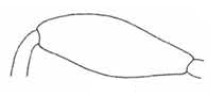
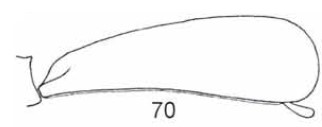
shapeHind femur (Fig. 4) 2.5-2.6 times as long as broad medially (♂: 2.6-2.7 x). Inner spur of hind tibia a bit longer than half basitarsus. Hind basitarsus as long as tarsomeres 2-4 combined [P3]. ♂ Hind femora 3 times as long as wide [T4, alboannulatus].
sculpture
colorTibiae pale, apex dorsally black. Trochanters completely and femora at anterior apically dark red. Tarsi dark, anterior base reddish [N]. Coxae + trochanters black, femora blackish brown; distal half of fore femur, apex of middle femur, fore tibia + tarsus entirely brownish-yellow; middle tibia yellowish, hind tibia dark brown with yellow ring; tarsi 2-3 reddish yellow and faintly brownish fumous [P3]. ♂: The legs are dark-colored [T14]. The legs are black; fore tibia entirely, hind tibia yellowish in the middle [Te1]. Hind femora black [T5]. Hind trochanter and proximal part of femur black, the latter occasionally reddish distally [T7].
wings
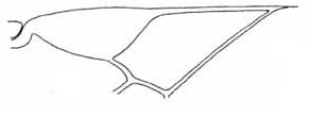
shapeFore wing about one-quarter shorter than body. Pterostigma (Fig. 5) 2.3 - 2.5 times as long as wide and issuing r distally from its middle; 3-SR 1.25 times as long as r and r somewhat curved; SR-1 faintly bent; 1-R1 almost as long as pterostigma [P3]. 1-R1 is equal to the length of the pterostigma [T14]. Marginal cell larger then pterostigma. SR1 slightly curved. Radial veins of the hind wing are straight [Te1].
colorTegulae blackish. Wings hyaline, subhyaline to faintly fumous, pterostigma brown, veins brownish, basal veins yellow [P3]. The wings are light; the pterostigma is brown [Te1].
metasoma
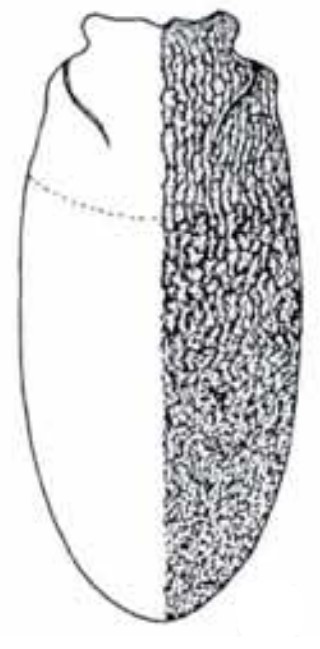
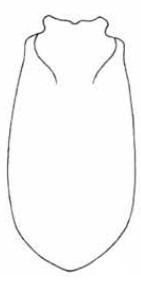
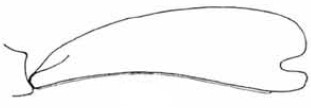
shape♀: Carapace in dorsal view (Fig. 6) 2.0 - 2.2 times as long as broad medially, apically somewhat pointed. Pair of basal keels short. Carapace in lateral view 3.0 - 3.2 times as long as high behind and apically rounded (Fig. 7). Ventral aperture of carapace almost as long as carapace itself, i.e. carapace apically somewhat incurved (Fig. 8). ♂: Carapace in dorsal view (Fig. 10) 1.8-2 times as long as broad behind, slightly broadening posteriorly. Carapace in lateral view 2.8-3.2 times as long as high behind (Fig. 11) [P3]. The metasoma is longer than the head and thorax, its sides are parallel, the slightly pointed end is somewhat indented on the lower side, the base with two carinae [S4, pulchricornis]. Metasoma 2.5 times as long as its greatest width [T4, alboannulatus][T16, alboannulatus]. Length of abdomen more than twice width [T5].
sculptureMetasoma finely rugulose [N][M2]. Metasoma coarsely rugose at the base [Te1]. Metasoma longitudinally rugose and on its hind part rugo-rugulose [P3].
colorBase of metasoma (first segment) pale brownish-yellow, on the sides a little extended [N][M2]. ♀: Basal third of carapace reddish yellow. Carapace frequently entirely black (var. nitens REINHARD) or feebly rusty or laterally with a pair of rusty to brownish maculae of variable size. ♂: Carapace entirely black, basally sometimes more or less rusty to reddish yellow. [P3]. ♂: the metasoma is sometimes reddish at the base or with yellow spots, but more often it is completely black [T14]. Metasoma black or basally with yellowish spots [T4, alboannulatus]. Female abdomen occasionally reddish at base or with indistinct yellowish spots. (Male abdomen black)[T7].
♀ ovipositorOvipositor hidden [N]. Ovipositor sheath short and concealed [P3]. Ovipositor straight [S4, pulchricornis].
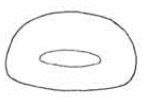
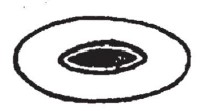
♂ apertureApical aperture 3-5 times as wide as high (Figs 12 - 13) [P3]. 0.7 - 0.8 times width of carapace in posterior view [Zh1]. Aperture is large; the edges of the aperture are shiny; upper edge with small serrations [Te1]. Aperture on apex of abdomen with parallel upper and lower margins [T4, alboannulatus]. Aperture occupying about 0.3 width of metasoma [T5]. Aperture with nearly parallel upper and lower margins, occupying 0.3-0.5 of width of apical part of carapace [T7].
other info
distributionAT, CH, DE, FR, GB, PL [FE].
remarks
hostsChamaesphecia tenthrediniformis (DENIS et SCHIFFERMÜLLER, 1775)


![metasoma, dorsal view [alboannulatus]](species/chelonus_pellucens/fig_15.jpg)
![abdominal apex, lateral view [alboannulatus]](species/chelonus_pellucens/fig_16.jpg)