Chelonus nomas
authorTobias 1997
synonyms
body
shape♀ 3.0 - 3.6 mm. ♂ 3.4mm. [T8]
colorBlack. Body largely finely rugose-punctate [T8].
head
shapeHead strongly roundly narrowed behind eyes, 1.1 times wider than mesonotum, nearly oval anteriorly, slightly less convex dorsally than ventrally, twice as wide as long, 1.2 times wider than high. Temples 1.0 -1.2 times shorter than eye. Base of ocellar triangle as long as OOL or somewhat shorter (5 : 6). POL equal to 2 ocellus diameter. Longitudinal eye diameter 1.6 times longer than transverse one, 3 times longer than malar space height, as long as face width. Face 1.8-2 times as wide as high, 1.2-1.4 times as high as clypeus. Labial palpi slightly longer than face height [T8]. Temples 0.8–1 times the transverse diameter of the eye. POL is twice the diameter of the ocellus [T14].
sculptureFace finely sculptured, with abundant transverse rugae; temples with thinner and more abundant rugae, but vertex behind ocelli with more smoothed rugae parallel to occipital carina [T8].
color
antenna
shape ♀Antennae equal in length to head and mesosoma combined, weakly setiform, with ventrally depressed apical segments. 3rd antennal segment 3 times longer than wide, two preapical segments as long as wide [T8]. Antennae equal to total length of head and mesosoma, segments in the apical half with depressions [T14].
shape ♂Antennae setiform, as long as head, mesosoma, and 0.3 of metasoma combined; 21(rarely)-22-segmented. Preapical segment 1.3 times as long as wide, apical segment 1.5 times longer than wide [T8]. Length of two preapical segments 1.5 and 1.3 times their width, respectively [T14].
color
mesosoma
shapeMesosoma 1.3 times longer than high. Propodeum without transverse carina, with rather small, obtuse denticles [T8].
sculptureMesonotum with smoothed sculpture, punctate, shining; with not coarse irregular cellular sculpture in front of scutellum. Scutellum weakly punctured, shining. Propodeum densely rugose-punctate; in posterior half with longitudinal rugae divergent from abdominal opening [?] [T8]. Mesonotum with smoothed sculpture, shining, before scutellum with coarse and uneven cellular sculpture, scutellum weakly punctate and shining [T14].
color
legs
shapeHind femur 3-3.5 times as long as wide. Inner spur on hind tibia as long as, or somewhat shorter than 0.4 length of hind metatars; 5th segment of hind tarsus a little longer than 3rd, significantly shorter than 2nd [T8].
sculpture
colorApices of femora brownish-yellow, more so in fore and middle femora than in hind femora. Fore and middle tibiae, except apical third, brownish-yellow. Apical third of hind tibia brown, sometimes also apex of middle tibia brownish. All tarsi brown with lightly colored metatars [T8]. Hind tibia partially brownish yellow; apical third brown. ♂ Hind tibia yellow, brown in apical third. Hind metatarsus yellow [T14].
wings
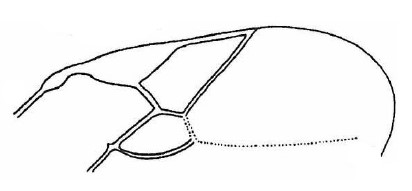
shapeMarginal cell twice as large as 2nd submarginal cell, with 1-R1 1.3-1.5 times shorter than pterostigma. Radial vein has an acute angle with longitudinal axis of pterostigma; 3-SR slightly longer than, or as long as r, 3-4 times as short as SR1, 1.8-2 times shorter than 2-SR; SR1 straight or weakly S-curved, or slightly curved outwards in apical half. 1-CU1 = 0.7 - 1.0 cu-a length [T8].
colorWing lightly colored, with pale-yellowish veins, brown pterostigma, light-brown veins surrounding marginal and 2nd submarginal cells [T8].
metasoma
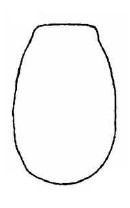
shapeMetasoma nearly oval, slightly stronger narrowed towards the base than towards the apex, 1.5-1.6 times longer than wide, 2.1-2.6 times longer than high [T8]. ♂ Metasoma 1.6–1.7 times as long as wide [T14].
sculptureMetasoma with abundant, sparse [?], sinuous and anastomosing longitudinal rugae extending to its posterior third [T8].
color
♀ ovipositorOvipositor thin, concealed or protruding by length of hind tarsus [T8].
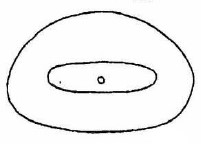
♂ apertureApical aperture parallel-sided, 0.5–0.65 times as wide and 0.3 times as high as width of metasoma; 3-4 times wider than high. Median process of apereture thin, parallel-sided, occasionally several times wider (in lateral view) than aperture height, or (rarely) massive, conical, as wide at base as about 0.5 aperture height [T8].
other info
distributionFR [FE].
remarks
hosts