colorblack, finely coriaceous-punctate, fine silky pubescence [D].
head
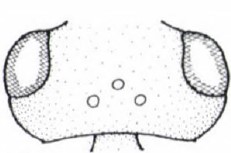
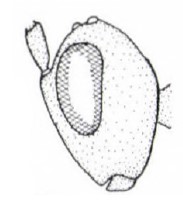
shapeHead in dorsal view (Fig. 19) transverse, 2.0 - 2.1 x as broad as long, temple constricted and one-third shorter than eye. Ocelli small and round, POL : OD : OOL as 8 : 3 : 8. Eye in lateral view (Fig. 20) distinctly twice as high as wide, temple behind eye broader than eye. Malar space one-quarter longer than basal width of mandible. Face just less than twice as wide as high, inner margin of eyes parallel; clypeus clearly less wide than face, somewhat more than twice as wide as high; distance between tentorial pits one-third ionger than distance between pit and lowest margin of eye. Occiput weakly excavated [P6]. The head is roundly narrowed behind the eyes, its width is twice its length. POL equal to OOL and almost 3 times the diameter of the ocellus (8: 3). Malar space 1.3 times basal width of mandibles [T14].♂ Malar space 0.3-0.8 longitudinal eye diameter, palpi not elongated [T14, in key].
sculptureFace concentrically and upwards, head above (frons + vertex) rather transversely, temple and cheek rather longitudinally with dense rugulo-striation, dull; clypeus almost smooth and shiny [P6]. Head covered with a whitish down, very shiny [M2].
shape ♀Antenna with 16 [in taxonomic remark 18] antennomeres, Third segment 2.5 times and penultimate segment 1.5 times as long as broad apically. in key: Third segment twice and penultimate segment 1.2 times as long as broad apically. [P6]. 3rd segment of antenna 2.5 times as long as wide, preapical segment 1.5 times [T14].
shape ♂Antenna shorter than body, as long as head, mesosoma and half carapace combined, with 18 - 20 segments. Third segment twice as long as broad apically. Further segments indistinctly shortening and attenuating so that penultimate segment 1.2 times as long as broad. in key: Third segment twice and penultimate segment 1.25 times as long as broad apically [P6].
color
mesosoma
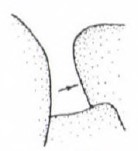
shapeMesosoma in lateral view 1.45 times as long as high. Mesonotum in lateral view projecting anteriorly similar to that of M. microphthalmus Wesmael (Fig. 21, see arrow). Notauli distinct by somewhat roughened sculpture of mesonotum. Propodeum latero-medially with a pair of tubercules [P6]. Propodeum with small lateral tubercles [T14].
sculptureMesosoma rugose, propodeum on anterior or horizontal part roughly rugose and on its posterior or vertical part with carinae radiating around lunule [P6].
color
legs
shapeHind femur 3.7 - 3.8 times as long as broad medially. Hind tibia just longer than hind tarsus; pair of spurs of hind tibia almost equal in length, inner spur half as long as basitarsus. Hind basitarsus slightly longer than tarsomeres 2-3 [P6]. ♂: The inner spur of the hind tibia is noticeably shorter than half of the hind metatarsus [T14, in key].
sculpture
colorBlack, with yellowish fore tibiae and tarsi, or black with yellow-brown tibiae and tarsi, with a black ring on the tip of the hind tibia [D]. Coxae and trochanters dark brown, hind femur brown, otherwise legs brownish with yellowish suffusion [P6]. Hind tibia dark brown, with a slight weak yellowish band or light brown patch in front of the middle [T14, in key].
wings
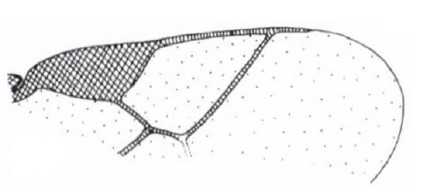
shapeFore wing one-fifth shorter than body. Pterostigma (Fig. 22) 2.2 - 2.3 times as long as wide, issuing radial vein distally from its middle, R1 just longer than pterostigma, 1-R1 0.8 times as long as pterostigma, r somewhat longer than 3-SR, SR1 straight and ending far before tip of wing [P6]. ♂: Vein SR1 of the fore wing is curved outward [T14]. ♂: The marginal cell is 1.5-2 times larger than the 2nd submarginal cell, 1-R1 is 1.5-3 times shorter than the pterostigma [T14, in key].
colorFine, pale veins. Wing with shifting rainbow colors [D]. Tegula dark brown to brown, wings subhyaline (or faintly fumous). Pterostigma opaque brownish, veins proximally opaque yellowish and distally brownish [P6].
metasoma
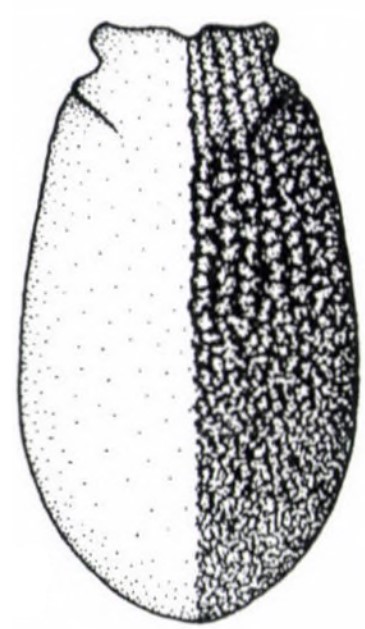
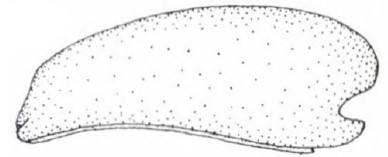
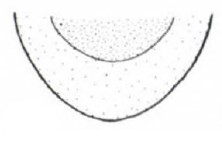
shapeSlender [D]. Carapace in dorsal view (Fig. 23) 1.7 - 1.8 times as long as broad medially, as long as mesosoma and half of head combined; in lateral view (Fig. 24) 2.5-2.6 times as long as high behind; in ventral view apically incurved (Fig. 25), i.e. ventral cavity somewhat shorter than carapace itself [P6]. ♂: Metasoma 1.6–1.7 times as long as wide [T14, in key].
sculptureCarapace longitudinally rugo-rugulose, sculpture weakening on its hind end; pair of keels distinct, short and converging (Fig. 23) [P6].
colorMetasoma black [T14, in key].
♀ ovipositorOvipositor sheath (in ventro-lateral view) as long as hind tarsomeres 1-3 [P6].
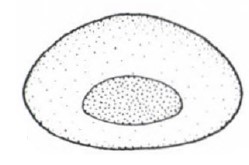
♂ apertureApical foramen elliptic, 2.2 times as wide as high (Fig. 26) [P6]. The apical aperture is located at the bottom of the posterior surface of the metasoma [T14]. The apical aperture is 3-3.5 times less wide than the metasoma [T14, in key].
other info
distributionDE, DK, SE [FE].
remarks
hosts
figures
fig. 1: ♂ head in dorsal view (Papp 1997b)
fig. 2: ♂ head in lateral view (Papp 1997b)
fig. 3: ♂ anterior part of mesonotum in lateral view (see arrow) (Papp 1997b)
fig. 4: ♂ distal part of right fore wing (Papp 1997b)
fig. 5: ♂ carapace in dorsal view (Papp 1997b)
fig. 6: ♂ carapace in lateral view (Papp 1997b)
fig. 7: ♂ posterior end of carapace in ventral view (Papp 1997b)
fig. 8: ♂ posterior end of carapace with foramen in frontal view (Papp 1997b)
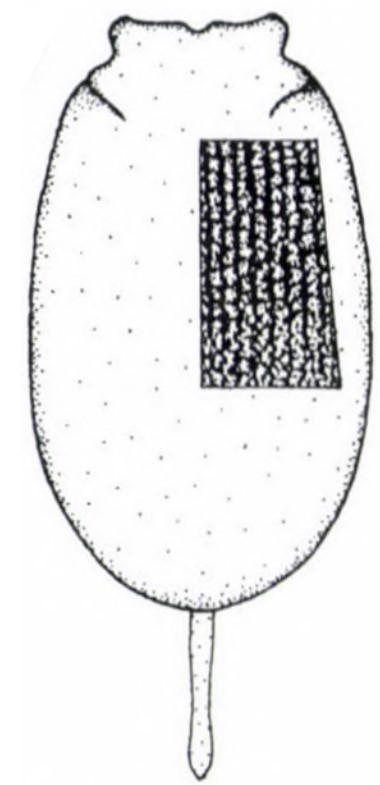
fig. 9: ♀ carapace in dorsal view with an indication of its sculpture (Papp 1997b)
var. a. Pedibus nigris, tibiis tarsisque anticis pallidis. Long. 1 1/8 lin.
var. b. Femoribus nigris, tibiis tarsisque testaceis; tibiis posticis apice nigro-annulatis. Long, 1 1/8 - 1 1/2 lin.
Vistelseort: Skåne. Var. a. ganska sällsynt vid Esperöd i gräs utmed hafsstranden och vid Lund, var. b. ganska allmän vid Abusa och I Fogelsäng.
Beskrifning. Hanne. Tre ganger mindre an Ch. Oculator, punkturen och kroppsytans skrynklighet mycket finare. Kroppen smärt, svart, beströdd med ett ytterst fint hvitglänsande silkesfjun. Vingarne stärkt skiftande i regnbågens färgor; fina, ljusa tydliga nerver. På var. a. äro pedes svarta, men tibiae och tarsi gulaktiga; var. b. har svarta femora, tegelgula tibier och tarser, samt svarta ringar pä spetsen af tibiae posticae.
Data used in the multi-access key
These data are collected from the species descriptions and redescriptions, from published figures and photographs and from own measureements and observations. For a description of the different variables and value classes see this pdf.
morphology
basic information
female
male
body length (mm):
(2.1) 2.1 - 3 (3.1)
(2.1) 2.1 - 3 (3.1)
number of antennal segments:
16
18 - 20
head, dorsal view
Head width : length
narrow, wide, very wide
narrow, wide, very wide
Temples narrowing - widening
narrowing, parallel
narrowing, parallel
Eye length : temple length
1.0 - 1.25, > 1.25
1.0 - 1.25, > 1.25
Roundness temple
medium, weak
medium, weak
POL : OD
2 - 3
2 - 3
Ocellar triangle shape
wide
wide
Excavation of head
<15%
<15%
head, lateral view
Head height : length
long
long
Eye height : length
short, long
short, long
Temple length : eye length
short
short
head, frontal view
Head width : height
---
---
Face width : height
narrow, wide
narrow, wide
Eyes converging ventrally
about parallel
about parallel
EH : MSL
---
---
Clypeus width : height
transverse, very transverse
transverse, very transverse
Clypeus extending above bottom of eyes
---
---
Tentorial pits
small, large
small, large
Shape of lower margin clypeus
---
---
antennae
Antennal shape
---
filiform, not widened
Segment 3 length : width
short, medium
short
Penultimate segment length : width
medium
short, medium
Length of antenna : length of body
---
3: long
mesosoma, lateral view
Length : height
short, medium
short, medium
transverse carina
---
---
lateral teeth
weak, small, short
weak, small, short
mesosoma, ventral view
Prepectal carina lamelliform
indistinct
indistinct
legs
Hind femur length : width ratio
medium, long
medium, long
Hind tibia length : hind tarsus length ratio
medium, long
medium, long
Hind tibia (longest) spur length : metatars length ratio
short, long
short, long
wings
Vein 1-R1 length : pterostigma length
short, medium, long
short, medium, long
Vein r length : vein 3-SR length
short
short
Shape vein SR1 (straight / concave / convex)
slightly convex
slightly convex
S-shape vein SR1
not S-shaped
not S-shaped
cell M : cell Sm2
Sm2 large, Sm2 medium
Sm2 large, Sm2 medium
Pterostigma length : width ratio
short
short
Angle between radial vein (r) : vein 1-R1
sharp, medium
sharp, medium
metasoma, dorsal view
Length : width ratio of metasoma
short, medium
short, medium
Shape of metasoma
widest in middle, widest towards apex
widest in middle, widest towards apex
metasoma, lateral view
Length : height ratio of metasoma
short, medium
short, medium
posterior : anterior height ratio of metasoma
small, medium
small, medium
Position of maximum height
medium, medium-posterior
medium-posterior
metasoma, ventral view
Metasoma posteriorly curved forwards
just/slightly incurved, (distinctly) incurved
just/slightly incurved, (distinctly) incurved
male apical aperture
Aperture width : metasoma width
no aperture
small, medium
Aperture shape
n. a.
(nearly) round, oval
Median process shape
n. a.
---
sculpture
head
general coarseness
fine
fine
clypeus
coarseness punctation
smooth to uneven
smooth to uneven
density punctation
---
---
face
sculpture type
striate, rugose
striate, rugose
sculpture direction
diagonal/concentric
diagonal/concentric
vertex and temple
sculpture type
transverse rugulose
transverse rugulose
mesonotum
sculpture type
---
---
scutellum
middle
---
---
lateral
---
---
metasoma
base - mid sculpture
longitudinally rugose / rugose-striate
longitudinally rugose / rugose-striate
sculpture at apex
rugulose
rugulose
coarse / fine boundary
mid (50 - 70%)
mid (50 - 70%)
color
head
mandibles color pattern
entirely light
entirely light
palpi, lightest color
brown, red
brown, red
antennae
scapus, lightest color
black, dark brown
black, dark brown
segment 3 and 4, lightest color
black, dark brown
black, dark brown
legs
fore coxae lightest colour
dark
dark
fore femur lightest colour
medium dark
medium dark
fore femur color pattern
entirely light
entirely light
hind femur lightest colour
medium dark
medium dark
hind femur color pattern
entirely dark
entirely dark
hind tibia lightest colour
medium light
medium light
hind tibia color pattern
narrow light ring, narrow light base, wide light base
narrow light ring, narrow light base, wide light base
hind basitarsus lightest colour
medium dark, medium light
medium dark, medium light
hind tarsus segment 2-3 lightest colour
medium dark, medium light
medium dark, medium light
wings
middle veins lightest colour
medium light
medium light
basal veins lightest colour
light
light
metasoma
metasoma colour pattern
entirely dark
entirely dark
metasoma lightest colour
dark
dark
metasoma base, colour pattern
entirely dark
entirely dark
metasoma base, light spots
n.a.
n.a.
metasoma base, light band
n.a.
n.a.
Chelonus nigritulus in published keys
P6: Papp, 1997b
Revision of the Chelonus species described by A. G. Dahlbom (Hymenoptera, Braconidae: Cheloninae).
T14: Tobias, 2010
Palearctic species of Microchelonus Szépligeti (Hymenoptera: Braconidae, Cheloninae): key to species.