Chelonus mucronatus
authorThomson 1874
synonyms
body
shape4 - 5 mill. (= 2.4-3.0 mm) [Th]. 3.0 - 3.1mm [P2]. 3.0 - 3.1mm [T14]. 4-5mm [T4][M2]
colorBlack [Th].
head
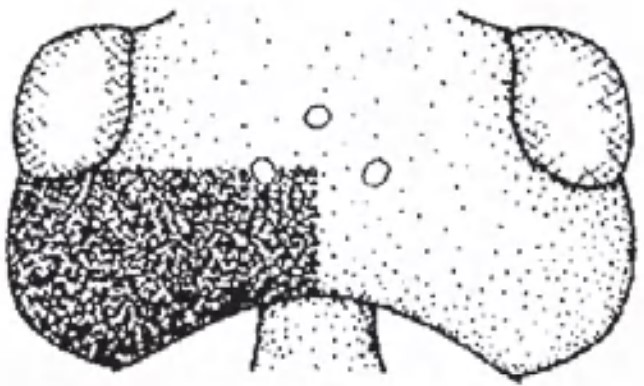
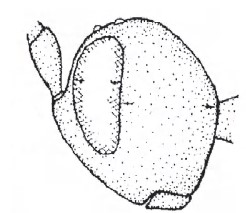
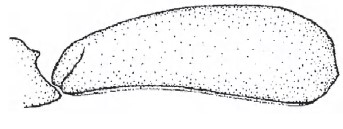
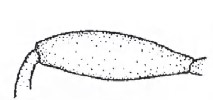
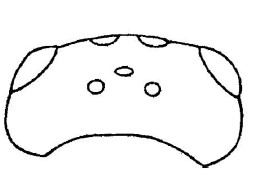
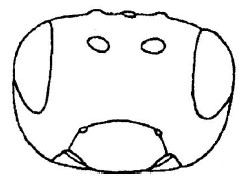
shapeHead in dorsal view (Fig. 1) transverse, 1.75 - 1.85x as broad as long, eye minutely shorter than temple, latter somewhat bulged or head between temples somewhat broader than between eyes. Ocelli small and almost round, POL : OD : OOL as 9 : 4 : 11. Eye in lateral view (Fig. 2) more than 2x as high as wide, temple 2x as wide as eye. Face 1.8x as wide as high, inner margin of eyes somewhat converging ventrally. Clypeus 1.66x as wide as high, its lower margin convex. Malar space as long as basal width of mandible [P2]. The head is transverse, roundly narrowed posteriorly. The temples are long [Te1]. The head is widened behind the eyes. Temples slightly longer than the transverse diameter of the eye. POL slightly smaller than OOL, almost half the diameter of the ocellus. Face width 1.8 times its height. The malar height is equal to the basal width of the mandible [T14]. Head is dorsally somewhat enlarged after the compound eye, temple is about twice the length of the compound eye; the face width is 1.8 times its height; the malar space is the same length as the mandible width [Zh1]. head almost cubical [S4].
sculptureHead densely rugulose, vertex and temple above transversely rugulose (Fig. 2) [P2]. Temples slightly rugose and striated [Te1]. Vertex transversely rugose behind ocelli [T14].
colorPalpi brown [P2]
antenna
shape ♀Antenna with 18 segments, above the middle somewhat dilated [Th]. Antenna about 0.25 shorter than body, with 19 antennomeres. Third segment 4x as long as broad, further segments indistinctly thickening so that penultimate segment 1.3x as long as broad [P2]. Antennae in ♀ 18-segmented, slightly widened in the middle [Te1]. Antennae one third shorter than body, 19-segmented; 3rd segment 4 times as long as wide, preapical segments 1.3 times [T14]. Female antennae 16 segments (see comment) [Zh1]. 18 segments, slightly dilated beyond the middle [M2].
shape ♂21 segments [Th][M2]. Antenna about 1/6 shorter than body, with 21 - 22 segments. penultimate flagellomere 1.5x as long as broad [P2]. 21-segmented, filiform, longer than the body [Te1].
colorFlagellum blackish [P2].
mesosoma
shapeMesosoma in lateral view somewhat short, 1.3x as long as high [P2][T14][Zh1]. The propodeum with 2 teeth on the sides [Te1].
sculptureMesosoma densely rugose, scutellum rugulose [P2]. Mesonotum densely punctate. The propodeum is coarsely reticulate-rugose [Te1]. Mesonotum densely rugose-punctate, scutellum with finer sculpture [T14]. Scutellum matt, very densely punctated [M2].
color
legs
shapeHind femur 3.5 - 3.66x as long as medially broad. Inner spur of hind tibia 0.5 as long as basitarsus. Hind basitarsus as long as tarsomeres 2-4 [P2]. Hind femur 3.5 times as long as wide. Inner spur of the hind tibia equal to half the length of the 1st segment of the hind tarsus [T14].
sculpture
colorHind tibiae in middle widely yellowish, fore coxae yellowish [?][Th]. Coxae blackish, trochanters and femora brownish, distal half of fore femur and tibiae 1-3 yellow, hind tibia blackish, tarsi brownish fumous [P2]. ♀: The legs are black; fore tibia entirely, middle and hind tibia reddish yellow in the middle [Te1]. The legs are brown.The hind femora are brown. Apical half of hind femur and all tibiae brownish yellow, but hind tibia darker. ♂: Hind tibia entirely dark-colored or with poorly developed yellowish pattern [T14]. Fore tibiae, much of the middle of hind tibiae and trochanters reddish-yellow [M2].
wings
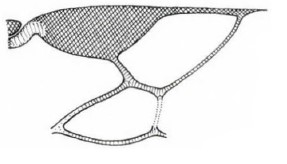
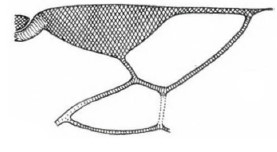
shapeFore wing shorter than body. Pterostigma (figs.9 - 10) 2.66 - 3.0x as long as wide, issuing radial vein distally from its middle: r short, 0.6x as long as 3-SR, SR1 straight and apically slightly incurved. R1 0.25x shorter than pterostigma, 1-R1 0.6 - 0.7x as long as pterostigma. ♂: r shorter than or same length as 3-SR [P2]. 1-R1 0.6 times as long as pterostigma [T14]. 1-R1 0.62 times pterostigma length [Zh1].
colorWings faintly fumous, pterostigma opaque brownish, veins proximo-distally opaque yellowish to brownish. Tegula brown [P2]. The wings are light; the stigma is brown [Te1]. The wings are darkened [T14].
metasoma
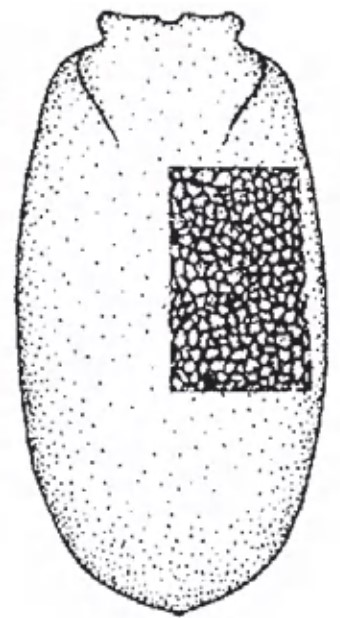
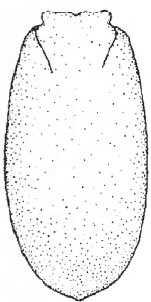
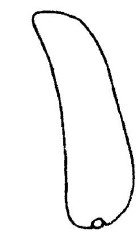
shape♀ Carapace in dorsal view (Fig. 3) 1.9 - 2.0x as long as medially broad; in lateral view (Fig. 5) 2.9x as long as posterior height, apically with a small median tubercule; in ventral view apically somewhat incurved. Pair of converging basal keels short. ♂: Carapace in dorsal view (Fig. 7) 1.95-2.1 x as long as broad somewhat posteriorly from middle [P2]. Metasoma elongated, slightly compressed laterally towards apex [Te1]. Metasoma widened toward posterior third, with a small apical tubercle; length 1.9 times its width [T14]. Metasoma long oval, 1.9 times as long as wide, in lateral view 2.9 times as long as high. In lateral view a small protrusion in the middle of the end of the metasoma [Zh1].
sculptureCarapace almost evenly, relatively rougly rugose, i. e. sculpture posteriorly indistinctly weakening (Fig. 3) [P2]. Metasoma not coarsely rugose [Te1]. Metasoma with reticulate shallow rugae [Zh1].
color
♀ ovipositorOvipositor sheath concealed [P2]. Ovipositor sheath is short, hidden under the metasoma [Zh1].
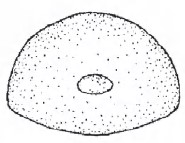
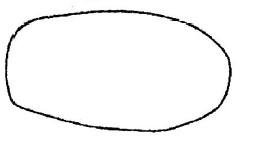
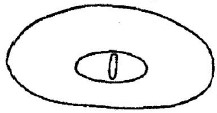
♂ apertureApical foramen of carapace small and less elliptic, 1.6-1,7x as wide as high (Fig. 8) [P2]. Without clearly visible opening in ♂ at apex of carapace [Te1]. Aperture small, 0.1–0.15 times the width of the metasoma [T14]. Aperture round [Zh1].
other info
distributionSE [FE].
remarksChelonus mucronatus (Thomson) is very close and similar to C. atripes (Thomson, 1874) [P2]. Except for the 16 segments of female antennae (19 segments of the type specimen) are the rest of the characteristics consistent with the type, so they are determined to be the same species [Zh1].
hosts