Chelonus minifossa
authorTobias 1986
synonyms
body
shape♀: 3.1-3.4, ♂: 3.3mm [T4]. ♀ 2.8 - 3.3 [T14]. ♀3.1 - 3.6, ♂3.0 - 3.6mm [Lt2].
colorBlack [T14].
head
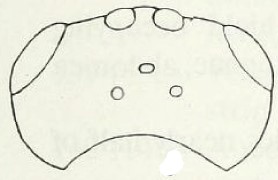
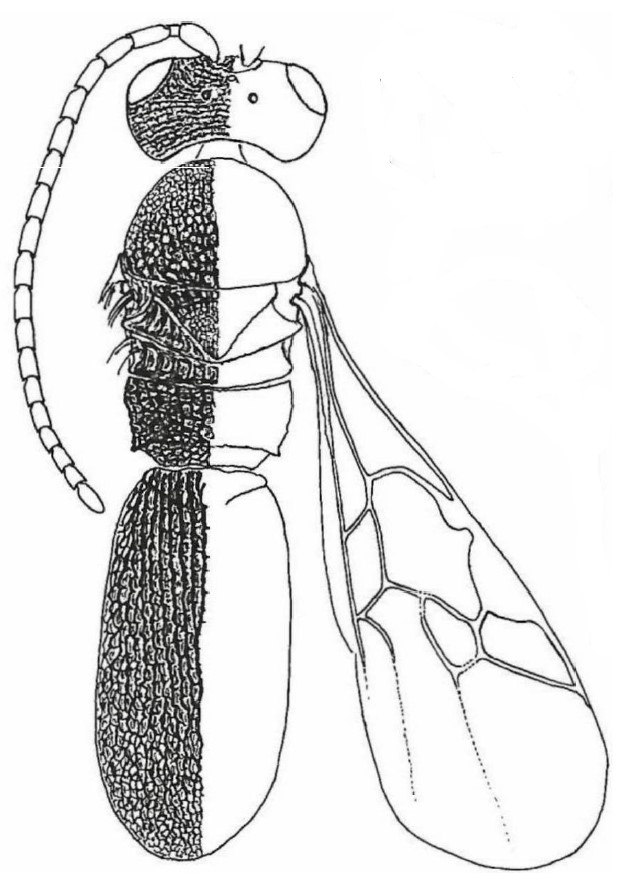
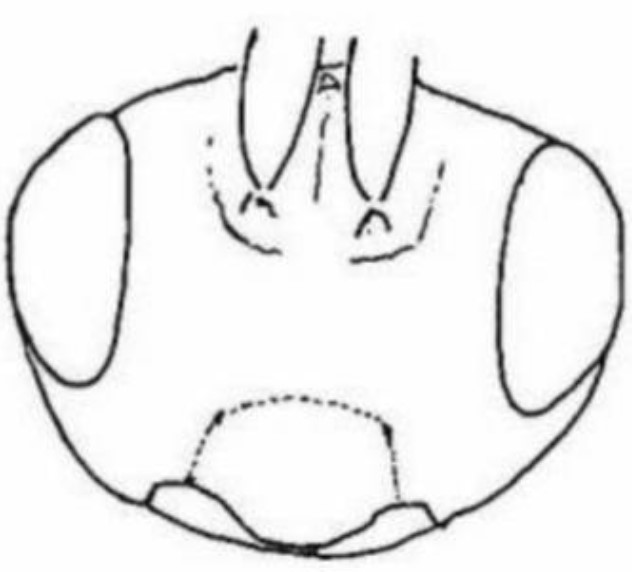
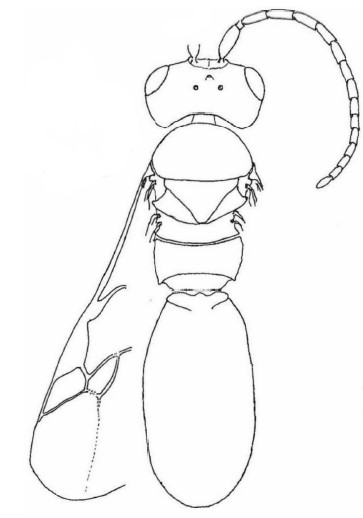
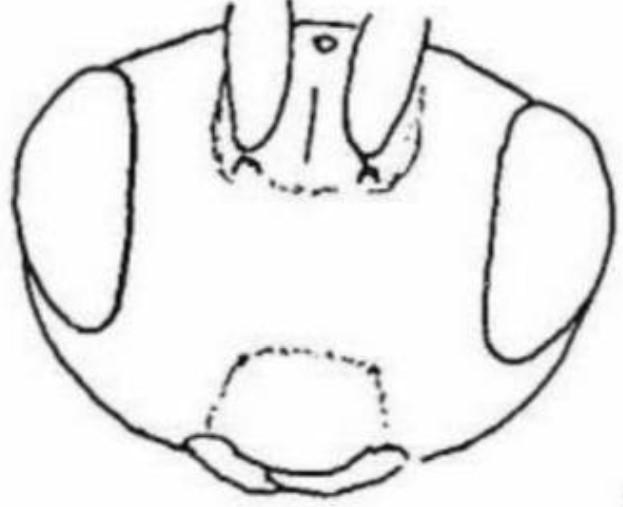
shapeHead not broadened behind eyes; temples slightly longer than eye (fig. 1); longitudinal diameter of eye almost 4 times height of malar space [T4]. ♂: Head behind eyes narrowed [T4, key]. Head 1.3 times as wide as mesonotum, roundly narrowed behind eyes, twice as wide as long, 1.3–1.4 times as wide as high. POL is slightly shorter than OOL. POL is 4 times the diameter of the ocellus. Longitudinal diameter of eye 1.5 times transverse, twice height of malar space. Face width 1.5 times its height [fig. 4: 2.5x!] The temples are noticeably longer than the transverse diameter of the eye (4: 3) [T14]. Roundly narrowed behind eyes, about twice as broad as long, as broad as mesosoma; in frontal view 1.3-1.4 times as broad as high. Ocelli small, not widely separated, POL 1.2 times as OOL. Temples 1.1 times as long as LO [LT2].
sculptureHead quite coarsely sculptured. Face with short transverse rugae. Five to seven relatively coarse transverse rugae on vertex behind ocelli [T4]. The face has rather coarse oblique rugae, extending from the upper corners to the middle [T14]. Head behind eye and face transversely striate. Frons with concentrical sculpture. Clypeus largely with faint strigosity and shining. ♂ Head generally with rougher transversal sculpture than in females [LT2].
colorPalpi black [P4, key]. Labiomaxillary complex dark brown [LT2].
antenna
shape ♀16 segments, segments in apical part of antennae square or slightly longer than wide [T4, key]. The antennae are slightly shorter than the body; length of 3rd antennal segment 3 times its width. The length of the segments at the apical part of the antenna is twice their width [T14]. Antennae with 16 segments, almost as long as head and mesonotum combined; scape slightly wider than flagellum, 2.5-3 times as long as wide; 1st flagellum segment about 3 times as long as wide, apical segments 1.5-1.7 times as long as wide [LT2].
shape ♂Antennae with 19-21 segments, apical flagellomeres 1.7 times as long as wide [LT2].
colorAntennae, including basal segment black [P4, key].
mesosoma
shapeMesosoma 1.5 times as long as wide. Propodeum with weak transverse carina and small lateral teeth [T14]. In dorsal view as broad as carapace. In lateral view, 1.5 times as long as high and almost as long as length of carapace Propodeum with clear transversal carina and two more or less distinct medial longitudinal carinae, lateral tubercles well developed [LT2].
sculptureMesonotum reticulate-rugose, scutellum longitudinally rugose, with smoothed rugae [T14]. Mesonotum rugose punctate. Mesoscutum anteriorly granulate-punctate with some longitudinal strigosity, area before scutellum with pronounced coarse rugae. Scutellum largely with soft longitudinal sculpture, medially punctate and more or less shining. Propodeum rugose [LT2].
color
legs
shape♀: Hind femur 4 times as long as wide. Hind tibia and tarsus of equal length [T14]. Fore and hind femora 3-3.5 times as long as broad. Hind tibia 1.2 times longer than hind femur and as long as tarsi. Outer spur of hind tibia longer than inner spur, almost reaching half of 1st metatarsal segment [LT2].
sculpture
color♀ Legs black [T4, key].♂: Hind tibiae almost entirely black [T4]. Hind femora black [T4, key]. ♀: Apex of femora, fore tibia brownish yellow, middle and hind tibia yellowish brown at base, brown at apex, tarsus yellow at base, brown at apex [T14]. all coxae black; fore femora dark brown except apices, hind femora dark; fore tibiae brown; all tarsi brown [LT2].
wings
shape♂: 1-R1 much shorter than pterostigma [T4, key]. ♀: 1-R1 is half as long as the pterostigma [T14]. Marginal cell in forewing comparatively small, 1-R1 shorter (0.7-0.8 times) than length of pterostigma. Second submarginal cell comparatively large, 0.7 times as large as marginal cell. 3-SR almost as long as r, 3 times shorter than SR1 [LT2].
color♀: Wings darkened, ♂: Wings distinctly darkened [T4]. Tegulae black [T4, key]. ♀:The wings are light [T14]. Forewings slightly infuscate. Pterostigma, metacarpus and costal vein brown, other veins brown yellowish [LT2].
metasoma
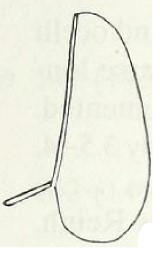
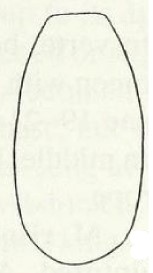
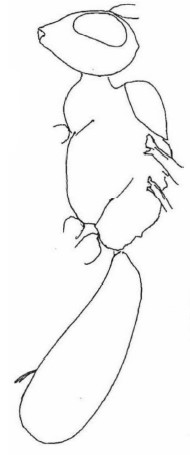
shape♀: Metasoma at apex curved on lower side for 1/4 of its length (fig. 2). ♂: metasoma 2 times as long as wide [T4]. Metasoma not broadened toward apex (maximum width in middle), without denticulate projection at apex and without emargination on lower side. Metasoma 2.0 - 2.5 times as long as wide in middle [T4, key]. ♀: Metasoma elongated-oval, twice as long as wide. The carapace is apically bent forward by 0.1 of its length [T14]. ♀ Carapace elongate with almost parallel sides, in dorsal view about twice as long as maximum breadth, slightly incurved apicoventrally. ♂: Carapace elongate, twice or more than twice as long as maximum breadth; sometimes nor parallel-sided (see variation in Fig 8) [LT2].
sculptureMetasoma with longitudinal rugae, usually not extending beyond its middle [T4, key]. The metasoma is wrinkled, in the anterior part with a predominance of rather coarse longitudinal rugae, in the middle third it is reticulate-rugose and with a predominance of longitudinal fold elements [T14]. Carapace with clear longitudinal undulations spanning its 2/3 visible surface, apical part with winding undulations wanishing into shallow sculpture [LT2].
colorMetasoma entirely black [T4].
♀ ovipositorOvipositor projecting beyond posteroventral rim of carapace or hidden [LT2].
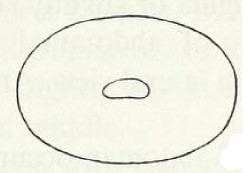
♂ apertureAperture small, but distinctly oval (fig. 4) [T4]. Aperture very small and oval, in rear view of posterior end 0.1-0.15 of carapace’s width [LT2].
other info
distributionCZ [LT2]. DK [P8].
remarks
hosts
type description
1. Body black, at most metasoma with light colored pattern
2. Antennae 16-segmented. Abdominal apex without aperture—females
4. Head usually not broadened behind eyes; if, occasionally, somewhat broadened, then antennae less thin, with shorter apical segments and metasoma rounded toward apex (as much as or almost as much as toward its base) with posterior margin somewhat curved forward.
8. Head of usual shape, not projecting laterally and angularly beyond genae; temples usually not, or only slightly, rarely 2 times as long as eye. Occiput very slightly excavate. metasoma at apex without tubercle.
34. metasoma uniformly rounded in posterior part, apically somewhat curved on lower side.
38. Palpi much shorter; proboscis slightly developed, not projecting or slightly projected.
40. Radial cell significantly longer [not extremely short]
42. Posterior margin of abdominal shield much less curved
44. metasoma with longitudinal rugae, usually not extending beyond its middle (not extending beyond middle, if rugae coarse). If rugae distinctly extending beyond mid-metasoma, then antennae thin with long segments or body smaller
45. metasoma 2—2.5 times as long as wide in middle
47. Body with less uniform though with less coarse and nonalvcolar sculpture on head and major part of mesonotum. Apex of metasoma without emargination on lower side.
48. Segments in apical part of antennae square or slightly longer than wide.
50. metasoma without denticulate projection at apex
51. Body relatively large, 2.5—4.
55. metasoma not broadened toward apex (maximum width in middle), entirely black or with two yellow spots at base. Antennae, including basal segment, palpi and legs black.
56. metasoma entirely black
58. metasoma at apex curved on lower side for 1/4 of its length (Fig. 196: 7). Head not broadened behind eyes; temples slightly longer than eye (Fig. 196: 6); longitudinal diameter of eye almost 4 times height of gena. Head quite coarsely sculptured. Face with short transverse rugae. Five to seven relatively coarse transverse rugae on vertex behind ocelli. Wings darkened (In male apical aperture extremely small and oval). Body 3.1-3.4. Moldavia
M. minifossa Tobias, sp. n.
129. Antennae more than 16-segmented. metasoma with aperture at apex—males
165. Aperture on apex of metasoma much smaller, occupies not more than half abdominal width.
169. Temples much shorter, not projecting angularly. Occiput significantly less emarginate.
170. Aperture on apex of metasoma extremely small, somewhat punctiform, sometimes slightly noticeable. Head behind eyes narrowed.
171. Hind femora and tegulae black; wings somewhat distinctly darkened.
177. Anterior margin of radial cell much shorter than stigma. Mesonotum more coarsely and sparsely rugose-punctate.
179. metasoma 2 times as long as wide, aperture on apex of metasoma small, but distinctly oval (Fig. 196: 14, 15). Head behind ocelli with coarser rugae. Hind tibiae almost entirely black. Wings distinctly darkened. Fig. 196: 6, 7. Body 3.3.
M. minifossa Tobias, sp. n.
Data used in the multi-access key
These data are collected from the species descriptions and redescriptions, from published figures and photographs and from own measureements and observations. For a description of the different variables and value classes see this
pdf.
| morphology |
| basic information | female | male |
| body length (mm): | (2.9) 2.9 - 3.6 (3.7) | (2.9) 2.9 - 3.6 (3.7) |
| number of antennal segments: | 16 | 19 - 21 |
| head, dorsal view |
| Head width : length | narrow, wide | narrow, wide |
| Temples narrowing - widening | narrowing, parallel | narrowing, parallel |
| Eye length : temple length | 0.75 - 1.0, 1.0 - 1.25 | 0.75 - 1.0, 1.0 - 1.25 |
| Roundness temple | medium | medium |
| POL : OD | 3 - 4, > 4 | 3 - 4, > 4 |
| Ocellar triangle shape | narrow, wide | narrow, wide |
| Excavation of head | 15 - 25% | 15 - 25% |
| head, lateral view |
| Head height : length | long, very long | long, very long |
| Eye height : length | very short, short | very short, short |
| Temple length : eye length | short, long | short, long |
| head, frontal view |
| Head width : height | narrow, wide | narrow, wide |
| Face width : height | narrow, wide | narrow, wide |
| Eyes converging ventrally | about parallel | about parallel |
| EH : MSL | short, long | short, long |
| Clypeus width : height | quadrangular, semicircular | quadrangular, semicircular |
| Clypeus extending above bottom of eyes | below, above | below, above |
| Tentorial pits | very small, small | very small, small |
| Shape of lower margin clypeus | convex, truncate | convex, truncate |
| antennae |
| Antennal shape | --- | filiform, not widened |
| Segment 3 length : width | medium | --- |
| Penultimate segment length : width | short, medium | medium, long |
| Length of antenna : length of body | 2: short, 3: long | --- |
| mesosoma, lateral view |
| Length : height | medium | medium |
| transverse carina | weak, indistinct, present, well developed | weak, indistinct, present, well developed |
| lateral teeth | weak, small, short, present, well developed | weak, small, short, present, well developed |
| mesosoma, ventral view |
| Prepectal carina lamelliform | indistinct | indistinct |
| legs |
| Hind femur length : width ratio | short, medium, long | short, medium, long |
| Hind tibia length : hind tarsus length ratio | medium | medium |
| Hind tibia (longest) spur length : metatars length ratio | short | short |
| wings |
| Vein 1-R1 length : pterostigma length | short, medium, long | short, medium, long |
| Vein r length : vein 3-SR length | short | short |
| Shape vein SR1 (straight / concave / convex) | straight or S-shaped, slightly convex | straight or S-shaped, slightly convex |
| S-shape vein SR1 | not S-shaped | not S-shaped |
| cell M : cell Sm2 | Sm2 large, Sm2 medium | Sm2 large, Sm2 medium |
| Pterostigma length : width ratio | short, medium | short, medium |
| Angle between radial vein (r) : vein 1-R1 | sharp, medium, blunt | sharp, medium, blunt |
| metasoma, dorsal view |
| Length : width ratio of metasoma | medium, long | medium, long |
| Shape of metasoma | widest in middle, widest towards apex | widest in middle, widest towards apex |
| metasoma, lateral view |
| Length : height ratio of metasoma | short, medium, long | short, medium, long |
| posterior : anterior height ratio of metasoma | small, medium | small, medium |
| Position of maximum height | medium, medium-posterior | medium-posterior, posterior |
| metasoma, ventral view |
| Metasoma posteriorly curved forwards | just/slightly incurved, (distinctly) incurved | just/slightly incurved, (distinctly) incurved |
| male apical aperture |
| Aperture width : metasoma width | no aperture | small |
| Aperture shape | n. a. | oval |
| Median process shape | n. a. | horizontal, nearly round, horizontal oval |
| sculpture |
| head |
| general coarseness | coarse | coarse |
| clypeus |
| coarseness punctation | smooth to uneven | smooth to uneven |
| density punctation | --- | --- |
| face |
| sculpture type | rugose | rugose |
| sculpture direction | transverse, diagonal/concentric | transverse, diagonal/concentric |
| vertex and temple |
| sculpture type | transverse rugulose | transverse rugulose |
| mesonotum |
| sculpture type | --- | --- |
| scutellum |
| middle | punctate | punctate |
| lateral | rugose / striate | rugose / striate |
| metasoma |
| base - mid sculpture | longitudinally rugose / rugose-striate | longitudinally rugose / rugose-striate |
| sculpture at apex | rugose, rugulose | rugose, rugulose |
| coarse / fine boundary | base (to 50%), mid (50 - 70%) | base (to 50%), mid (50 - 70%) |
| color |
| head |
| mandibles color pattern | --- | --- |
| palpi, lightest color | black, dark brown | black, dark brown |
| antennae |
| scapus, lightest color | black, dark brown | black, dark brown |
| segment 3 and 4, lightest color | black, dark brown | black, dark brown |
| legs |
| fore coxae lightest colour | dark | dark |
| fore femur lightest colour | medium light | medium light |
| fore femur color pattern | tip light | tip light |
| hind femur lightest colour | dark, medium light | dark |
| hind femur color pattern | entirely dark, tip light | entirely dark |
| hind tibia lightest colour | medium light | dark, medium light |
| hind tibia color pattern | narrow light base | entirely dark, narrow light base |
| hind basitarsus lightest colour | medium dark, medium light, light | medium dark, medium light, light |
| hind tarsus segment 2-3 lightest colour | medium dark | medium dark |
| wings |
| middle veins lightest colour | medium dark | medium dark |
| basal veins lightest colour | medium light, light | medium light, light |
| metasoma |
| metasoma colour pattern | entirely dark | entirely dark |
| metasoma lightest colour | dark | dark |
| metasoma base, colour pattern | entirely dark | entirely dark |
| metasoma base, light spots | n.a. | n.a. |
| metasoma base, light band | n.a. | n.a. |