colorBody black, with short sparse hairs, densely rugose-punctate, matte [T19].
head
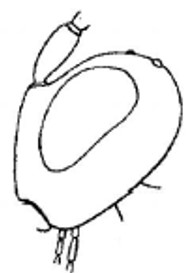
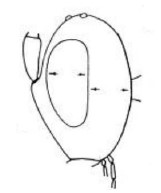
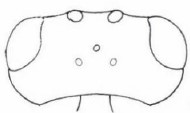
shapeHead slightly wider than mesosoma, roundly narrowed behind eyes, slightly more than half as long as wide; the occiput is rather deeply cut not in fig. 2!; temples equal to the width of the eye; eyes in an obtuse triangle, the base of which is equal to OOL; POL is 4 times the ocelli diameter; the eyes are ovoid, the longitudinal diameter of the eye is almost 2.5 times the transverse one, three times as long as the malar space; face with weak longitudinal median carina in apical half, its height is half its width, clypeus height is half its width; the distance between the tentorial pits is half the distance from the eye to the pits; proboscis poorly developed; maxillary palps half as long as head height [T19]. Head slightly more than twice as wide as long. The width of the ocellar triangle equal to OOL. POL is 4 OD. Longitudinal diameter of eye 1.5 times transverse, 2.5 times height of malar space. The width of the face is twice its height [T14]. Malar space 0.4 - 0.5 times longitudinal eye diameter [T9]. In lateral view temple as wide as eye (Fig. 5) [P16]. Head in dorsal view twice as broad as long; temple rather constricted and about one-third shorter than eye (fig. 9). In lateral view eye somewhat more than twice as high as wide, and slightly wider than temple, latter somewhat narrowing ventrally (fig. 10) [P4]. Head behind eyes roundly narrowed [T4].
sculptureClypeus slightly weaker sculpted than face, shining; Vertex gently transversely striated [T19][T14]. Vertex with weak transverse rugulosity [P16].
color
antenna
shape ♀Antennae much longer than head and mesosoma, weakly setaceous; 3rd segment half as large as scapus, slightly longer than 4th; segments of flagellum gradually shortening from base to apex, in apical third 1.5 times as long as wide, notched outside [T19]. Length of 3rd antennal segment 3-3.5 times its width [T14, key]. Antennae filiform [T9]. Antennal segments in apical third approximately 1.5 times as long as wide [T4].
shape ♂Antennae slightly shorter than body, 22-23 segmented; their segments in apical third are almost twice as long as wide [T19].
colorScape and pedicel black [P16].
mesosoma
shape♀: The mesosoma is 1.65 times longer than high; notauili not clear; propodeum truncate posteriorly, with weak but distinct transverse carina and two small teeth laterally. ♂: mesosoma 1.5 times as long as high [T19]. Mesosoma length 1.7 times its height. Propodeum with weak transverse carina and small lateral teeth [T14]. ♀ Mesosoma 1.5 times as long as high [T4]
sculptureScutellum in middle less sculpted than at margins, shining [T19]. Scutellum weakly sculpted and shining in middle [T14].
color
legs
shapeHind femora 5 times as long as wide; large spur of hind tibiae not longer than one third of 1st tarsus segment; The 5th segment of the hind legs is equal to the 3rd, greater than the 2nd [T19]. Hind femur 4 times as long as wide [T14].
sculpture
colorApices of fore femora and fore tibia yellowish red; middle and hind tibia brown, paler at base; tarsi brown, mid and hind metatarsus yellow [T19]. Hind tibia entirely dark, occasionally slightly yellowish in the middle [T9, key].
wings
shapeVein 1-R1 is half as long as the pterostigma; 3-SR longer than r, three times shorter than SR1. half as long as 2-SR; 1-CU1 = 0.33 times 2-CU1 [T19]. Vein 1-R1 as long as, or slightly shorter [NOT markedly shorter] than pterostigma [T9, key]. 1-R1 about 0.75 times length of pterostigma, r (just) as long as 3-SR (Fig. 6) [P16]. 1-R1 as long as pterostigma [T4].
colorWings in basal half light with pale yellow veins, in apical half slightly darkened with brown veins and pterostigma [T19]. Tegulae black to blackish [P16].
metasoma
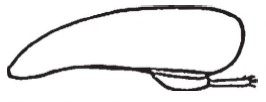
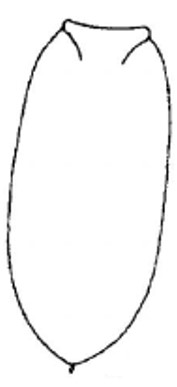
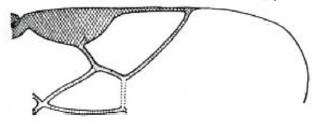
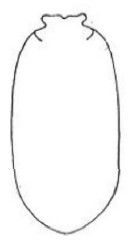
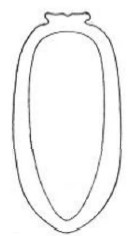
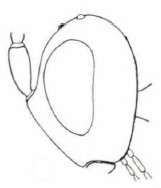
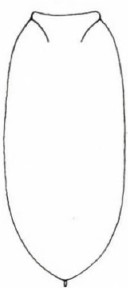
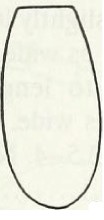
shape♀: Metasoma (Fig. 1) equal in length to mesosoma and head, elongated-oval, incurved from behind: its length 2.5 times its width in the middle part, three times its height at apex; the length of the ventral cavity of the carapace is 5/6 of the length of the metasoma. ♂: Metasoma three times as long as wide, more bent posteriorly; the length of the ventral cavity of the carapace is equal to ¾ the length of the metasoma [T19]. Metasoma elongated oval, twice as long as wide. The carapace is apically bent forward by 0.15–0.2 of its length [T14]. Metasoma 1.9-2.0 times as long as wide [T9, key]. Ventral cavity of carapace less wide and posteriorly pointed (Fig. 8). Carapace in dorsal view 2.0 - 2.1 times as long as broad, hardly broadening posteriorly (Fig. 7) [P16]. Metasoma in lateral view at least 3.5 times as long as high [P16, key]. Carapace of female twice as long as broad and not broadening posteriorly [P4]. Carapace curved on lower side 1/6 to 1/7 its length [T4].
sculpture
color
♀ ovipositorThe ovipositor valves protrude slightly beyond the apex of the carapace [T14]. Ovipositor sheath at least as long as hind basitarsus [P16].
♂ apertureAperture 4 times wider than its height, slightly less than length of 1st segment of hind tarsus [T19].
other info
distributionDE [T14].
remarksClose to C. contractus Nees, from which it differs in a protruding metasoma and longer antennae [T19]. closely related to M. atripes, the distinction of the two species is very difficult [P4].
Близок к N. contracta Nees, от которого отличается вытяпутым брюшком и более длинными усиками. От другого близкого вида — N. pamirica Voin.-Kr., известного только по самцу, отличается сильнее подогнутым задним краем брюшка, развитым поперечным валиком на промежуточном сегменте, меньшими размерами тела, слабее развитыми или неразвитыми продольными складками на брюшке.
Самка. 2.8 мм. Голова немного шире груди, за глазами округленно суженная, ее длина немногим более чем вдвое меньше ширины; затылок довольно глубоко вырезанный; виски равны ширине глаза; глазки в тупоугольном треугольнике, основание которого равно расстоянию отпето до глаза; расстояние между задними глазками в 4 раза больше диаметра глазка; глаза яйцевидной формы, продольный диаметр глаза почти в 2.5 раза больше поперечпого, втрое длиннее щек; лицо со слабым продольным срединным валиком в вершинной половине, его высота вдвое меньше ширины, вдвое больше высоты паличника; высота наличника вдвое меньше его ширины; расстояние между тенториальными ямками наполовину больше расстояния от глаза до ямки; хоботок слабо развит; челюстные щупики вдвое меньше высоты головы.
Усики значительно длиннее головы и груди, слабо щетинковидные; 1-й членик жгутика наполовину меньше основного, едва больше 2-го; членики жгутика постепенно укорачиваются от основания к вершипе, в вершинной трети наполовину длиннее своей ширины, снаружи выемчатые. Грудь на 2/3 длиннее своей высоты; парапсидальные борозды неясные; ромежуточный сегмент сзади обрывистый, со слабым, но явственным поперечным валиком п двумя небольшими зубцами по бокам. Передний край радиальной ячейки переднего крыла равеп половине длины стигмы; 2-й отрезок радиальной жилки длиннее 1-го, втрое короче 3-го. вдвое короче 1-й поперечной кубитальной жилки; нервулюс отходит на расстоянии четверти длины задней стороны дискоидальной ячейки.
Задние бедра в 5 раз длпнпее своей ширины; большая шпора задних голеней немпого длинное трети 1-го членика лапки; 5-й членик задних лапок равен 3-му, больше 2-го. Брюшко (рис. 24) по длине равно груди и голове, вытянуто-овальное, сзади подогпутое: его длина в 2.5 раза больше ширины в средпей части, втрое больше высоты на вершине; длина нижнего отверстия панциря равна 5/6 длины брюшка. Тело в коротких редких волосках, густо морщинисто-пунктированное, матовое; наличник немного слабее скульптпрован, чем лицо, блестящий; затылок нежно поперечно исчерченный; щитнк в середине слабее скульптпрован, чем по краям, блестящий; брюшко в основной половине со слабыми продольными складками. Черный; вершины передппх бедер и передние голени желтовато-красные; средние и задние голени коричневые, в основании более светлые; лапки коричневые, 1-о членики средних и задних лапок желтые; крылья в основной половине светлые с бледно-желтыми жилками, в вершинной половине слабо затемненные с коричневыми жилками и стигмой.
Самец. 2.8 - 3,3. мм. Похож на самку. Усики едва короче тела, 22 - 23 члениковые; их членики в вершинной трети почти вдвое длиннее ширины. Грудь наполовину длиннее своей высоты. Брюшко втрое длиннее ширины, сзади сильнее подогнуто; длина ижнего отверстия панциря равна ¾ длины брюшка; заднее отверстие панциря в 4 раза шире своей высоты, его ширина немного меньше длины 1-го членика задней лапки.
Целипогр. обл.: 10 км сев. оз. Жарколь (южп.), сухое русло в степи, па цветках СГцшшрЬуИищ prescottii, 11 VI 1957, 1 ♀, голотиц, 3 ♂♂; сев.-зап. оз. Жарколь (южн.), разнотравная западина, 11 VI 1957, 1 ♀ (В. Тобиас).
Data used in the multi-access key
These data are collected from the species descriptions and redescriptions, from published figures and photographs and from own measureements and observations. For a description of the different variables and value classes see this pdf.
morphology
basic information
female
male
body length (mm):
(2.6) 2.6 - 3.3 (3.5)
(2.6) 2.6 - 3.3 (3.5)
number of antennal segments:
16
22 - 23
head, dorsal view
Head width : length
wide, very wide
wide, very wide
Temples narrowing - widening
narrowing
narrowing
Eye length : temple length
0.75 - 1.0, 1.0 - 1.25, > 1.25
0.75 - 1.0, 1.0 - 1.25, > 1.25
Roundness temple
medium
medium
POL : OD
3 - 4, > 4
3 - 4, > 4
Ocellar triangle shape
narrow
narrow
Excavation of head
<15%, 15 - 25%
<15%, 15 - 25%
head, lateral view
Head height : length
short, long
short, long
Eye height : length
short, long
short, long
Temple length : eye length
very short
very short
head, frontal view
Head width : height
---
---
Face width : height
wide
wide
Eyes converging ventrally
---
---
EH : MSL
---
---
Clypeus width : height
transverse, very transverse
transverse, very transverse
Clypeus extending above bottom of eyes
---
---
Tentorial pits
very small
very small
Shape of lower margin clypeus
---
---
antennae
Antennal shape
filiform, not widened
filiform, not widened
Segment 3 length : width
medium
---
Penultimate segment length : width
medium
long
Length of antenna : length of body
2: short, 3: long
3: long, 4: very long
mesosoma, lateral view
Length : height
medium, long
medium, long
transverse carina
weak, indistinct, present
weak, indistinct, present
lateral teeth
weak, small, short
weak, small, short
mesosoma, ventral view
Prepectal carina lamelliform
indistinct
indistinct
legs
Hind femur length : width ratio
long
long
Hind tibia length : hind tarsus length ratio
---
---
Hind tibia (longest) spur length : metatars length ratio
short
short
wings
Vein 1-R1 length : pterostigma length
short, medium, long
short, medium, long
Vein r length : vein 3-SR length
short
short
Shape vein SR1 (straight / concave / convex)
convex
convex
S-shape vein SR1
not S-shaped
not S-shaped
cell M : cell Sm2
Sm2 medium
Sm2 medium
Pterostigma length : width ratio
short, medium
short, medium
Angle between radial vein (r) : vein 1-R1
medium, blunt
medium, blunt
metasoma, dorsal view
Length : width ratio of metasoma
medium, long
long
Shape of metasoma
narrowing to apex, widest in middle, widest towards apex
narrowing to apex, widest in middle, widest towards apex
metasoma, lateral view
Length : height ratio of metasoma
medium, long
medium, long
posterior : anterior height ratio of metasoma
small, medium
small, medium
Position of maximum height
medium-posterior, posterior
posterior
metasoma, ventral view
Metasoma posteriorly curved forwards
(distinctly) incurved
(distinctly) incurved
male apical aperture
Aperture width : metasoma width
no aperture
medium, large
Aperture shape
n. a.
oval, elongate - slit
Median process shape
n. a.
---
sculpture
head
general coarseness
fine, medium
fine, medium
clypeus
coarseness punctation
---
---
density punctation
---
---
face
sculpture type
---
---
sculpture direction
---
diagonal/concentric
vertex and temple
sculpture type
striate-rugulose, transverse rugulose
striate-rugulose, transverse rugulose
mesonotum
sculpture type
---
---
scutellum
middle
smooth, punctate, rugulose
smooth, punctate, rugulose
lateral
rugulose, rugose / striate
rugulose, rugose / striate
metasoma
base - mid sculpture
---
---
sculpture at apex
---
---
coarse / fine boundary
---
---
color
head
mandibles color pattern
---
---
palpi, lightest color
---
---
antennae
scapus, lightest color
black, dark brown
black, dark brown
segment 3 and 4, lightest color
black, dark brown
black, dark brown
legs
fore coxae lightest colour
dark
dark
fore femur lightest colour
medium light
medium light
fore femur color pattern
tip light
tip light
hind femur lightest colour
dark
dark
hind femur color pattern
entirely dark
entirely dark
hind tibia lightest colour
dark, medium light
dark, medium light
hind tibia color pattern
entirely dark, narrow light ring, narrow light base
entirely dark, narrow light ring, narrow light base
hind basitarsus lightest colour
light
light
hind tarsus segment 2-3 lightest colour
medium dark
medium dark
wings
middle veins lightest colour
medium dark
medium dark
basal veins lightest colour
light
light
metasoma
metasoma colour pattern
entirely dark
entirely dark
metasoma lightest colour
dark
dark
metasoma base, colour pattern
entirely dark
entirely dark
metasoma base, light spots
n.a.
n.a.
metasoma base, light band
n.a.
n.a.
Chelonus longiventris in published keys
T9: Tobias 1999
Species of the Genus Microchelonus, Closely Related to M. atripes (Hymenoptera, Braconidae), from the Western Palaearctic.
T4: Tobias, 1986
Key to the Insects of the European Part of the USSR Volume III. Hymenoptera. Part four. Chapter 16
P4: Papp, 1990
A revision of Thomson’s Microchelonus species (Hymenoptera: Braconidae, Cheloninae).
P16: Papp, 1989
Redescription of Microchelonus minutus (A. Costa, 1884), comb. n. (Hymenoptera, Braconidae).
T14: Tobias, 2010
Palearctic species of Microchelonus Szépligeti (Hymenoptera: Braconidae, Cheloninae): key to species.