Chelonus latrunculus
authorMarshall, 1885
synonyms
body
shapeLength 1 1/2 lin. [M]. Body 2.5 - 3 mm [T4]. ♀ 3.0-3.5 mm (3.8mm) , ♂ 2.0-3.0 mm (T14]. ♂ 2.5 - 3.5mm [S1]. ♀ 3.0 - 3.4mm [T10]
colorBlack [M]. The body is densely rugose-punctured [T14].
head
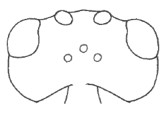
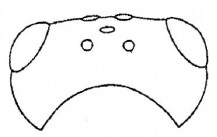
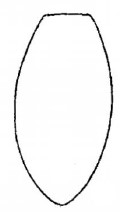
shapeHead less transverse, more orbicular, temples somewhat dilated [M]. Temple in dorsal view not bulging (Fig. 2) [P1]. Head roundly narrowed behind eyes, sometimes slightly broadened, but its maximum width behind eyes not greater than in ocular region [T4]. Head as wide as mesoscutum, weakly behind eyes, but rather strongly rounded-narrowed in posterior half; head width 1.6 times its length, 1.3 times its height. Temples 1.3 times as long as transverse eye diameter. Ocellar triangle 1.6 times as wide as OOL. POL 2.5 times eye diameter. Longitudinal diameter of eye 1.7 times transverse, twice height of malar space. Face width 1.7 times its height. Maxillary palp slightly shorter than height of face with clypeus [T14]. Head, transverse, posteriorly narrowed; the cheeks are not widened. The pits on the forehead at the base of the antennae are rugose, separated by a longitudinal ridge [Te1]. Head behind eyes usually roundly narrowed, rarely weakly widened [T10]. Temples as wide as eye [T24].
sculptureFace mildly and densely sculptured [T4]. Vertex behind ocelli densely transversely rugose, face with numerous thin rugae diverging from its upper corners [T14].
colorPalpi black ; mandibles reddish at the tips [M]. Palpi pale yellow[T14].
antenna
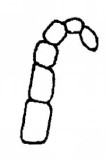
shape ♀16 segments, flattened and widened beyond the middle, the last 3 - 4 segments abruptly decreasing in size [M]. Antennae bristly, equal to the total length of the head, mesosoma and 0.3 of the metasoma; 3rd segment 3-3.5 times as long as wide, 12th segment 1.3 times, two apical segments equal to their width [T14]. Antennae 16-segmented, thickened in the middle, narrowed towards the apex, flattened [Te1]. Two apical segments nearly as long as wide; preceding ones distinctly longer [T10].
shape ♂22 segments [M]. Antennae 22-25-segmented [Te1].
colorThird segment yellow-brown [M]. Antennae yellowish in basal half [T14]. Scapus reddish-yellow [Te1].
mesosoma
shapeMesosoma length 1.3 times its height. Propodeum with weak transverse carina, with rather large lateral teeth rounded at apex [T14]. Propodeum with 2 teeth [Te1].
sculptureScutellum in middle usually with somewhat smooth sculpture [T4]. Scutellum punctated, dull [H2]. ♀ Mesonotum before scutellum with short and sinuous longitudinal rugae; scutellum weakly sculptured and shining in middle. ♂ Mesoscutum and scutellum more strongly sculptured, scutellum rugose-punctate at least laterally [T14]. The whole mesosoma, including propodeum is rugose [Te1]
color
legs
shapeHind femur 3 times as long as wide. Hind tibia equal to length of hind tarsus [T14].
sculpture
colorLegs ♀ orange-brown, including the trochanters, coxae black, tarsi and tips of hind tibiae dark brown; of the ♂ the four anterior femora are black, yellow-brown at both ends, hind femora entirely, and their tibiae at the apex, black [M]. ♂ Legs light brown to brown [P1]. ♂ Hind femora reddish brown [T4]. Legs ♀ red, ♂ black with red fore-tibiae and hind tibiae with yellow in middle [H2]. ♀ Legs are mostly brownish yellow. Hind femora brownish yellow, middle of hind tibiae yellow. ♂ Hind femora entirely brownish yellow [T14]. Legs reddish-yellow; coxae, hind tibia apex and tarsi black [Te1]. Hind femur red [S1]. Legs pale, brownish or reddish yellow [T10]. Hind coxae dark [T24].
wings
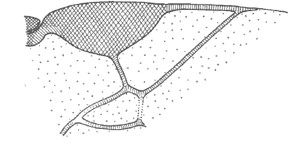
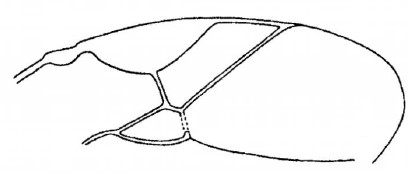
shapeVein r nearly perpendicular to the fore margin of pterostigma. ♂ Pterostigma issuing radial vein from its middle, 3-SR half as long as r, SR1 straight, 1-R1 about half as long as pterostigma (fig. 1) [P1]. r: 3-SR = 2 [H2]. The marginal cell of the fore wing is 2.5–3 times larger than the 2nd submarginal cell,1-R1 1.6–1.7 times shorter than pterostigma. ♂ 1-R1 is 0.7 times as long or slightly shorter than the pterostigma; 3-SR is much shorter than r [T14]. The marginal cell is larger than pterostigma. SR1 is straight. The radial vein of the hind wing is slightly curved [Te1]. 1-R1 about half as long as pterostigma; marginal cell 3-4 times as large as 2nd submarginal cell; r much longer than 3-SR, situated nearly vertically with respect to longitudinal axis of pterostigma [T10].
colorTegulae brown [T4]. Tegulae brownish yellow. The wings are slightly darkened [T14]. Wings smoky, with light transverse stripe behind brown stigma [Te1].
metasoma
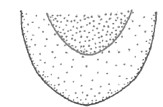
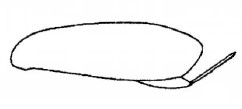
shapeMetasoma [compared to sulcatus] less oval, more contracted at the base, the sides more parallel [M]. ♂ Carapace apically more incurved, i.e. ventral cavity of carapace distinctly shorter than carapace itself (Fig. 3) [P1]. ♀ Metasoma 1.5 times as long as wide [T4]. Metasoma angularly narrowed toward apex, bent apically anteriorly by 0.1 times its length, 1.8–1.9 times as long as wide [T14]. Metasoma ovoid, strongly narrowed at the base [Te1]. Carapace not reflexed apically, oval [T10]. Metasoma rounded apically, not or only weakly incurved [T24].
sculptureLongitudinal rugae on metasoma fine and short [T4]. Metasoma in the basal half with weak sinuous longitudinal rugae, its apex transversely rugose against the background of dense granular ornamentation [T14]. Metasoma without sharp longitudinal rugae, coarsely rugose at the base, slightly rugose at the apex, shining [Te1].
colorMetasoma without spots [M]. metasoma entirely black [T4].
♀ ovipositorThe ovipositor is hidden or protrudes to the total length of the 1st-3rd segments of the hind tarsus [T14]. The ovipositor is short [Te1].
♂ apertureAperture of the ♂ more cordiform, emarginate on the lower side and there ciliated, with a depressed shining margin [M]. Aperture of abdominal shield 2 - 3 times as wide as high, reddish, small [T4]. Small, round [H2]. The aperture is small, rounded [Te1].
other info
distributionCH, DE, CZ, FR, GB, NL, PL, SE [FE].
remarksVery like C. sulcatus Nees [M]. The two names, M. parcicornis and M. latrunculus, seem to refer to the same species. On the basis of Herrich-Schaeffer's key and short description the species M. parcicornis is unrecognizable and, furthermore, the syntype material of this taxon does not exist. The single female specimen of M. parcicornis sensu Wesmael is conspecific with M. latrunculus [P1]. In the western Palearctic there are only 3 species with light legs, dark body, no yellow abdominal spot: C. latrunculus, C. starki and C. radialis [T24].
hostsTortrix sp. (Tortricidae), Depressaria sp. (Oecophoridae) [Ay3].