Chelonus kopetdagicus
authorTobias 1966
synonymsM. caucasicus (Abdinbekova, 1967)
body
shape♀ 3mm [T15]. Body length 2.7 - 3.7 mm. [T2].
colorBlack. The body is completely rugulose, matte; The hairs on the body are relatively sparse and short, light-colored [T15].
head
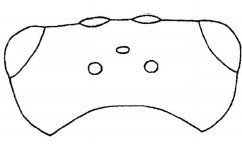
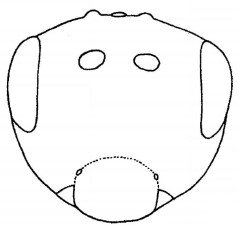
shapeHead 2.5 times as wide as long, roundly narrowed behind eyes; temples equal to the width of the eye; the width of the base of the ocellar triangle is 1.5 times less [?] than the distance from it to the eye, the distance between the posterior ocelli is twice the ocellus diameter; longitudinal eye diameter 2.5 times transverse, 4 times longer than cheeks; face height half its width, 1.5 times its [?] height; palps short, slightly more than height of face [T15]. Head roundly narrowed behind eyes, wider than mesosoma, more than twice as wide as long. Length of temples equal to, or slightly less than transverse diameter of eye. Length of base of ocellar triangle 1.5 times OOL or subequal to it. POL 2–3 times diameter of ocellus. Longitudinal diameter of eye 2.5 times, or little more, exceeding transverse one, 3–4 times malar space. Width of face twice its height. Rostrum not developed. Length of maxillary palpus half height of face [T2][T14]. Malar space 0.4 times the longitudinal diameter of the eye [T14]. The head is wider than the mesosoma, roundly narrowed behind the eyes: its width is almost 2.5 times its length; the occiput is strongly carved; temples slightly shorter than the width of the eye; ocelli in an obtuse triangle, base of which is almost equal to the distance from it to the eye; the distance between the posterior ocelli is three times greater than the diameter of the ocellus; eyes relatively weakly narrowed downwards, their longitudinal diameter is slightly larger than twice the transverse and three times longer than the cheeks. The width of the clypeus is twice its height; the distance between tentorial pits is almost equal to the distance from them to the eye; [Ab2].
sculptureClypeus smooth, face and occiput without conspicuous transverse rugae [T15]. Face and vertex behind ocelli delicately transversely rugose; clypeus densely and finely punctate, shiny.
color
antenna
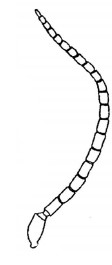
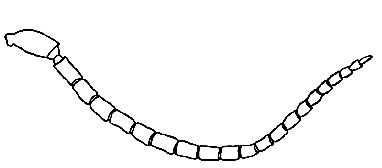
shape ♀Antenna slightly longer than the head and mesosoma, scapus much longer than the 3rd segment of the antenna; flagellum thin, filiform, segments of flagellum 3-4 times, at apex twice as long as wide [T15]. Antennae slightly longer than head and mesosoma combined; segments in basal part of flagellum 4 times as long as wide, those in its apical part nearly twice as long as wide [T2]. 12th antennal segment 3 times as long as wide [T9]. Third segment four times as long as broad [P4].
shape ♂Antennae 22-segmented [T2][T14]. Antennae longer than head and mesosoma, thin, filiform; 3rd antennal segment slightly shorter than the scapus, slightly longer than the 4th segment, three times as long as wide; segments of flagellum beyond middle slightly shortened towards apex [Ab2].
color
mesosoma
shapeThe mesosoma is one third longer than its height, the parapsidal grooves are indistinct. Propodeum with a weak transverse ridge and two lateral teeth [T15]. Length of mesosoma 1.3 times its height. Propodeum with weak transverse carina and moderately developed lateral teeth [T2][T14]. Notauli are weak. The propodeum is truncate posteriorly, with two teeth on the sides [Ab2].
sculptureScutellum densely and finely punctate, shiny [T2][T14].
color
legs
shape♀ Hind femur 4–5 times as long as wide [T2]. Length of hind tibia 6 times its apical width [T14]. Hind femora 4.0 - 4.2 times as long as wide; large spur of hind tibia slightly more than one third of 1st tarsus segment, 5th segment of hind tarsus equal to 3rd, shorter than 2nd [Ab2]. Hind femora 4.5 times as long as wide [T4].
sculpture
colorThe legs are brown. Fore and middle tibiae, apices of fore femora, main 2/3 of hind tibiae yellowish brown [T15]. Fore and middle femora apically, fore and middle tibiae, and also most part of hind tibia yellowish brown. Middle of hind tibiae usually brownish yellow [T2]. 1st segment of hind tarsus, except for apex, yellow [T9].
wings
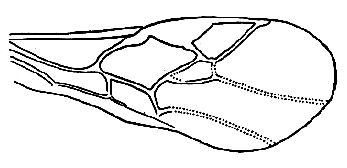
shape1-R1 is 1.5 times as long as [shorter than?] the pterostigma; the radial vein departs at a short distance behind the middle of the pterostigma, r and 3-SR are approximately equal in length; 1-CU1 = 0.5 times 2-CU1 [T15]. 1-R1 0.6–0.9 times as long as pterostigma [T2]. 1-R1 is almost equal to the length of the pterostigma; 3-SR is 1.5 times shorter than r, 4.5-5 times shorter than SR1, 2.5 times shorter than 2-SR; 1-CU1 = 0.5 times 2-CU1 (Fig. 11) [Ab2, caucasicus]. 1-R1 distinctly (1.5 times) less wide than length of pterostigma [P4].
colorWings slightly darkened, pterostigma and veins in apical half of wing brown, veins in basal half of wing yellowish [T15]. Wings slightly infuscate [T2][T14]. Veins in the middle of wing, before 2nd submarginal cell, pale yellow [T9].
metasoma
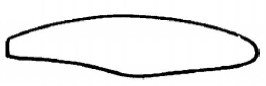
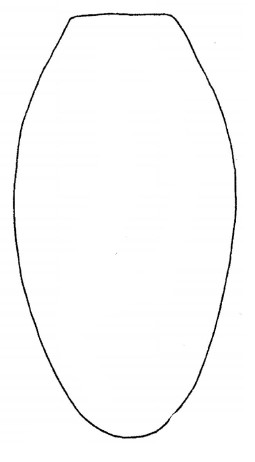
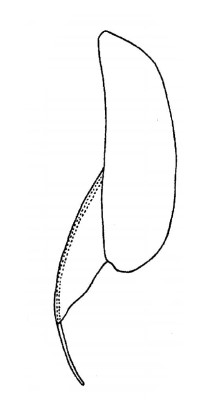
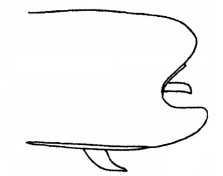
shapeThe metasoma is equal to the length of the head and mesosoma, elongated-oval; metasomal carapace not bent posteriorly, its length 4 times its height at apex, 2.5 times its width in middle part [T15]. Metasoma oblong-oval, not bend apically [T2]. Metasoma slightly shorter than head and mesosoma, slightly oval, bent down from behind, its length 2.5 times its width, 3.5 times its height in apical third [Ab2]. Carapace more or less linearly narrowing in apical third [T9]. Metasoma without emargination at apex [T4]. ♂ metasomal length 2.0-2.1 its width [T14, key].
sculptureBase of the metasoma with longitudinal rugae [T15]. Base of metasoma with longitudinal rugae [T2].
color
♀ ovipositorThe ovipositor does not project beyond the apical metasoma [T15]. Ovipositor not projecting or projecting slightly beyond apex of metasoma [T2]. Ovipositor sheath very short, hardly projecting beyond carapace [P4].
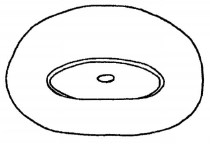
♂ apertureAperture oval, occupying about half, but no more than half of width of metasoma [T2]. Aperture occupies 0.3 abdominal width [T14].
other info
distributionCH [FE].
remarksClose to C. parcicornis H.-Sch., From which it differs in significantly more elongated eyes, short cheeks, thin antennae and hind femora [T15].
hosts
type description
Neochelonella kopetdagica Tobias, sp. n.
Близок к N. parcicornis H.-Sch., от которого отличается значительно более вытянутыми глазами, короткими щеками, тонкими усиками и задними бедрами
Самка. 3 мм. Голова в 2.5 раза шире своей длины, за глазами округленно суженная; виски равны ширине глаза; ширила основания глазкового треугольника в 1.5 раза меньше расстояния от него до глаза, расстояние между задними глазками вдвое больше диаметра глазка; продольный диаметр глаза в 2.5 раза больше поперечного, в 4 раза длиннее щек; высота лица вдвое меньше его ширины, в 1.5 раза больше высоты паличника; щупики короткие, едва больше высоты лица. Усики немного длиннее головы и груди, основной членик усика значительно длиннее 1-го членика жгутика; жгутик тонкий, нитевидный, членики жгутика в 3—4 раза, па вершине вдвое длиннее своей ширины. Грудь на треть длиннее своей высоты, парапсидальные борозды неясные. Передний край радиальной ячейки переднего крыла в 1.5 раза короче стигмы; радиальная жилка отходит на небольшом расстоянии за серединой стигмы, ее 1-й и 2-й отрезки приблизительно равной длины; первулюс отходит на расстоянии 1/3 длины задней стороны дискоидальной ячейки. Задние бедра (рис. 6) сильно сужены к основанию и значительно на вершине, в 5 раз длиннее своей ширины; большая шпора задних голеней немного больше трети 1-го членика лапки; 5-й члепик задних , лапок немного меньше 3-го, значительно меньше 2-го. Брюшко равно длине головы и груди, удлиненно-овальное; панцирь брюшка сзади не подогнут, его длина в 4 раза больше высоты па вершине, в 2.5 раза больше ширины в средней части. Яйцеклад не выступает за вершнпу брюшка. Тело сплошь морщішисто-пушстировашіоо, матовое; наличник гладкий, лицо и затылок без бросающихся в глаза поперечных складок; промежуточный сегмент со слабым поперечным валиком и двумя зубцами по бокам; основание брюшка с продольными складками. Волоски на теле сравнительно редкие и короткие, светлые. Черный; передние и средние голени, вершины передних бедер, основные 2/3 задних голеней желтовато-коричневые; лапки коричневые; крылья слабо затемнеппые, стигма и жилки в вершинной половине крыла коричневые, жилки в основной половине крыла желтоватые.
Самец неизвестен.
Материал. Туркмения: Копет-Даг, ущелье Нол-Дере, 19 V 1955, 1 ♀, голотип (В. Тобиас).,
Data used in the multi-access key
These data are collected from the species descriptions and redescriptions, from published figures and photographs and from own measureements and observations. For a description of the different variables and value classes see this
pdf.
| morphology |
| basic information | female | male |
| body length (mm): | (2.7) 2.7 - 3.5 (3.7) | (2.7) 2.7 - 3.5 (3.7) |
| number of antennal segments: | 16 | (21) 21 (23) |
| head, dorsal view |
| Head width : length | very wide | very wide |
| Temples narrowing - widening | narrowing | narrowing |
| Eye length : temple length | 0.75 - 1.0 | 0.75 - 1.0 |
| Roundness temple | medium | medium |
| POL : OD | 2 - 3, 3 - 4 | 2 - 3, 3 - 4 |
| Ocellar triangle shape | very wide | very wide |
| Excavation of head | 15 - 25%, 25 - 35% | 15 - 25%, 25 - 35% |
| head, lateral view |
| Head height : length | --- | --- |
| Eye height : length | very long | very long |
| Temple length : eye length | --- | --- |
| head, frontal view |
| Head width : height | very narrow | very narrow |
| Face width : height | narrow, wide | narrow, wide |
| Eyes converging ventrally | distinctly converging, about parallel | distinctly converging, about parallel |
| EH : MSL | very short | very short |
| Clypeus width : height | semicircular, transverse, very transverse | semicircular, transverse, very transverse |
| Clypeus extending above bottom of eyes | far below | far below |
| Tentorial pits | very small, small | very small, small |
| Shape of lower margin clypeus | convex | convex |
| antennae |
| Antennal shape | --- | filiform, not widened |
| Segment 3 length : width | medium, long | --- |
| Penultimate segment length : width | long | --- |
| Length of antenna : length of body | 2: short, 3: long | --- |
| mesosoma, lateral view |
| Length : height | short | short |
| transverse carina | weak, indistinct | weak, indistinct |
| lateral teeth | present | present |
| mesosoma, ventral view |
| Prepectal carina lamelliform | indistinct | indistinct |
| legs |
| Hind femur length : width ratio | long | long |
| Hind tibia length : hind tarsus length ratio | --- | --- |
| Hind tibia (longest) spur length : metatars length ratio | | |
| wings |
| Vein 1-R1 length : pterostigma length | medium, long | medium, long |
| Vein r length : vein 3-SR length | short | short |
| Shape vein SR1 (straight / concave / convex) | straight or S-shaped, slightly convex | straight or S-shaped, slightly convex |
| S-shape vein SR1 | not S-shaped | not S-shaped, apically convex |
| cell M : cell Sm2 | Sm2 medium | Sm2 medium |
| Pterostigma length : width ratio | medium, long | medium, long |
| Angle between radial vein (r) : vein 1-R1 | medium, blunt | medium, blunt |
| metasoma, dorsal view |
| Length : width ratio of metasoma | medium, long | medium, long |
| Shape of metasoma | narrowing to apex | narrowing to apex |
| metasoma, lateral view |
| Length : height ratio of metasoma | medium, long | medium, long |
| posterior : anterior height ratio of metasoma | small | small |
| Position of maximum height | medium | medium-posterior |
| metasoma, ventral view |
| Metasoma posteriorly curved forwards | (almost) not incurved | (almost) not incurved |
| male apical aperture |
| Aperture width : metasoma width | no aperture | small, medium |
| Aperture shape | n. a. | oval |
| Median process shape | n. a. | horizontal oval |
| sculpture |
| head |
| general coarseness | fine | fine |
| clypeus |
| coarseness punctation | smooth to uneven, punctulate | smooth to uneven, punctulate |
| density punctation | --- | --- |
| face |
| sculpture type | rugose | rugose |
| sculpture direction | irregular, transverse | irregular, transverse |
| vertex and temple |
| sculpture type | transverse rugulose | transverse rugulose |
| mesonotum |
| sculpture type | --- | --- |
| scutellum |
| middle | punctate | punctate |
| lateral | punctate | punctate |
| metasoma |
| base - mid sculpture | longitudinally rugose / rugose-striate | longitudinally rugose / rugose-striate |
| sculpture at apex | rugulose | rugulose |
| coarse / fine boundary | base (to 50%) | base (to 50%) |
| color |
| head |
| mandibles color pattern | --- | --- |
| palpi, lightest color | --- | --- |
| antennae |
| scapus, lightest color | black, dark brown | black, dark brown |
| segment 3 and 4, lightest color | black, dark brown | black, dark brown |
| legs |
| fore coxae lightest colour | medium dark | medium dark |
| fore femur lightest colour | medium light | medium light |
| fore femur color pattern | tip light | tip light |
| hind femur lightest colour | medium dark | medium dark |
| hind femur color pattern | entirely dark | entirely dark |
| hind tibia lightest colour | medium light | medium light |
| hind tibia color pattern | wide light ring, wide light base | wide light ring, wide light base |
| hind basitarsus lightest colour | light | light |
| hind tarsus segment 2-3 lightest colour | medium dark | medium dark |
| wings |
| middle veins lightest colour | medium dark | medium dark |
| basal veins lightest colour | light | light |
| metasoma |
| metasoma colour pattern | entirely dark | entirely dark |
| metasoma lightest colour | dark | dark |
| metasoma base, colour pattern | entirely dark | entirely dark |
| metasoma base, light spots | n.a. | n.a. |
| metasoma base, light band | n.a. | n.a. |