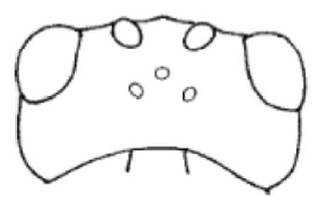
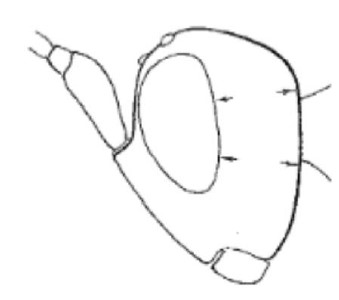
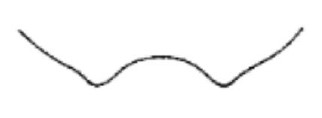
shapeHead in dorsal view (Fig. 1) transverse, 1.85 - 1.9 times as broad between eyes as long, eye a bit shorter than temple, temple straight and on its posterior third rounded, occiput deeply excavated. Ocelli small and round, OOL one-third longer than POL. Eye in lateral view twice as high as wide, beyond eye temple just broader than eye and ventrally faintly narrowing (Fig. 2, see arrows). Lower margin of clypeus truncate [P12].
sculptureClypeus densely and finely punctate, interspaces somewhat greater than punctures. Face transversely rugose with anastomoses. Frons rugose, vertex and temple rugo-striate [P12].
colorPalpi brownish black [P12].
antenna
shape ♀Antenna about two-thirds as long as body and with 22 - 24 antennomeres. Third segment three times as long as broad apically, further segments gradually shortening so that penultimate segment subcubic, i.e. only a bit longer than broad [P12].
shape ♂
colorAntenna black [P12]
mesosoma
shapeMesosoma in lateral view 1.2 times as long as high [P12].. Scutellum uneven. Notaulix indistinct [P12].
sculptureMesosoma rugose, upper (or horizontal) half of propodeum with areolate sculpture [P12].
color
legs
shapeHind femur 3.3 times as long as broad medially. Inner spur of hind tibia longer than outer one and half as long as basitarsus [P12].
sculpture
colorCoxae, trochanters entirely and femora proximally black, femora distally and tibiae yellow-brown, hind tibia apically and every tarsus blackish. Sometimes hind femur black and only apically reddish yellow [P12].
wings
shapeFore wing somewhat shorter than body. Pterostigma 2.6 times as long as wide and issuing r from its middle. 3-SR somewhat longer than r; 1-R1 as long as pterostigma [P12].
colorTegula and parategula black. Wings weakly brownish or brownish subhyaline, pterostigma dark brown, veins light brown, M + CU1 and 1-M yellow [P12].
metasoma
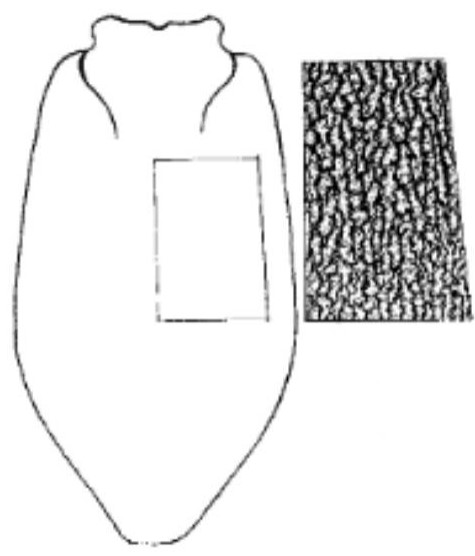
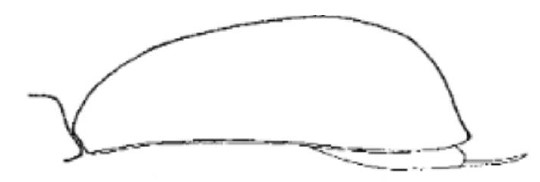
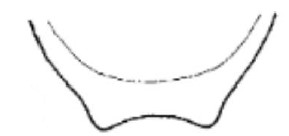
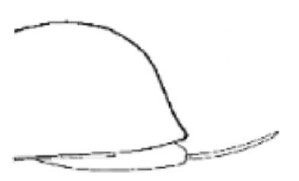
shapeCarapace as long as head and mesosoma combined, in dorsal view (Fig. 3) almost twice as long as broad behind, its hind third pointed; in lateral view (Fig. 4) 2.85 times as long as high behind and its hind third declivous, its apical end excised as in Fig. 5. Carapace apically just incurved (Fig. 6), i.e. its ventral cavity just shorter than carapace itself. Hind third of carapace in lateral view sometimes more declivous (Fig. 7) [P12].
sculptureCarapace longitudinally areolate-rugose (Fig. 3), its declivous hind third rugo-rugulose [P12].
color
♀ ovipositorOvipositor sheath long and clearly surpassing posterior end of carapace, as long as hind basitarsus (Fig. 4) [P12].
♂ aperture
other info
distributionCH [FE].
remarksMale and host unknown [P12].
hostsunknown [P12]
figures
fig. 1: head in dorsal view (Papp 2003)
fig. 2: head in lateral view (Papp 2003)
fig. 3: carapace in dorsal view with indication of its sculpture (Papp 2003)
fig. 4: carapace in lateral view (Papp 2003)
fig. 5: apical end of carapace in dorsal view (Papp 2003)
fig. 6: apical end of carapace in ventral view (Papp 2003)
fig. 7: posterior third of carapace in lateral view (Papp 2003)
Material examined (5 ♀). - Female holotype and 1 female paratype: Greece, prov. Lakonia, Monemvasia. 2 June 1979, leg. L. Gozmany. 3 female paratypes: Switzerland, Kanton Graubünden. Engadin, Val Roseg, 9 August 1964 (1 ♀) and 20 August 1964 (1 ♀), 1 ♀: Pontresina 13 August 1964. leg. J. Erdos. Holotype and four paratypes are deposited in the Hungarian Natural History Museum (Department of Zoology), Budapest, Hym. Typ. Nos 10626 (holotype) and 10627-10630 (paratypes).
The female holotype is in good condition: (1) pinned by middle of the mesosoma, (2) left flagellum damaged. The four female paratypes are also in good condition: (1) every specimen pinned by middle of the mesosoma, (2) female of No. 10627 missing right fore leg except coxa + trochanter, (3) left fore wing of the female of No. 10628 somewhat damaged distally beyond pterostigma. (4) distal third of left fore wing of the female No. 10629 somewhat shrivelled.
Etymology: The new species is dedicated to its collector and my good collegue, Dr. Laszló Gozmany, the world-wide well-known Hungarian lepidopterist and steadfast explorer of the moth fauna of Greece, celebrated his 80th birthday in 2001
Description of the female holotype. - Body 6.5 mm long. Antenna about two-thirds as long as body and with 23 antennomeres. First flagellomere three times as long as broad apically, further flagellomeres gradually shortening so that penultimate flagellomere subcubic, i.e. only a bit longer than broad. Head in dorsal view (Fig. 17) transverse, 1.85 times as broad between eyes as long, eye a bit shorter than temple, temple straight and on its posterior third rounded, occiput deeply excavated. Ocelli small and round, OOL one-third longer than POL. Eye in lateral view twice as high as wide, beyond eye temple just broader than eye and ventrally faintly narrowing (Fig. 18, see arrows). Lower margin of clypeus truncate. Clypeus densely and finely punctate, interspaces somewhat greater than punctures. Face transversely rugose with anastomoses. Frons rugose, vertex and temple rugo-striate.
Mesosoma in lateral view 1.2 times as long as high, rugose, upper (or horizontal) half of propodeum with areolate sculpture. Scutellum uneven. Notaulix indistinct. Hind femur 3.3 times as long as broad medially. Inner spur of hind tibia longer than outer one and half as long as basitarsus.
Fore wing somewhat shorter than body. Pterostigma 2.6 times as long as wide and issuing r from its middle. 3-SR somewhat longer than r; 1-R1 as long as pterostigma.
Carapace as long as head and mesosoma combined, in dorsal view (Fig. 19) almost twice as long as broad behind, its hind third pointed; in lateral view (Fig. 20) 2.85 times as long as high behind and its hind third declivous, its apical end excised as in Fig. 21. Carapace apically just incurved (Fig. 22), i.e. its ventral cavity just shorter than carapace itself. Carapace longitudinally areolate-rugose (Fig. 19), its declivous hind third rugo-rugulose. Ovipositor sheath long and clearly surpassing posterior end of carapace, as long as hind basitarsus (Fig. 20).
Antenna and body black. Palpi brownish black. Tegula and parategula also black. Coxae, trochanters entirely and femora proximally black, femora distally and tibiae testaceous, hind tibia apically and every tarsus blackish. Wings weakly brownish or brownish subhyaline, pterostigma dark brown, veins light brown, M + CU1 and 1-M yellow.
Description of the four female paratypes: Similar to the female holotype. Body 6.5 mm long. Antenna with 22-24 antennomeres (1 ♀: 22, 2 ♀ 23, 1 ♀: 24). Head in dorsal view 1.85-1.9 times as broad as long. Hind third of carapace in lateral view more declivous (Fig. 23). Hind femur black and only apically reddish yellow (2 ♀).
Male and host unknown. Distribution: Greece
The new species. Chelonus gozmanyi, is nearest to Ch. caradrinae Kokujev and Microchelonus erosus (Herrich-Schaeffer) considering their peculiar form of the apical end of carapace.
Data used in the multi-access key
These data are collected from the species descriptions and redescriptions, from published figures and photographs and from own measureements and observations. For a description of the different variables and value classes see this pdf.
morphology
basic information
female
male
body length (mm):
(5.5) 5.5 - 7 (7.5)
(5.5) 5.5 - 7 (7.5)
number of antennal segments:
(21) 21 - 24 (25)
---
head, dorsal view
Head width : length
wide
wide
Temples narrowing - widening
parallel
parallel
Eye length : temple length
0.75 - 1.0, 1.0 - 1.25
0.75 - 1.0, 1.0 - 1.25
Roundness temple
strong, medium
strong, medium
POL : OD
2 - 3, 3 - 4
2 - 3, 3 - 4
Ocellar triangle shape
narrow, wide
narrow, wide
Excavation of head
15 - 25%, 25 - 35%
15 - 25%, 25 - 35%
head, lateral view
Head height : length
very short, short
very short, short
Eye height : length
very short, short, long
very short, short, long
Temple length : eye length
very short, short
very short, short
head, frontal view
Head width : height
---
---
Face width : height
---
---
Eyes converging ventrally
---
---
EH : MSL
---
---
Clypeus width : height
---
---
Clypeus extending above bottom of eyes
---
---
Tentorial pits
---
---
Shape of lower margin clypeus
truncate
truncate
antennae
Antennal shape
---
filiform, not widened
Segment 3 length : width
medium
---
Penultimate segment length : width
short
---
Length of antenna : length of body
---
3: long
mesosoma, lateral view
Length : height
short
short
transverse carina
---
---
lateral teeth
---
---
mesosoma, ventral view
Prepectal carina lamelliform
indistinct
indistinct
legs
Hind femur length : width ratio
short, medium
short, medium
Hind tibia length : hind tarsus length ratio
---
---
Hind tibia (longest) spur length : metatars length ratio