Chelonus fenestratus
authorNees, 1816
synonyms
body
shape♂ 2 lin. (4.5mm) , ♀ 1 1/2 lin. (3.4mm) [N]. ♀: 3.5-4 mm [P6]. ♂ 3.6-3.8mm [TL]. 3-4mm [T4][T14]. ♀ 3.8 - 4.0 [P13].
colorblack [N].
head
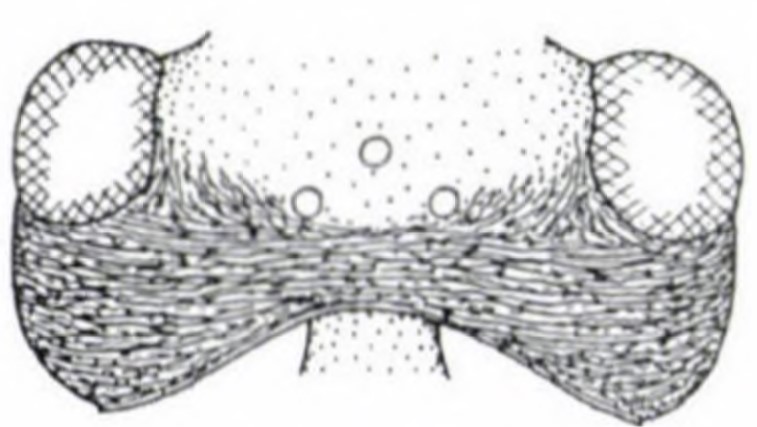
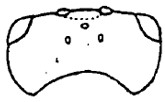
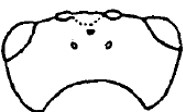
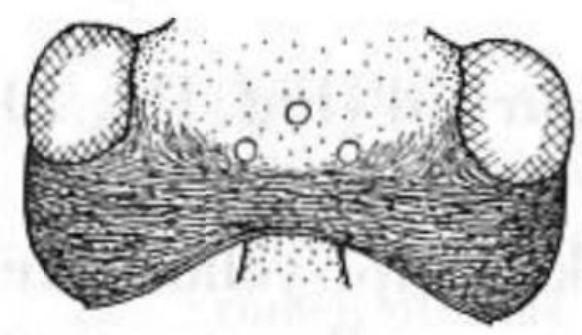
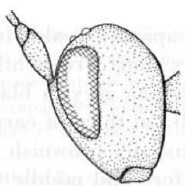
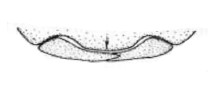
shapeHead with a transverse vertex, contracted behind the eyes [M]. Roundly narrowed behind eyes, about temples narrower than about eyes, 1.85 times as broad as long, in frontal view as broad as high, 1.1 (♀ 1) times as wide as mesosoma [TL]. Eye in dorsal view somewhat longer than temple [P6]. In frontal view eye 2.2 times as high as long, 1.8 times as long as malar space [TL]. Ocelli small. Ocellar triangle 1.5 times shorter than OOL. POL 4 times longer than OD [TL]. Temple 2 x (♀ 1.4) longer than eye width [TL], Face 1.8 times as broad as high and 1.6 times as broad as eye, twice higher than clypeus. Maxillary palpi as long as height of face and clypeus combined [TL]. Head in dorsal view (Fig. 14) transverse, 1.9-2 times as broad as long, eye about one-quarter longer than temple, latter moderately rounded, occiput excavated. Ocelli forming a low triangle, POL somewhat shorter than OOL. Eye in lateral view (Fig. 15) 2.2-2.3 times as high as wide, temple behind eye 1.5-1.6 times as wide as eye. Occipital and hypostomal carinae separated (Fig. 16). Malar space 1.7 times as long as basal width of mandible. Clypeus medially truncate (Fig. 17). Distance between tentorial pits somewhat longer than that between eye and pit. Face 1.75 times as wide as high, eyes with parallel margins [P13]. The head is roundly narrowed behind the eyes, its width is 1.9–2 times its length. POL is slightly shorter than OOL. The eyes are slightly longer than the temples. Face width 1.75 times its height. Malar space 1.7 times basal width of mandible [T14].
sculpture♂ Head densely and finely pointed. Face fine transversal striate with longitudinal sculpture about eyes. Frons finely sculptured. Vertex finely transversely striate and temples finely longitudinally [?] striate. Clypeus finely punctate with polished transversal rows, shining. ♀ Head finely punctated. Face densely punctate, finely longitudinally striate about eyes with more or less developed central carina. Clypeus finely punctate, shining [TL]. Punctulate in front, orbits and cheeks striolated [M]. Around pair ol antennal sockets face somewhat concentric strio-rugose. Vertex and occiput with fine, dense and transverse striation (Fig. 14), temple also striated [P13]. The face is concentrically rugose, the vertex behind the eyes with dense and soft transverse rugae, the temples are finely striated [T14].
colorPalpi brown [TL]. Palpi yellow [P13][T14].
antenna
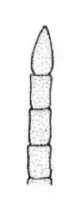
shape ♀16 segments, thin [N]. ♀ 16 segments, dilated from the middle to near the apex, the last 3 segments smaller [M], much shorter than the body [H], scarcely longer than head and metasoma combined, apical segments 1.5-2 times as long as wide [TL]. Antenna shorter than body and with 16 segments. Third segment almost four times as long as broad apically, further segments gradually shortening and attenuating so that penultimate segments 1.4-1.5 times as long as broad (Fig. 18) [P13]. Length of 3rd antennal segment 3–4 times its width. Antennae are shorter than the body; preapical segment 1.4–1.5 times as long as wide [T14].
shape ♂Gently tapering, thin [N]. Antennae ♂ 28 segments, filiform to about the 18th segmentt, thence gradually attenuated, as long as the body [M]; Shorter than body. Scape widened, twice as wide as flagellum, 2.5 times as long as wide; 3rd segment 3 times as long as wide, apical segments twice as long as wide [TL].
colorAntennae black [T4]. Scape partially brown or brown-yellowish [TL]. Antenna greyish black [P13].
mesosoma
shapeMesosoma ♂ 1.3 (♀ 1.4) times longer than high [TL]. Propodeum short, truncate, with 2 medial carinae, and the hind angles dentiform [M]. Propodeum with well-developed transverse carina and lateral tubercles {LT]. ♀ Mesosoma in lateral view 1.4 times as long as high. Propodeum with a pair of median as well as a pair of lateral tubercules, latter somewhat stronger than former [P13]. Mesosoma length 1.4 times its height. Propodeum with weak lateral teeth [T14].
sculpture♂ Mesonotum rugose-rugulose punctate and shining, pre-scutellar depression and area before it strongly striate with longitudinal rows. Scutum anteriorly more or less rugose punctate, sides of mesonotum roughly punctate [TL]. Mesonotum rather shining in front, punctulate-rugulose, coarsely reticulated or sulcate behind [M]. Scutellum finely punctate, shining [TL], rugulose [M], base smooth, glossy [N]. Propodeum reticulated [M]. ♀ Sides of mesonotum areolate-punctate with unclear longitudinal sculpture. Propodeum areolate-rugulose, without distinct longitudinal elements [TL]. Notauli faintly distinct, crenulate. Mesonotum rugo-rugulose and shiny, scutellum smooth and shiny, otherwise mesosoma scabrous [P13]. Mesonotum densely and finely punctate, slightly shining, irregularly rugose in front of scutellum, with sinuous and anastomosing rugae. Mesonotum finely irregularly rugose, scutellum smooth, sometimes with longitudinal rugae [T14].
color
legs
shapeHind femur 4 times as long as broad. Outer spur of hind tibiae scarcely longer than (or as long as) inner, almost reaching 0.5 (much longer than 0.3) length of metatars. 5th tarsal segment as long as 4th and 1.5 times shorter than 2nd [TL]. Hind femur 3.8-4.1 times as long as broad medially. Inner spur of hind tibia almost as long as half of basitarsus. Hind basitarsus as long as tarsomeres 2-4 [P13]. Hind femur 3.5–4 times as long as wide, hind tibia 4.5 times as long [T14].
sculpture
color♂ Femora all with broad red apex [N]. Coxae dark, almost black; fore femora dark-brown with yellow apex, tibiae yellowish, tarsi yellowish with brown apex; hind femora dark-brown, tibiae brown with yellowish central part (like a yellow belt), tarsi brown-yellowish with dark apex [TL]. Legs ♂ brownish-yellow; coxae, a streak on the intermediate femora, hind femora except at the base, hind tibiae at the apex and narrowly at the base, black; tarsi dark, metatars more or less brownish-yellow; in the ♀ the trochanters are partly dark, and the intermediate femora black nearly to the apex [M]. Fore femur blackish to black and apically yellow, middle femur blackish to black [P6]. Legs blackish; fore femur apically, entire fore and middle tibiae + tarsi, ring of hind tibia yellow, hind tarsomeres dark brown and basally yellowish [P13]. Apices of fore femora, fore and middle tibiae and tarsus and band on hind tibia brownish yellow [T14]. Hind tibia with non-contrasting yellowish band [T7].
wings
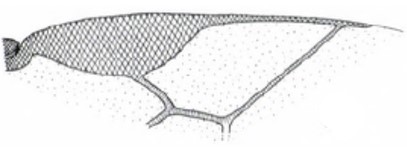
shapePterostigma 2.6-2.8 times as long as wide and issuing radial vein more distally from its middle, 3-SR usually somewhat longer than r, 1-R1 shorter than pterostigma (Fig. 16) [P6]. ♂ 1-R1 as long as length of pterostigma. Marginal cell 1.5 times greater than submarginal cell. 3-SR 1.2 times as long as r, 3 times shorter than SR1. 1-CU1 longer than cu-a; ♀ As for male except as follows. 3-SR and r equal in length, but separately 3 times shorter than SRI. 1-CU1 equal to cu-a [TL]. Marginal cell longer but not broader than the pterostigma; 3-SR slightly curved; radius of hind wings sinuated. wings 3 lin. (7.5mm) [M]. Fore wing clearly shorter than body. Pterostigma (Fig. 19) 2.6-2.8 times as long as wide, issuing radial vein distally from its middle, R1 as long as pterostigma or somewhat longer; r usually a bit shorter than 3-SR (or two veins equal in length), SR1 straight; 1-R1 somewhat shorter than pterostigma [P13]. The marginal cell of the fore wing is 1.5–2 times larger than the 2nd submarginal cell; 1-R1 is equal to the length of the pterostigma. ♂ The marginal cell of the fore wing is 2.5 times larger than the 2nd submarginal cell [T14].
colorTegulae black [T4]. Wings faintly infuscate with a transparent belt along medial vein. Pterostigma and veins brown [TL]. Wings infumated, especially towards the apex; costa, veins, and stigma dark; parastigma, M+CU1, and tegulae dull yellowish-brown[M]. Tegula dark brown to blackish brown. Wings weakly fumous, pterostigma brown, veins opaque brown [P13]. The wings are slightly darkened [T14]. Wings faintly infuscate, pale in basal half, with brownish veins [T7].
metasoma
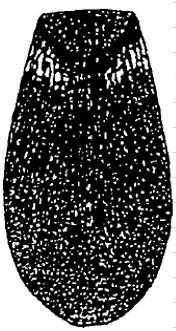
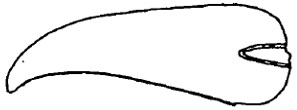
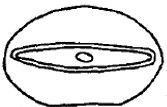
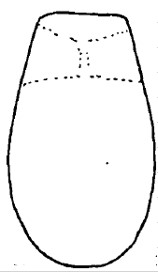
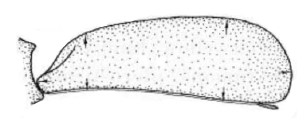
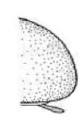
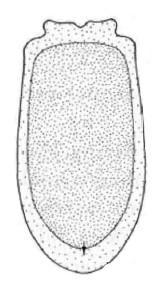
shapeMetasoma oval, subcylindrical [N]. ♂ Carapace twice as long as maximal broad, laterally incurved on its 0.3 height. In lateral view posteriorly enlarged, 2.5 times as high posteriorly as anteriorly. ♀ Carapace shorter than of male, 1.7 times as long as broad. In lateral view enlarged posteriorly and incurved on its 0.3 height, twice as high posteriorly as anteriorly. [TL]. In lateral view hind end of carapace rounded (Fig. 17, see arrow); in ventral view carapace slightly more incurved (Fig. 18) [P6]. ♀ with two strongly converging basal carinae [H]. Carapace about one-fifth shorter than head + mesosoma combined, in dorsal view (Fig. 20) 1.8-1.9 times as long as broad medially, in lateral view 2.9(-3) times as long as high behind and one-third higher behind than basally (Fig.21, see arrows), behind (or apically) less truncate (Fig. 21, 22). Ventral cavity of carapace (Fig. 23) nearly as long as carapace itself, i.e., carapace apically weakly incurved (Fig. 23, 24, see arrow) [P13]. ♀ Metasoma slightly widened toward apical third, slightly bent apically anteriorly, 1.7–1.9 times as long as wide. ♂ The length of the metasoma is 1.8 - 2.0 times its width [T14]. ♀ Metasoma uniformly rounded apically, its length 1.7-1.8 times its width, reflexed apically along 0.2 of its length. ♂ Length of metasoma twice its width [T7].
sculptureVery finely punctulate-rugose [N]. Carapace longitudinally undulate rugulose on its 1/2 to 2/3, apex without longitudinal elements of sculpture [TL]. Metasoma at the base sulcate, afterwards reticulate-rugose, striated, behind more finely, the apex somewhat shining [M]. Carapace longitudinally striate, its hind third rugose, interstriation subrugulose (Fig. 20) [P13]. The metasoma is longitudinally rugose, its apical third is irregularly rugose, with longitudinal rugae [T14].
colorMetasoma at the base with 2 large triangular yellowish subconfluent spots [M]. ♂ basally with pair of yellow or yellow-brownish spots, ♀ with a larger pair of yellow or yellow-brownish spots, almost forming a belt [TL]. metasoma at base with two yellow spots (if they merge, then one brown spot in middle of abdominal base) [T4]. Basal third of carapace yellow to straw yellow, between short pair of keels usually brownish black to black [P13]. ♀ Metasoma with distinct yellow basal spots. ♂ Metasoma often with 2 weak yellow basal spots [T14]. ♂ Metasoma with 2 yellow basal spots [T7].
♀ ovipositorOvipositor hidden [N][M][TL]. Ovipositor sheath very short, frequently concealed [P13][T14].
♂ apertureAMA chink-formed, 0.9 as broad as carapace; in back view about 0.25 height and in lateral view about 0.25 - 0.3 length of carapace [TL]. Aperture 3 times as wide as high [H]. Anus ♂ imperforate [M]. Aperture oval [T14]. Aperture slit-like, occupying nearly entire width of posterior surface of metasoma [T7].
other info
distributionWestern Europe, … [T4] , Almost all Palaearctic region [TL]. BE,AT,DE,CZ,FR-F,GB-G,IE,NL,PL [FE]
remarks
hosts