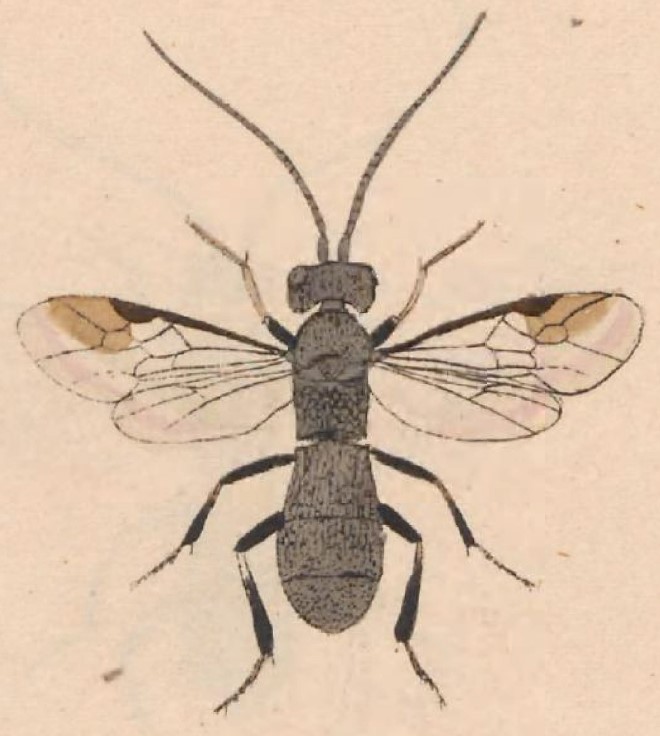
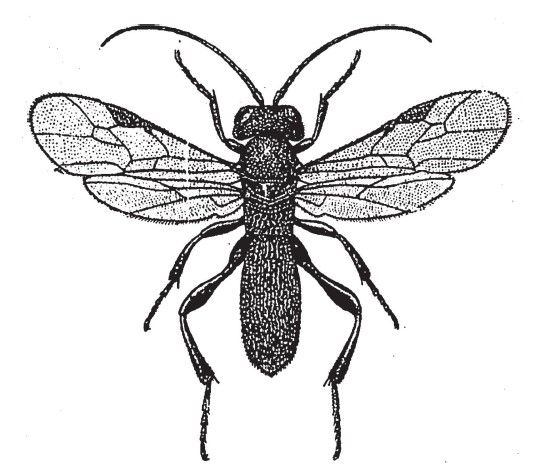
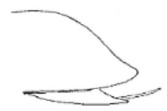
Chelonus erosus
authorHerrich-Schäffer, 1838
synonymsanalipennis (Fahringer 1934), hungaricus (Szépligeti 1896)
body
shapeThe body is very large, ♀ 6.0-7.0 mm, ♂ 7.0 - 9.0 mm [T14]. ♀ 6 - 7mm, ♂ 5.5 - 6.5 (-7) mm [P3]. 6.0 - 6.5mm [P12]. 6 - 7 [T4, analipennis]. 2.7 - 3.0 [T4, hungaricus]. 6 mm [S2, hungaricus].
colorBody black, coarsely rugose [T2][T14].
head
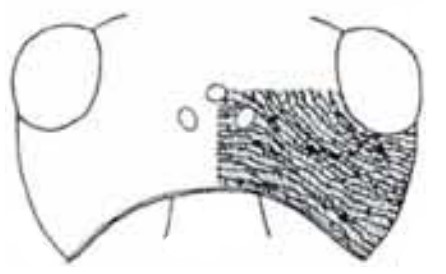
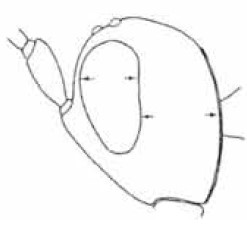
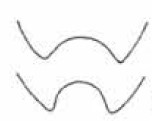
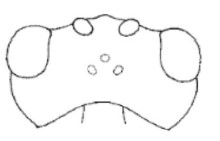
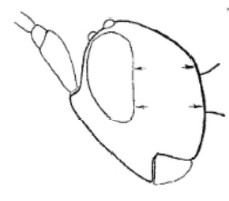
shapeThe head is roundly narrowed behind the eyes, between the bases of the antennae with a protruding carina [T2][T14]. Head in dorsal view transverse, 1.8 - 1.9 (♀) or 1.85 - 1.95 (♂) times as broad as long, eye just shorter than temple, temple moderately rounded, occiput deeply excavated. Ocelli medium sized, near to each other, imaginary tangent to fore ocellus touching hind pair of ocelli; OOL twice as long as POL. Eye in lateral view 1.8 times as high as wide, temple beyond eye one-third (or 1.4 times) wider than eye, ventrally broadening (Fig. 3, see arrows). Malar space slightly longer than basal width of mandible. Face 2.2 times as wide as high, inner margin of eyes somewhat divergent ventrally. Clypeus 1.6 times as wide as high, its lower margin truncate [P3]. The mouthparts are elongated in the form of a short proboscis [Te1]. Temple in dorsal view rounded, eye 1.2 times as long as temple (Fig. 18). Temple in lateral view distinctly broadening ventrally (Fig. 19. see arrows) [P12]. Maxillary palpi long, approximately as long as height of head, mouthparts produced into proboscis [T4, hungaricus].
sculptureThe head is rugose [H]. Face rugose, clypeus punctate, interspaces shiny and greater than punctures. Vertex with somewhat non-parallel striation (Fig. 2), occiput and temple with stronger striation [P3]. Head with coarse transverse rugae [T4, analipennis]. Clypeus punctated and shiny [S2, hungaricus].
colorMandible basally brown, apically yellow, palpi light brown [P3]. Mandible red, tip black; palpi yellow [S2, hungaricus].
antenna
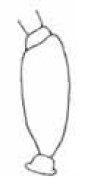
shape ♀Antenna with 16 segments [H]. Antenna about as long as body and with 16 segments. Scape almost three times as long as broad apically, apically obliquely truncate. Third segment 3.6 - 3.8 and penultimate segment 2.1-2.5 times as long as broad, segments gradually shortening and attenuating distally [P3]. Antennae slightly shorter than body, filiform, 16-segmented; scapus is oval, not very thickened; segments of flagellum 2–3 times longer than wide [Te1]. Penultimate segment twice as long as broad [P12].
shape ♂Antenna about as long as body and with 25-27 segments. Third segment 3.3(-3.4) times and penultimate segment 1.6 times as long as broad [P3]. Antennae filiform, 21 segments [Te1].
colorScape with very weak rusty suffusion [P3]. Antennae black, first and second segment partly red, last segments lighter [S2, hungaricus]
mesosoma
shapePropodeum short, with uniform longitudinal carinae, 2 in middle somewhat stronger [H]. Mesosoma in lateral view 1.3 times as long as high, propodeum with a transverse carina [P3]. Mesonotum with distinct carina along middle. Propodeum in the middle with 3 longitudinal ridges and poorly developed lateral teeth [T2][T14]. Mesosoma is almost twice as long as wide. Propodeum with a transverse carina, on the sides with blunt short teeth [Te1]. Mesonotum with distinct carina along middle [T2]. Transverse carina on propodeum not distinct [T4, analipennis]. Propodeum without or with weak lateral denticles [T4, hungaricus]. Propodeum without teeth [S2, hungaricus].
sculptureScutellum smooth, finely punctated [H]. Mesonotum rugo-rugulose, scutellum smooth and shiny with a few rugose elements [P3]. Mesosoma coarsely rugose and slightly shining, scutellum rugose-punctate, almost matt, propodeum coarsely rugose [T2][T14]. Notauli weak, roughly rugose [Te1]. The pronotum, the sides of the mesonotum, and the propodeum are coarsely reticulate-rugose. Scutellum, and an area on sides of mesonotum smooth and shiny. [Te1]. Mesonotum coarsely wrinkled, with median longitudinal ridge; scutellum coarsely rugose-punctate [T4, analipennis].
color
legs
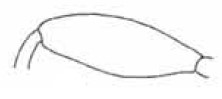
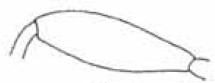
shapeHind femur 2.7 - 3.3 (♀) or 2.6 - 3.1 (♂) times as long as broad medially. Inner spur of hind tibia just shorter than half basitarsus. Hind basitarsus as long as tarsomeres 2-5 combined except claws [P3].
sculpture
colorTip of the femora and tibiae yellow-brown. Hind tibiae at base and tip broadly brown [H]. Fore and middle tibiae and partly also tarsi brownish red; hind tibiae brownish black, with whitish band at the base [T14]. Legs brown, tibiae yellow, distal half of tibiae 2-3 brownish to light brown, hind tibia proximally with a yellow ring, tarsi also lightbrown. Light colour pattern yellow to reddish yellow, ring of hind tibia always yellow. In ♂ brownish to brown colour of tibiae more extended [P3]. Hind femur entirely black [P12]. Hind tibial spurs pale [S2, hungaricus].
wings
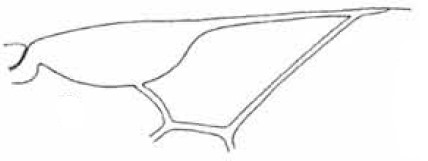
shapeFore wing marginal cell slightly longer than pterostigma [T2][T14]. Pterostigma 2.5 - 2.6 times as long as wide and issuing r distally from its middle, 3-SR as long as r, SR1 usually bent, 1-R1 as long as to a bit shorter than pterostigma [P3]. r slightly shorter than 3-SR, SR1 slightly curved [Te1]. 1-R1 shorter than pterostigma [T4, hungaricus]. SR1 is curved, with a nerve stump opening into the marginal cell [S2, hungaricus].
colorWings infuscate [T6]. Tegulae brown. Wings subhyaline, pterostigma brown, veins light brown, basally yellow [P3]. Smoky wings; prterostigma and veins brown [Te1]. The wings are brownish, the veins are brown, the pterostigma is blackish-brown, the band extending under the pterostigma is barely perceptible whitish; the tegulae are black [S2, hungaricus].
metasoma
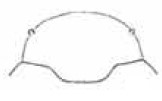
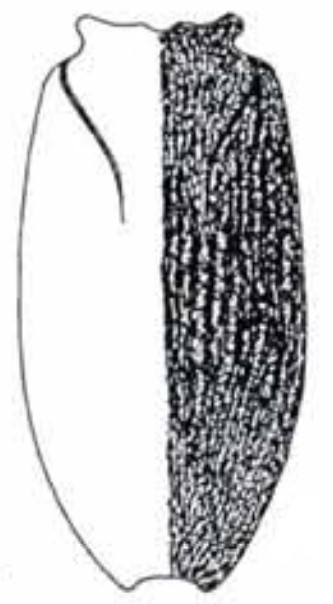
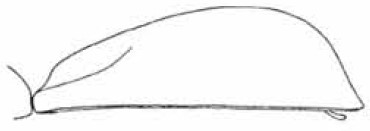
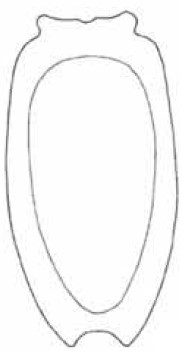
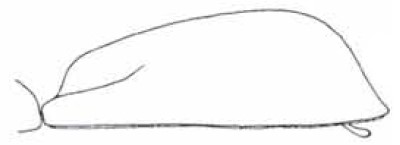
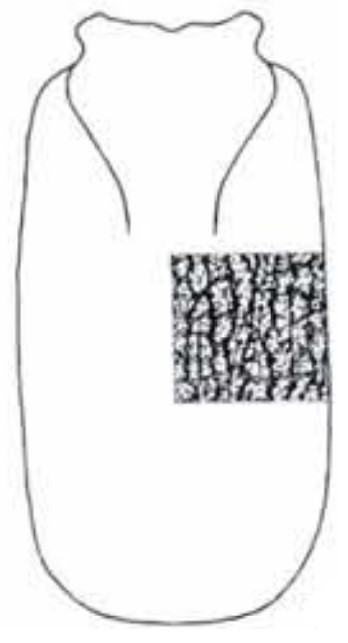
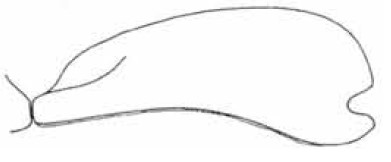
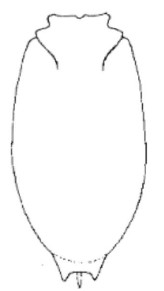
shapeMetasome more pointed towards the apex than towards the base [H]. The carapace is deeply notched at the apex [T14]. Carapace in dorsal view 1.8 - 2.0 times as long as broad behind, slightly broadening posteriorly; apically incised. In lateral view 2.7 - 3.0 (♀) or 2.6 - 2.8 (♂) times as long as high behind, ♀ hind end somewhat pointed, ventrally not incurved. In ventral view aparture of carapace almost as long as carapace itself. ♂ apically rounded to rather truncate [P3]. The apex of the metasoma is not rounded [Te1]. Metasomal carapace with deep emargination at apex [T2]. Carapace in dorsal view posteriorly rounded and incised (Fig. 20), apically in lateral view as in Fig. 21 [P12]. Metasoma as long as head and mesosoma, with nearly parallel sides, apex rounded. Apex with semicircular notch through which the ovipositor extends. Metasoma with two basal carinae [S2, hungaricus].
sculptureMetasoma reticulate-rugose, with two longitudinal basal carinae [T2][T14]. Pair of basal keels converging and extending on basal third of carapace. Anterior half of carapace striate, its lateral side with more anastomoses, posterior half of carapace rugose [P3]. In basal half with sharp longitudinal rugae [Te1]. Longitudinal folds on metasoma faint, anastomosing [T4, hungaricus].
color
♀ ovipositorOvipositor half as long as metasoma [H]. Ovipositor about half the length of the metasoma, but slightly protruding beyond its apex [T14]. Ovipositor sheath short [P3]. Ovipositor noticeably protrudes beyond the apex of the metasoma [Te1]. The ovipositor is yellow and curved. Hypopygium is prominent and yellow [S2, hungaricus].
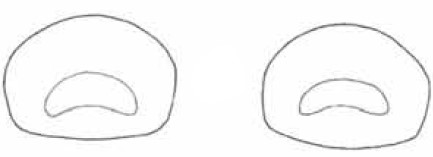
♂ apertureAperture occupies 0.3 times the width of the metasoma [T14]. Aperture small, oval, occupying 1/3 of metasoma width [T2][T6]. Apical aperture small, 2.3 - 3.0 times as wide as high [P3].
other info
distributionAT, DE [FE].
remarks
hosts