Chelonus elongatus
authorSzépligeti, 1898
synonyms
body
shapeLength: 5.5 mm. [S4]. ♀♂ (4.8-)5.5-6 mm [P7]. ♀♂ 6.0 - 7.0 mm [P1]. ♂ 6 mm [SZC]
colorBlack [S4].
head
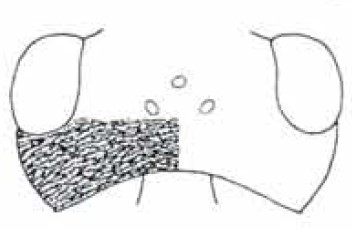
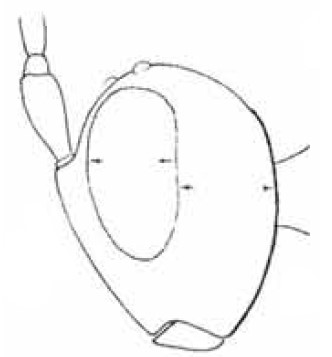
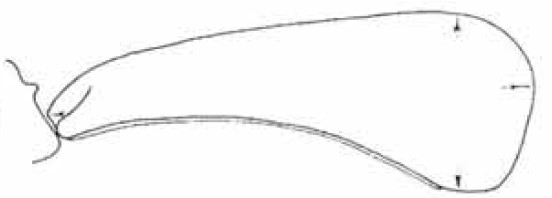
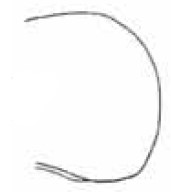
shapeHead is transversely wide and only slightly bulged at the back [S4]. Head in dorsal view (Fig. 1) transverse, 1.8 - 1.85 times as broad as long, eye somewhat longer than temple, temple rounded, occiput excavated. Ocelli small and round, OOL slightly longer than POL. Eye in lateral view almost twice as high as wide, temple beyond eye widening ventrally and slightly wider than eye (Fig. 2, see arrows). Malar space somewhat longer than basal width of mandible. Face 1.7 times as wide as high, inner margin of eyes parallel. Clypeus 1.5 times as wide below as high medially, its lower margin medially truncate [P7]. In dorsal view the head is 1.6 x as wide as high. The eyes are slightly longer than the temple, the temple is rounded. Ocelli are small and round, OOL is slightly longer than POL, and eyes are almost twice as long as wide when viewed from the side [Zh1][SZC].
sculptureClypeus punctured, both side margins indented; the face is wrinkled, the cheeks are striate-rugose, the vertex is imperfectly striate-rugose [S4]. Face rugose, clypeus densely and finely punctate. Vertex and occiput transversely rugoso-striate (Fig. 1), temple also rugoso-striate [P7]. Vertex and temples transversely striate [Zh1].
colorMandibles and palpi are red [S4]. Mandible and palpi brownish yellow [P7].
antenna
shape ♀The antennae have 33 segments [S4]. 32 segments [Ay1][Zh1]. Antenna with 29-32 segments. Female flagellum not filiform, i.e. medially more or less flattened [P1, key].
shape ♂Antenna as long as head, mesosoma and half of carapace, with 31 - 42 segments. First flagellomere 2.5 times and penultimate flagellomere subcubic, i.e. just longer than broad to 1.6 times as long as broad apically [P7][Zh1]. Antenna with 34-36 segments [P1, key]. 33 segments, 3rd segment 2.5 times as long as wide, penultimate segment subcubic, length1.6 times end width [SZC]
colorAntenna black, scape with faint brownish tint [P7].
mesosoma
shapePropodeal teeth blunt [S4]. Mesosoma in lateral view 1.7 times as long as high, transverse carina less distinct and ending laterally in a less large tubercle [P7]. Mesosoma length is 1.7 times height. Propodeum with transverse carina and tubercules on the side [Zh1][SZC].
sculptureMesosoma rugose [S4]. Mesosoma rugose to areolate-rugose, notaulix distinct by somewhat rougher sculpture. Scutellum with strong punctures, interspaces shiny. Propodeum areolate-rugose [P7]. Mesosoma reticulate-rugose, mesonotum with longitudinal groove, scutellum punctated, medially smooth and shiny. Propodeum reticulate-rugose [Zh1].
color
legs
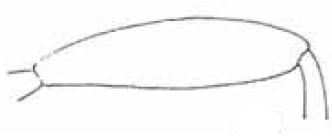
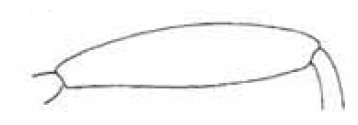
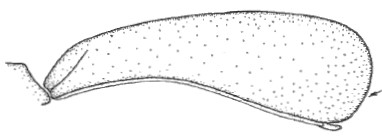
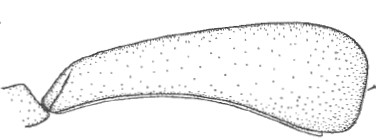
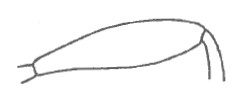
shape♂ Hind femur 3.8 - 4 times as long as broad medially. Inner spur of hind tibia half as long as basitarsus. Hind basitarsus as long as tarsomeres 2-4 combined. ♀ Hind femur 4.1 times as long as broad medially [P7]. Inner spur of hind tibia less than half as long as half basitarsus. Hind femur at least four times as long as broad, broadest at its middle (Fig. 13) [P1].
sculpture
colorFore femora completely, mid femora basal half red. Fore tibiae red, mid tibae red except for the tips. The middle of the hind tibiae is fairly white, the metatarsus is entirely white [S4]. Ground colour of legs brown to dark brown, coxae blackish to black, fore and middle femora + tibiae reddish yellow, middle femur + tibia apically darkening, hind tibia proximally and basitarsi 2-3 pale yellow; fore tarsus brownish yellow, middle and hind tarsi brownish [P7]. Hind femur black(ish) [P1].
wings
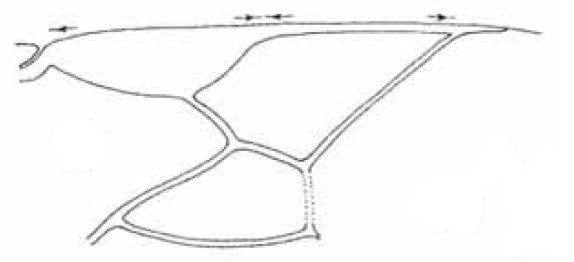
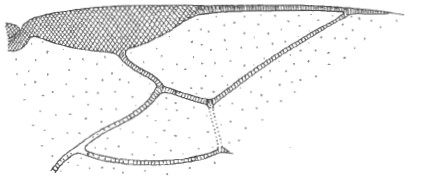
shapeSR1 is straight [S4]. Fore wing clearly one-third shorter than body. Pterostigma three times as long as wide and isuing r distally from its middle (♂) or from its middle (♀); 3-SR as long as r, 1-R1 a bit shorter than pterostigma (Fig. 4, see arrows) [P7]. 1-R1 as long as pterostigma, r as long as 3-SR (Fig. 12) [P1].
colorCosta and parastigma are yellow [S4]. Tegula blackish [P7]. Wings hyaline, pterostigma brown, veins yellowish to brownish [P7]. Wings usually hyaline [P1]. Tegula black [P1, key].
metasoma
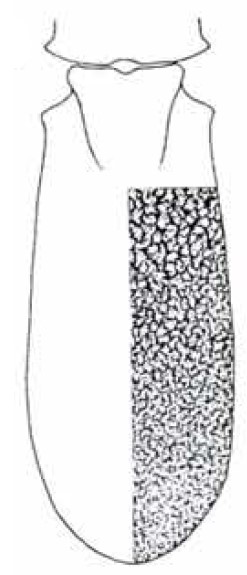
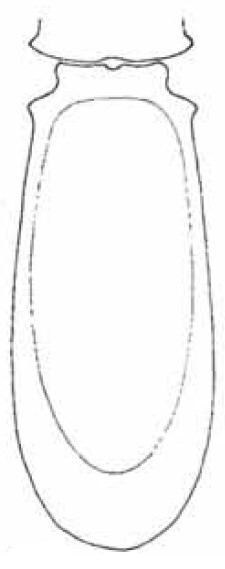
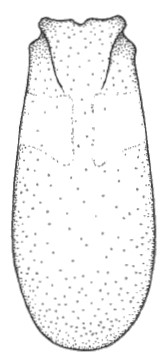
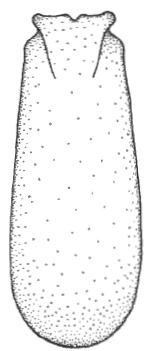
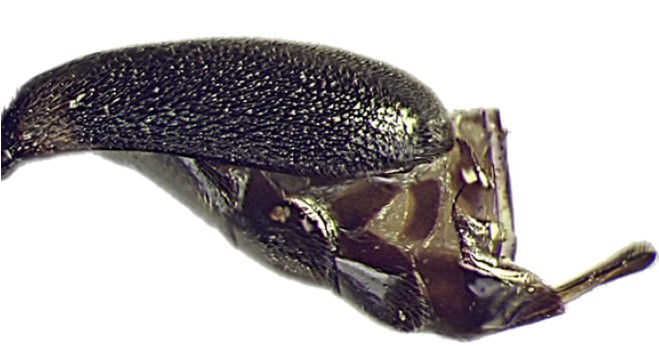
shapeThe metasoma is longer than the head and mesosoma, the sides parallel, the end rounded and thick, the carinae at the base are weak [S4]. Carapace in dorsal view (Fig. 5) 2.4 times as long as broad, almost paralallel-sided, apically rounded. Pair of basal carinae extending to anterior fifth of carapace. Carapace in lateral view 2.8 times as long as high behind, its hind end rather truncate and ventrally incurved (Fig. 6, see arrows). ♀ Carapace in lateral view behind somewhat less truncate. Aperture of carapace in ventral view nearly as long as carapace itself (Fig. 7). [P7]. The metasoma is quite long, the two sides are almost parallel, in dorsal view length is 2.4 times the maximum width, and in lateral view the length is 2.8 times its height; the apex is truncated in the lateral view and slightly curved inward [Zh1]. Metasoma not narrowed toward apex [Ay1]. Metasoma 3.5–4.5 times as long as high in apical third [Ay1, key]. Carapace more than 4.0 times longer than height of apical third in lateral view [FTR]. Carapace long, in dorsal view (Figs 14 and 15) 2.2-2.3 times (♀) and 2.3-2.45 times (♂) as long as broad posteriorly; in lateral view its hind end rounded (♀ Fig. 10) or truncate (♂ Fig. 11) [P1, key].
sculptureCarapace antero-posteriorly strongly rugose to rugose, weakly rugose (Fig. 5). The anterior half is roughly striate-rugose, the posterior is leathery [S4]. The base of the metasoma has coarse longitudinal grooves, the apical part is leathery-wrinkled [Te1]. Metasoma at apex slightly less sculptured than at base [Ay1].
colorThe two sides of the metasoma are red [S4]. Spots on both sides of the metasoma [Zh1]. ♂ Carapace with brownish tint, ♀ Carapace basally pale yellow [P7]. Lateral margins of metasoma red [Te1]. Carapace of female with a pair of basal yellow maculae, carapace of male entirely black [P1].
♀ ovipositorThe ovipositor sheath is short, hidden under the metasoma [Zh1].
♂ aperture
other info
distributionCH, DE, PL [FE].
remarksIs closest to Ch. carbonator Marsh, from which it differs by the red palpi, by the long, slender metasoma, as well as by its size [S4]. The two species, Ch. elongatus and Ch. zimini [(C. wesmaeli)], are very similar to each other. perhaps Ch. zimini will prove to be in the future only a light coloured variety of Ch. elongatus [P1].
hosts