shape6-7mm [Te1]. ♀♂: (3-)4-5 mm [P7][P1][T4]. ♀ ♂: 3-5 mm [P10]. 4.5mm [Zh1]. ♀♂ (3-)4.5-5.5 mm [P2]. 4.5 - 6.0 [T13].
colorBlack [Te1].
head
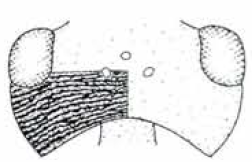
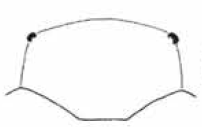
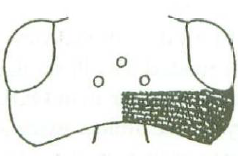
shapeThe head is transverse, not narrowed posteriorly. Malar space equal to half the longitudinal diameter of the eye; temples equal to the width of the eye. The ocelli are small [Te1]. Temple in dorsal view (Fig. 3) as long as or somewhat longer than eye, moderately rounded [P7]. The head retracts in an arc behind the compound eye. The middle of the front edge of the clypeus is truncated [Zh1]. Temple in dorsal view (Fig. 14) either as long as or somewhat longer than eye, occiput deeply excavated [P1]. Head roundly narrowed behind eyes, 1.1 - 1.2 times as wide as mesoscutum, 0.5 -0.55 times as long as wide. Temples equal or slightly shorter than the transverse diameter of the eye. [T13].
sculptureHead, except for the clypeus, roughly rugose-striated. Antennal scrobes are usually rugose, rarely smooth [Te1]. [Te1]. Temple striate [P7]. Vertex behind ocelli with more than 5 weak transverse rugae [Ay1]. Temples with very rough reticular rugae; frons and vertex with rough transverse rugae; the frons (scrobe?) is hardly sunken. The face rather roughly and irregular reticular-rugose; the clypeus is smooth and shiny [Zh1]. The face and vertex with coarse winding transverse rugae, the temples with slightly less coarse winding rugae [T13].
color
antenna
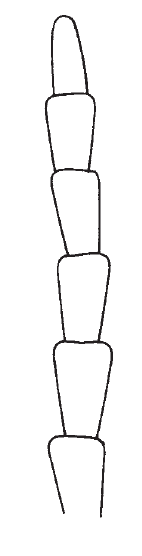
shape ♀Antennae filiform, slightly thinning towards apex, 24-segmented [Te1]. Antenna with 24-27(-30) segments [P7][P1]. Antennae 25-segmented, gradually thinning toward apex [T4]. Antenna with 23-26 segments [P10]. 24 segments, clearly thickened beyond the middle, and antennae become thinner at the end [Zh1]. Antennae slightly longer than head and mesosoma, thickened behind middle, 23-24 segments; length of 3rd segment 2.5 times as long as wide, length of segments in its thickened part slightly less than their width [T13].
shape ♂Longer and thinner than ♀, with 31 segments [Te1]. Antennae slender, not thickened beyond the middle, with 30 segments [Zh1]. Antenna with 23-31, usually with 26-28 segments [P1].
colorAntenna black [T4].
mesosoma
shapePropodeum on the sides with blunt teeth [Te1]. Propodeum with transverse ridge, denticles along sides weakly developed [T4]. Length of mesosoma 1.5 times its height. Propodeum with transverse carina and small flattened and rounded lateral teeth [T13]. Transverse carina of propodeum distinct, with 4 small teeth of which the middle are inconspicuous [Zh1].
sculptureMesonotum slightly rugose-punctate, shining. Notauli are poorly visible. The pre-scutellar groove is narrow, roughly crenate. Scutellum smooth, coarsely punctate at margins. The sides of the mesonotum and propodeum are not particularly coarsely rugose, punctate [Te1]. Mesonotum with softer sculpture, usually without conspicuous longitudinal rugae in front of scutellum (fig. 1) [T4][Ay1]. The pronotum with rugae, mesonotum with rough honeycomb-like wrinkles, shiny, roughly reticulate before scutellum. Propodeum roughly reticulate [Zh1].
color
legs
shapeLength of hind femur 3.5 - 3.8 times its width. Inner spur of back tibia equal to 0.5 length of metatars, 5th tarsus segment longer than 3rd but less than 2nd [T13].
sculpture
colorFore tibia entirely and hind tibia reddish yellow in the middle; spurs are white [Te1]. Hind femur black, at most with brownish tint [P7]. Usually greater part of legs black [Ay1]. The tibiae are red and yellow, the tips of the hind tibiae are black [Zh1]. The legs are mostly black, the tips of the femora are yellowish-red, the fore tibia is yellowish-brown, the middle tibiae are brown, the hind tibae are dark brown with a brown middle third. Tarsi brown; hind metatars yellowish [T13].
wings
shapeSm2 is clearly narrowed towards the outer edge. SR1 vein slightly curved, three times as long as 3-SR. 1-CU1 = 0.5 times 2-CU1 [Te1]. 1-R1 about as long as pterostigma (fig. 13) [P2]. Marginal cell 1.5-2 times larger than 2nd submarginal cell, 1-R1 equal to length of pterostigma. 3-SR a little to twice as long as r, 3-3.5 times shorter than SR1, 0.5-0.7 times as long as 2-SR [T13].
colorThe wings are light; stigma and tegulae are black [Te1]. Tegulae brown or black [T4]. Wings noticeably darkened; stigma brown; usually tegulae black [Ay1]. Wings darkened with brown veins, pale up to basal vein [T13].
metasoma
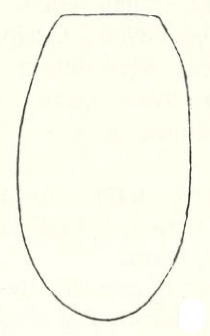
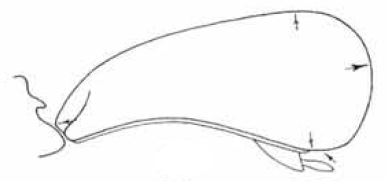
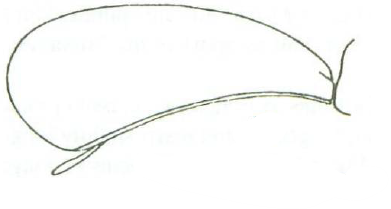
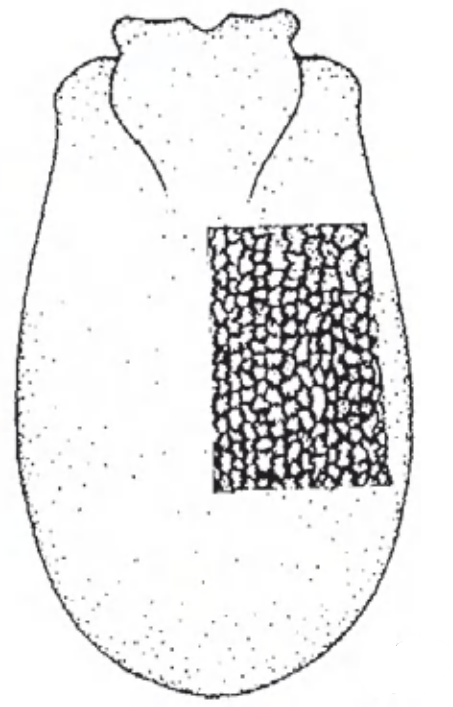
shapeMetasoma equal to length of head and mesosoma, oval, slightly rounded-narrowed at apex and rounded downward [Te1]. Carapace more incurved in lateral view and lower behind (Fig. 4, see arrows), less globose in dorsal view [P7]. Metasoma 2 times as long as its width in middle or slightly less (Fig. 2). Height of abdominal shield in apical third 1/3 to 2/5 length of metasoma [T4]. Metasoma 1.6–1.7 times as long as its width in middle [Ay1]. Carapace 2.4 times as long as high posteriorly (Fig. 10) [P10]. The ♀ metasoma is short and oval, in dorsal view the length is 1.6 - 1.7 times the width; in lateral view the apex is significantly higher than the base, and the length is twice the hight; the metasoma is apically bent inwards for about 1/5 of its length. ♂ metasoma longer, 1.9 - 2.0 times its width [Zh1]. Metasoma in dorsal view 1.7- 1.8x as long as broad medially (Fig. 12) [P2]. ♀ Carapace in lateral view high behind, more than twice as high posteriorly as basally (Fig. 15, see arrows) [P1]. Metasoma oval, 1.7–2 times as long as wide, 2.5–3 times as long as high [T13].
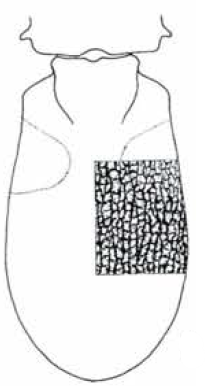
sculptureThe rugae at the base of the metasoma are clearly visible, but weak, the apex of the metasoma is slightly rugulose, shining [Te1]. Longitudinally rugose (Fig.5) [P7]. Metasoma apically densely sculptured, matt [T4]. Metasoma with sinuous and strongly anastomosed longitudinal rugae reaching its apical third [T13].
color♀ metasoma with yellow spots at base, ♂ completely black metasoma [Te1]. Carapace either black or with a pair of yellow basal spots [P10]. ♂ with small spots at the base of the metasoma [Zh1]. ♀ Pair of basal yellow maculae of carapace usually present, ♂ usually fully black or with faint to small yellow pair of spots basally [P1].
♀ ovipositorThe ovipositor is short, curved [Te1].
♂ aperture
other info
distributionNL [FE]
remarks
hosts
figures
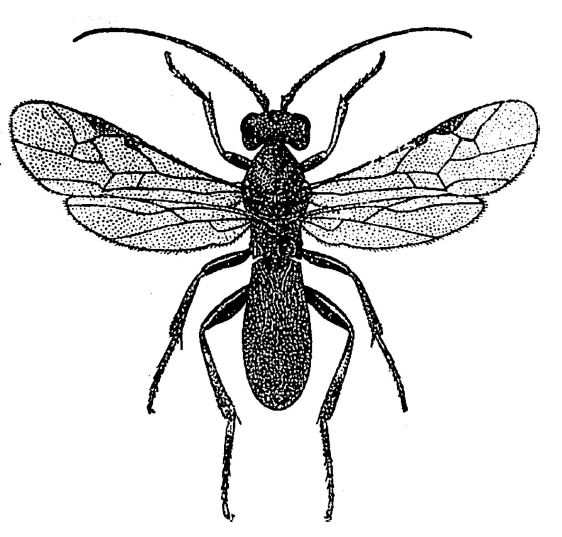
fig. 1: habitus (Tobias 1986)
fig. 2: metasoma, dorsal view (Tobias 1986)
fig. 3: head in dorsal view with indication of its sculpture (Papp 2003)
fig. 4: carapace in lateral view (Papp 2003)
fig. 5: carapace in dorsal view with indication of its sculpture (Papp 2003)
fig. 6: clypeus (Papp 2003)
fig. 7: antenna (Aydoğdu 2008)
fig. 8: habitus ♀ (Telenga 1941)
fig. 9: head in dorsal view (Papp 1993)
fig. 10: carapace in lateral view (Papp 1993)
fig. 11: ♀ carapace in lateral view (Papp 1997a)
fig. 12: ♀ carapace in dorsal view with indication of its sculpture (Papp 1997a)
fig. 13: distal part of right fore wing (Papp 1997a)
fig. 14: head in dorsal view (Papp 1995)
fig. 15: ♀ carapace in lateral view (Papp 1995)
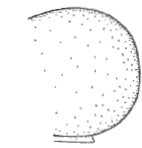
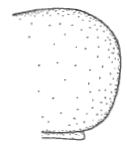
fig. 16: ♂ hind end of carapace in lateral view (Papp 1995)
fig. 17: ♂ hind end of carapace in lateral view (Papp 1995)
♀. Тело черное; брюшко в основании с желтыми пятнами, передние голени сплошь и задние посредине красновато-желтые; шпоры белые. Голова поперечная, кзади не суженная, кроме наличника грубо морщинисто-исчерченная. Усиковые ямки обычно морщинистые, редко гладкие. Щеки равны половине продольного диаметра глаза; виски равны ширине глаза. Глазки маленькие. Усики нитевидные, к вершине, слабо утончающиеся, 24-членикопые. Среднеспинка слабо морщинисто-пунктированная, блестящая. Парапснды слабо заметные. Предщитиковая бороздка узкая, грубо кренударованная. Щнтик гладкий, по краям грубо пунктированный. Бока груди и промежуточный сегмент не особенно грубо морщинистопунктированные, последний по бокам с тупыми зубцами. Брюшко равно длине головы и груди, овальное, на вершине слабо округло-суженное и книзу закругленное. Морщинки в основании брюшка ясно заметные, но слабые, вершина брюшка'слабо мелко морщинистая, блестящая. Яйцеклад короткий, изогнутый. Крылья светлые; стигма и крышечки крыльев черные. Вторая кубитальная ячейка к наружному краю ясно суженная. 3. отрезок радиальной жилки слабо изогнутый, в три раза длиннее 2. отрезка. Поперечная субмедиальная жилка постфуркальная, отделяет 1/3 часть основания 1. днскоидальной ячейки. ♂ похож на самку, но отличается сплошьчерныы брюшком, более длинными тонкими, 31-членнковымн усйкамн. б—7 мм.
От Ch, annulatus Nees легко отличается формой брюшка и меньшим количеством члеников усика, от СЙ. carbonafor Marsh. окраской брюшка и более грубо морщинистой среднеспинкой.
Распространение. СССР: вост. Сибирь: Забайкалье, оэ. Барун-Торей,-устье р. Ульзы, 29 VI1925 (Виноградов); Монголия: Гоби, Джаргаланта-булык, 19 VII1926 (Козлов); сев. Гоби, р. Онгиин-гол, 20 VIII 1926 (Козлов); долина реки Толы, Халха, 10 VII1926 (Козлов); р. Сугу-нур, верховья Хара-гола, Кентэй 9 VII1924 (Козлов).
Data used in the multi-access key
These data are collected from the species descriptions and redescriptions, from published figures and photographs and from own measureements and observations. For a description of the different variables and value classes see this pdf.
morphology
basic information
female
male
body length (mm):
(3.2) 3.2 - 5 (5.6)
(3.2) 3.2 - 5 (5.6)
number of antennal segments:
(22) 22 - 27 (30)
(23) 23 - 28 (30)
head, dorsal view
Head width : length
narrow, wide
narrow, wide
Temples narrowing - widening
parallel
parallel
Eye length : temple length
0.75 - 1.0, 1.0 - 1.25, > 1.25
0.75 - 1.0, 1.0 - 1.25, > 1.25
Roundness temple
medium, weak
medium, weak
POL : OD
3 - 4
3 - 4
Ocellar triangle shape
narrow
narrow
Excavation of head
15 - 25%, 25 - 35%
15 - 25%, 25 - 35%
head, lateral view
Head height : length
---
---
Eye height : length
---
---
Temple length : eye length
very short, short
very short, short
head, frontal view
Head width : height
---
---
Face width : height
---
---
Eyes converging ventrally
---
---
EH : MSL
short
short
Clypeus width : height
---
---
Clypeus extending above bottom of eyes
---
---
Tentorial pits
---
---
Shape of lower margin clypeus
truncate
truncate
antennae
Antennal shape
filiform, not widened, slightly widened, clearly widened
filiform, not widened
Segment 3 length : width
short, medium
---
Penultimate segment length : width
---
---
Length of antenna : length of body
---
---
mesosoma, lateral view
Length : height
medium
medium
transverse carina
present, well developed
present, well developed
lateral teeth
weak, small, short
weak, small, short
mesosoma, ventral view
Prepectal carina lamelliform
indistinct
indistinct
legs
Hind femur length : width ratio
medium, long
medium, long
Hind tibia length : hind tarsus length ratio
---
---
Hind tibia (longest) spur length : metatars length ratio
long
long
wings
Vein 1-R1 length : pterostigma length
long
long
Vein r length : vein 3-SR length
short
short
Shape vein SR1 (straight / concave / convex)
concave, slightly concave
concave, slightly concave
S-shape vein SR1
not S-shaped
not S-shaped, apically convex
cell M : cell Sm2
Sm2 large, Sm2 medium
Sm2 large, Sm2 medium
Pterostigma length : width ratio
medium, long
medium, long
Angle between radial vein (r) : vein 1-R1
sharp
sharp
metasoma, dorsal view
Length : width ratio of metasoma
short, medium
short, medium
Shape of metasoma
widest in middle, widest towards apex
widest in middle, widest towards apex
metasoma, lateral view
Length : height ratio of metasoma
short, medium
short, medium
posterior : anterior height ratio of metasoma
medium, large
medium, large
Position of maximum height
medium-posterior, posterior
medium-posterior, posterior
metasoma, ventral view
Metasoma posteriorly curved forwards
(distinctly) incurved
(distinctly) incurved
male apical aperture
Aperture width : metasoma width
no aperture
no aperture
Aperture shape
n. a.
n. a.
Median process shape
n. a.
n. a.
sculpture
head
general coarseness
coarse
coarse
clypeus
coarseness punctation
smooth to uneven
smooth to uneven
density punctation
---
---
face
sculpture type
rugose, reticulate
rugose, reticulate
sculpture direction
irregular, transverse
irregular, transverse
vertex and temple
sculpture type
striate-rugulose
striate-rugulose
mesonotum
sculpture type
notauli slightly distinct
notauli slightly distinct
scutellum
middle
smooth
smooth
lateral
---
---
metasoma
base - mid sculpture
longitudinally rugose / rugose-striate
longitudinally rugose / rugose-striate
sculpture at apex
rugulose, smooth
rugulose, smooth
coarse / fine boundary
mid (50 - 70%)
mid (50 - 70%)
color
head
mandibles color pattern
---
---
palpi, lightest color
---
---
antennae
scapus, lightest color
black, dark brown
black, dark brown
segment 3 and 4, lightest color
black, dark brown
black, dark brown
legs
fore coxae lightest colour
dark
dark
fore femur lightest colour
medium dark, medium light
medium dark, medium light
fore femur color pattern
tip light
tip light
hind femur lightest colour
dark
dark
hind femur color pattern
entirely dark
entirely dark
hind tibia lightest colour
medium light
medium light
hind tibia color pattern
narrow light ring
narrow light ring
hind basitarsus lightest colour
medium light
medium light
hind tarsus segment 2-3 lightest colour
medium dark
medium dark
wings
middle veins lightest colour
medium dark
medium dark
basal veins lightest colour
medium light
medium light
metasoma
metasoma colour pattern
entirely dark, color only on basal third
entirely dark, color only on basal third
metasoma lightest colour
dark, light
dark, light
metasoma base, colour pattern
entirely dark, 1, 2 or 4 spots
entirely dark, 1, 2 or 4 spots
metasoma base, light spots
n.a., 2 small spots
n.a., 2 small spots
metasoma base, light band
n.a.
n.a.
Chelonus cesa in published keys
T4: Tobias, 1986
Key to the Insects of the European Part of the USSR Volume III. Hymenoptera. Part four. Chapter 16
P7: Papp 2003b
Revision of Szépligeti's Chelonus s. str. species described from Hungary (Hymenoptera: Braconidae: Cheloninae).
P2: Papp, 1997a
Revision of the Chelonus s. str. species described by C. G. Thomson (Hymenoptera: Braconidae, Cheloninae)
Ay1: Aydogdu 2008
A new species of the genus Chelonus Panzer, 1806 (Hymenoptera: Braconidae: Cheloninae) from Western Anatolia (Turkey).
P1: Papp, 1995
Revision of C. Wesmael’s Chelonus species (Hymenoptera, Braconidae, Cheloninae).