Chelonus carbonator
authorMarshall, 1885
synonyms
body
shape♂ ♀ Length, 1 3/4 - 2 li (3.9 - 4.5 mm) [M], ♀: 4.5-5, ♂: 4.8-5(-5.2) mm [P2][P1]. 4 - 5mm [Te1].
colorBlack [M].
head
shapeVertex transverse, narrowed behind the eyes, cheeks not dilated; frontal fovea deep, geminated. The punctiform tentorial pits very small [M]. The face is twice as wide as the height; malar space 0.5 times the longitudinal diameter of the head; temples slightly less than the width of the eye. The ocelli are small; the distance between them and the eyes is 4 times the diameter of the ocellus [Te1].
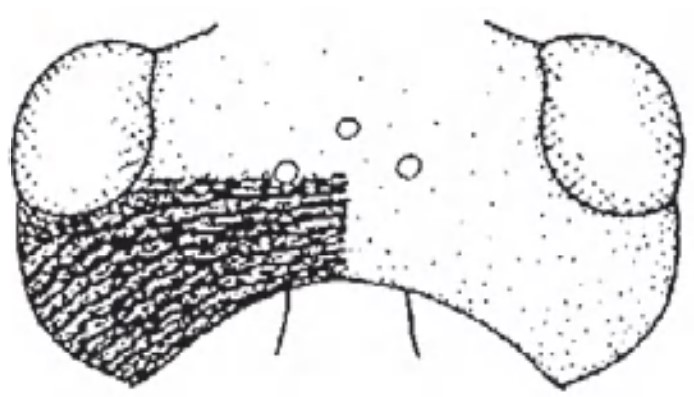
sculptureHead rather shining, finely and irregularly rugulose, reticulated, partly striato-rugulose, beset with pale hairs, especially on the face, which is also tranversely striated; clypeus shining, densely punctulate, discrete. Frontal fovea shining [M]. Temple and vertex transversely striated and at most with a few anastomosis (Fig. 4) [P2]. Temples reticulate-rugose, vertex transverse rugose [Zh1]. Antennal fossae on the forehead smooth, shiny, separated by a longitudinal carina [Te1].
colorpalpi blackish ; tips of mandibles yellow-brown [M].
antenna
shape ♀Antennae with 28 - 33 segments, widened for about 2/3 of their length, afterwards slightly and gradually decreasing [M]. Antenna with (27) 29-33 segments, penultimate 3-4 segments 1.2 - 1.4x as long as broad [P2][P1]. Antennae equal to body length, slender, not compressed behind the middle, 28-33-segmented [Te1].
shape ♂Antennae ♂ as long as the body, 33-34 segments [M]. Antenna with 29-34 segments, penultimate 3-4 segments 1.6-2x as long as broad [P2][P1]. 33-34-segmented in ♂ [Te1].
colorAntennae black [S4].
mesosoma
shapePost-scutellum not dentiform. Propodeum short, very transverse, quadridenticulate, shining, with traces of a medial carina [M]. Propodeum with a clear transverse carina, and 4 teeth [Zh1]. Propodeum with a transverse ridge in the middle, with 2 teeth on the sides [Te1].
sculptureMesonotum shining, uneven, with coarse irregular scattered punctures in front, striated and subreticulated towards the scutellum, which is shining and sparingly punctulate. Propodeum coarsely reticulated [M]. Scutellum is slightly convex, smooth and shiny [Zh1]. Mesoscutum weakly but densely rugose-punctate. Notauli are poorly visible. Scutellum smooth in middle, rugose along margins. The sides of the mesosoma and the propodeum are roughly rugose [Te1]. Mesonotum roughly rugose in front of scutellum, significantly different from somewhat smoothed sculpture on its anterior and lateral parts [T13].
color
legs
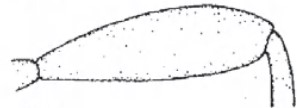
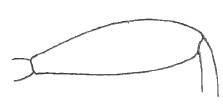
shape Hind femur 3.3-3.4x as long as broad (Fig. 1) [P2][P1]. Hind tibia spurs equal to 1/2 metatarsus length [Te1].
sculptureHind coxae rugose [Te1].
colorFore femora except the base, fore tibiae entirely, mid femora at the extreme apex, yellow-brown; 4 posterior tibiae dull yellow-brown, broadly blackish at the apex and darkish near the base, or the hind tibiae black with a yellow-brownish ring; tarsi blackish, the 4 anterior reddish at the base [M].
wings
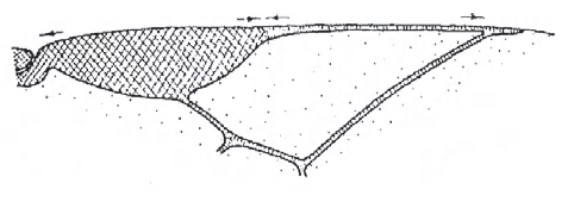
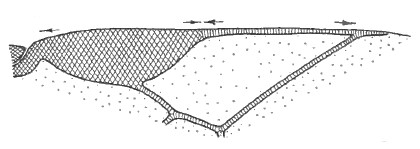
shapeMarginal cell short, broader than the stigma; SR1 curved; radius of the hind wings sinuated. wings, 3-3 1/2 lin. (6.9 - 7.8 mm) [M]. 1-R1 about as long as pterostigma and at most slightly shorter (Fig. 8, see arrows) [P2][P1]. r usually nearly as long as 3-SR [P1]. r is noticeably shorter than 3-SR and is equal to r-m; SR1 curved, three times as long as 3-SR. 1-R1 is equal to the length of the pterostigma. cu-a is postfurcal, ♀: 1-CU1 = 0.33 x 2-CU1 [Te1].
colorFore wings infumated, darker in the ♀ with a curved whitish streak behind the pterostigma; hind wings nearly transparent ; tegulae black; pterostigma, costa, and veins dark, only the parastigma and M+CU1 yellow-brown [M]. The wings are slightly smoky; the pterostigma is brown; tegulae are black [Te1].
metasoma
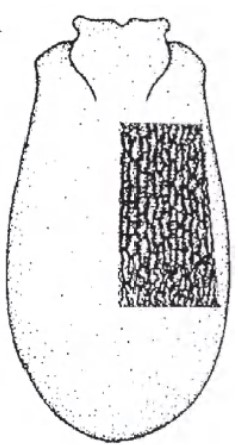
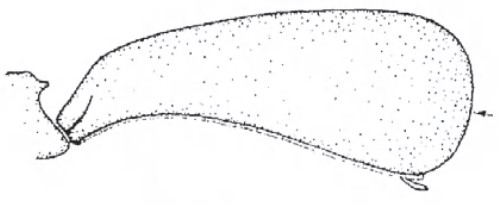
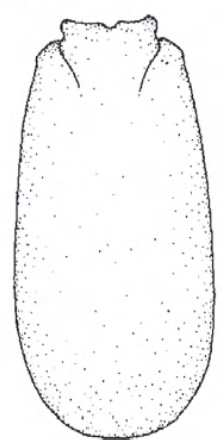
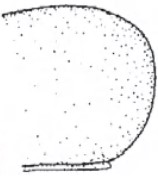
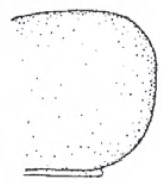
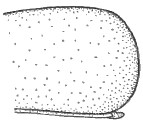
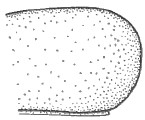
shapeMetasoma as long as the head and mesosoma, without basal carinae, depresso-cylindrical. Metasoma ♂ obtuse, of the ♀ ovate, less bluntly rounded behind [M]. Carapace in lateral view (Figs. 3, 6, 7) posteriorly more or less rounded; in dorsal view (Figs. 2, 5) 2x (♀) or 2-2.2x (♂) as long as posteriorly broad [P2]. The metasoma is equal to the length of the head and mesosoma taken together [Te1]. Carapace (♀♂) in lateral view (Fig. 9, 10) more or less rounded behind [P1]. Metasoma 1.9–2.0 times as long as wide [T13].
sculptureDull, pubescent at the apex, reticulated and striato-rugose at the base, the striae becoming shorter and finer posteriorly, leaving the apex punctulate and somewhat shining [M]. Metasoma completely irregularly wrinkled, without sharp longitudinal rugae [Te1].
colorMetasoma immaculate [M]. Completely black [T13].
♀ ovipositorovipositor hidden [M]. The ovipositor is straight [Te1].
♂ apertureNo aperture [M].
other info
distributionAT, CH, DE, CZ, GB, NL, PL [FE].
remarksCh. humilis and Ch. carbonator, are very similar to each other. In the future, probably, the two forms will be unified into one species being variable in several respects. - The main difference between Ch. carbonator / Ch. humilis and Ch. cylindrus is restricted to their colour [P1]
hostsCrambus luteelus; Cydia janthinana; Laspeyresia cacoecia; Laspeyresia janthinana; Spodoptera mauritia; Pachynematus scutellatus; Spodoptera litura; Tortrix diversanas Christaphora Shenefelt, 1973) [Zh1].