shape6-7 mill (3.6 - 4.2mm?) [Th]. Body length ♀ 4.5 - 4.6 mm, ♂ 4.1 mm [P2]. 4.5mm [Zh1]. 6-7 mm [Te1][M2].
colorGround colour of body black [P2].
head
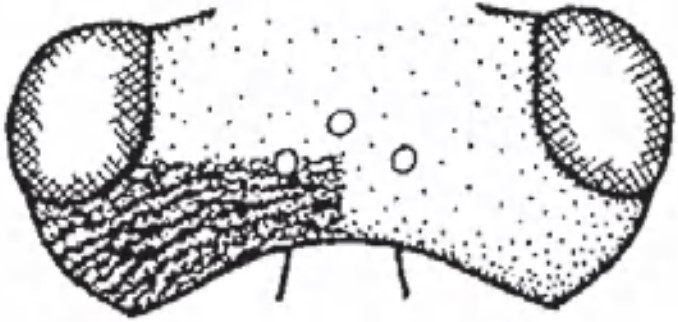
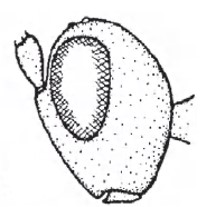
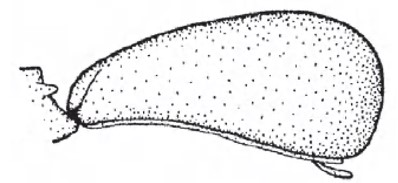
shapeHead behind eyes somewhat narrowed, not bulging [Th]. Head in dorsal view (Fig. 1) transverse, 2.0-2.2x as broad as long, eye almost 2x as long as temple, latter constricted. Ocelli small, round, far from each other, distance between fore and hind ocelli longer than diameter of hind ocellus, POL : OD : OOL as 15 : 6 : 18. Eye in lateral view 1.53x as high as wide, temple as wide as eye (Fig. 2). Malar space unusually long, 2x as long as basal width of mandible. Face slightly more than 2x as wide as high, inner margin of eyes parallel. Clypeus less wide than face, 1.8x as wide as high; distance between tentorial pits about as long as distance between pit and lowest point of eye [P2].
sculptureFace rather semicircularly rugose, head dorsally and temple strio-rugose (Fig. 1). Clypeus with very fine and disperse punctation, interspaces smooth and glistening [P2].
colorPalpi blackish brown [P2].
antenna
shape ♀Antenna with 22 segments, widened beyond middle [Th][Te1]. ♀ 22 segments, about as long as head + mesosoma + basal 1/4 of carapace. Third segment 3.66x as long as apically broad; further segments increasingly slender and shorter so that penultimate segment is subcubic, i. e., 1.25x as long as broad [P2]. 23 segments [Zh1].
shape ♂♂ Antenna 3/4 as long as body, with 24 segments [P2]. 24 segments [Zh1].
color
mesosoma
shapeMesosoma in lateral view 1.35x as long as high. Notaulix distinct. Median pair of tubercules hardly distinct, lateral pair of tubercules strong [P2]. Transverse carina of propodeum distinct, no teeth in middle, large lateral teeth [Zh1].
sculptureMesonotum strongly punctate, Scutellum subopace-rugose [Th]. Mesosoma areolate-rugose to rugose (mesonotum + scutellum) [P2]. Scutellum clearly punctated [H2]. Scutellum with longitudinal grooves, medially finely rugulose, smooth and shiny [Zh1]. Mesonotum coarsely punctured; the sides of the mesosoma are weaker and more irregularly punctured. Scutellum slightly convex, rugose, matt. The propodeum is coarsely reticulate-rugose [Te1].
color
legs
shapeHind femur 3.5x as long as medially broad; pair of spurs of hind tibia unequal in length, inner spur longer than 0.5x basitarsus. Hind tarsus slightly shorter than hind tibia, hind basitarsus as long as tarsomeres 2-3 + 0.5 tarsomere 4 [P2].
sculpture
colorLegs blackish brown; fore femur distally, middle femur apically and tibiae 1- 3 yellow, hind tibia basally and apically together with tarsi 1-3 brownish or blackish [P2]. Apex of fore femora, fore tibia entirely and middle of hind tibia reddish [Te1].
wings
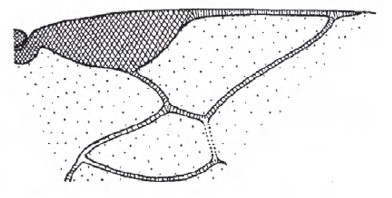
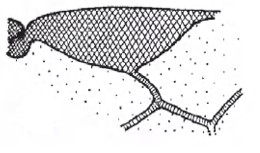
shapeFore wing 1/6 shorter than body. Pterostigma (Fig. 7) 2.5-2.7x as long as wide, issuing radial vein distally from its middle, R1 somewhat longer than pterostigma; 1-R1 as long as pterostigma, r arched and somewhat shorter than 3-SR, SR1 weakly S-formed and ending far before tip of wing [P2]. vein r and SR1 slightly curved [Zh1]. The radial cell of the fore wing is larger than the stigma [Te1].
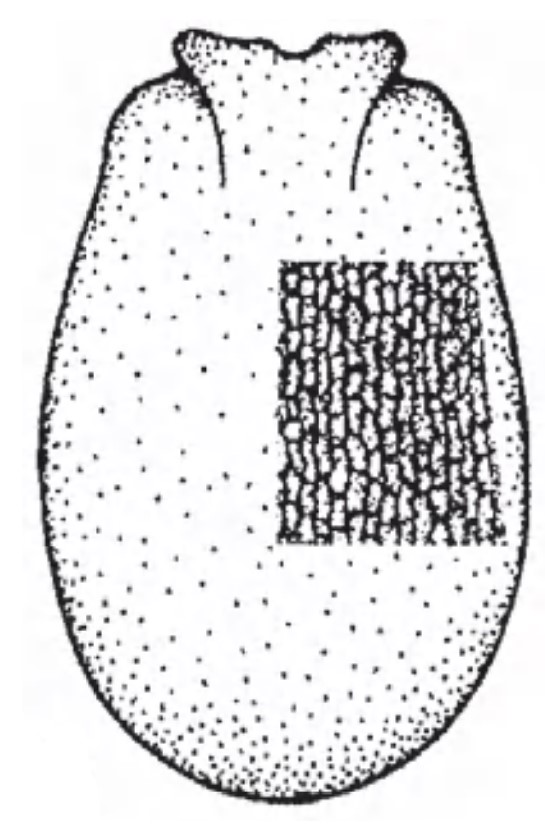
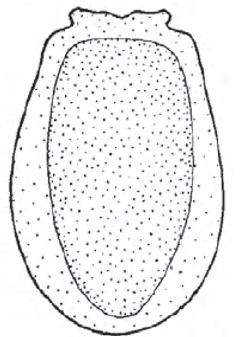
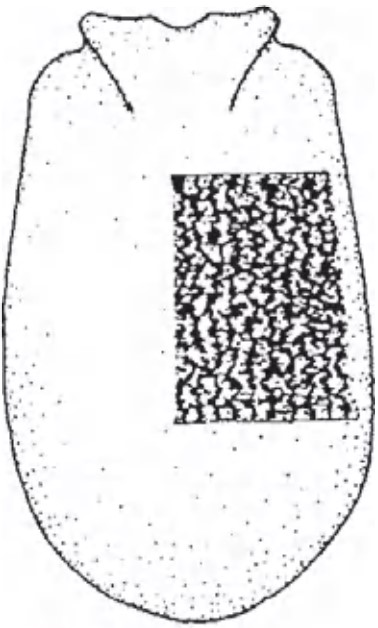
shapeMetasoma short, obovate, with long basal carinae [Th]. Carapace somewhat bellied in dorsal view (Fig. 4), 1.5-1.7x as long as medially broad; in lateral view (Fig. 5) 2.1x as long as posterior height; in ventral view (Fig. 6) apically just incurved, i. e. ventral opening just shorter than carapace itself [P2]. Metasoma length is 1.5 x width. Metasoma somewhat curved inwards [Zh1]. Metasoma with two long carinae at the base [Te1].
sculptureBase rimose-rugose [Th]. Carapace longitudinally strio-rugose with anastomosis (Fig. 4), posterior declivious part rugose-subrugose, interspaces subrugulose to uneven. ♂ Carapace with less striate elements (Fig. 9) [P2]. Up to ¾ strongly striate [H2]. The basal half has rough longitudinal wrinkles and the apical half has rough net-like wrinkles [Zh1]. Metasoma rugose-striated [Te1].
colorMetasoma immaculate [Th]. Carapace usually entirely black, sometimes with a pair of yellow maculae with variable extent. Carapace anteriorly with or without rusty tint [P2]. Completely black [H2].
♀ ovipositorOvipositor sheath short [P2].
♂ aperture
other info
distributionAT, SE [FE].
remarks
hosts
figures
fig. 1: Head in dorsal view (Papp 1997a)
fig. 2: Head in lateral view (Papp 1997a)
fig. 3: Distal part of right fore wing of holotype (Papp 1997a)
fig. 4: Female carapace in dorsal view with indication of its sculpture (Papp 1997a)
fig. 5: Carapace in lateral view (Papp 1997a)
fig. 6: Carapace in ventral view (Papp 1997a)
fig. 7: Distal part of male right fore wing (Papp 1997a)
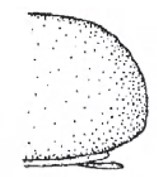
fig. 8: Hind end of male carapace in lateral view (Papp 1997a)
fig. 9: male carapace in dorsal view with indication of its sculpture (Papp 1997a)
6. C. breviventris n. sp: Niger, genis haud buccatis, rugosis, genubus anterioribus, tibiis posticis medio late, anterioribus totis testaceis, abdomine obovato-rotundato. Long 6—7 mill.
Species capite pone oculos subangustato, genis rugosis, haud buccatis, mesonoto fortiter punctato, mesosterno subumbilicato-punctato, abdomine brevi, obovato, immaculato, basi rimoso-rugoso, carinis sat longis, antennis 22-articulatis, supra medium sat dilatatis, scutello disco subconvexo subopaco-rugoso, alis superioribus praestigmate fusco, cellula radiali sat longa, appendice brevi; mas abdomine brevi, ano haud longe inflexo ab affinibus discedens.
Sällsynt i Småland och Skåne.
Data used in the multi-access key
These data are collected from the species descriptions and redescriptions, from published figures and photographs and from own measureements and observations. For a description of the different variables and value classes see this pdf.
morphology
basic information
female
male
body length (mm):
(3.9) 3.9 - 4.6 (4.8)
(3.9) 3.9 - 4.6 (4.8)
number of antennal segments:
(21) 21 - 23 (24)
(23) 23 (25)
head, dorsal view
Head width : length
very wide
very wide
Temples narrowing - widening
strongly narrowing, narrowing
strongly narrowing, narrowing
Eye length : temple length
> 1.25
> 1.25
Roundness temple
weak
weak
POL : OD
2 - 3, 3 - 4
2 - 3, 3 - 4
Ocellar triangle shape
wide
wide
Excavation of head
15 - 25%
15 - 25%
head, lateral view
Head height : length
short
short
Eye height : length
very short
very short
Temple length : eye length
short
short
head, frontal view
Head width : height
---
---
Face width : height
wide
wide
Eyes converging ventrally
about parallel
about parallel
EH : MSL
---
---
Clypeus width : height
semicircular, transverse
semicircular, transverse
Clypeus extending above bottom of eyes
---
---
Tentorial pits
very small, small
very small, small
Shape of lower margin clypeus
---
---
antennae
Antennal shape
clearly widened
filiform, not widened
Segment 3 length : width
medium, long
---
Penultimate segment length : width
short, medium
---
Length of antenna : length of body
2: short, 3: long
3: long
mesosoma, lateral view
Length : height
short, medium
short, medium
transverse carina
well developed
well developed
lateral teeth
well developed
well developed
mesosoma, ventral view
Prepectal carina lamelliform
indistinct
indistinct
legs
Hind femur length : width ratio
medium
medium
Hind tibia length : hind tarsus length ratio
medium, long
medium, long
Hind tibia (longest) spur length : metatars length ratio
long
long
wings
Vein 1-R1 length : pterostigma length
long
long
Vein r length : vein 3-SR length
short
short
Shape vein SR1 (straight / concave / convex)
slightly concave
slightly concave
S-shape vein SR1
apically convex
not S-shaped
cell M : cell Sm2
Sm2 medium
Sm2 medium
Pterostigma length : width ratio
short, medium
short, medium
Angle between radial vein (r) : vein 1-R1
sharp
sharp
metasoma, dorsal view
Length : width ratio of metasoma
short
short
Shape of metasoma
widest towards apex
widest towards apex
metasoma, lateral view
Length : height ratio of metasoma
short
short
posterior : anterior height ratio of metasoma
medium, large
medium, large
Position of maximum height
medium-posterior
medium-posterior
metasoma, ventral view
Metasoma posteriorly curved forwards
just/slightly incurved
just/slightly incurved
male apical aperture
Aperture width : metasoma width
no aperture
no aperture
Aperture shape
n. a.
n. a.
Median process shape
n. a.
n. a.
sculpture
head
general coarseness
medium, coarse
medium, coarse
clypeus
coarseness punctation
punctulate
punctulate
density punctation
---
---
face
sculpture type
rugose
rugose
sculpture direction
diagonal/concentric
diagonal/concentric
vertex and temple
sculpture type
striate-rugulose
striate-rugulose
mesonotum
sculpture type
notauli indistinct
notauli indistinct
scutellum
middle
smooth, rugulose
smooth, rugulose
lateral
rugose / striate
rugose / striate
metasoma
base - mid sculpture
(sulcate) / striate, striate-rugose
(sulcate) / striate, striate-rugose
sculpture at apex
rugose, rugulose, smooth
rugose, rugulose, smooth
coarse / fine boundary
mid (50 - 70%)
mid (50 - 70%)
color
head
mandibles color pattern
---
---
palpi, lightest color
black, dark brown
black, dark brown
antennae
scapus, lightest color
black, dark brown
black, dark brown
segment 3 and 4, lightest color
black, dark brown
black, dark brown
legs
fore coxae lightest colour
dark
dark
fore femur lightest colour
medium light, light
medium light, light
fore femur color pattern
tip light
tip light
hind femur lightest colour
dark
dark
hind femur color pattern
entirely dark
entirely dark
hind tibia lightest colour
medium light, light
medium light, light
hind tibia color pattern
narrow light ring, wide light ring
narrow light ring, wide light ring
hind basitarsus lightest colour
dark, medium dark
dark, medium dark
hind tarsus segment 2-3 lightest colour
dark, medium dark
dark, medium dark
wings
middle veins lightest colour
medium dark, medium light
medium dark, medium light
basal veins lightest colour
light
light
metasoma
metasoma colour pattern
entirely dark, color only on basal third
metasoma lightest colour
dark, light
dark, light
metasoma base, colour pattern
entirely dark, 1, 2 or 4 spots
entirely dark, 1, 2 or 4 spots
metasoma base, light spots
n.a., 2 small spots
n.a., 2 small spots
metasoma base, light band
n.a.
n.a.
Chelonus breviventris in published keys
P2: Papp, 1997a
Revision of the Chelonus s. str. species described by C. G. Thomson (Hymenoptera: Braconidae, Cheloninae)