shape4 mm [S2][Te1]. 3.8 - 4.4 mm [P7]. 3 - 4.8 [P2], ♂ 4.5-5 mm, ♀ 5 mm [P1]. 3 - 4 [T4]. 5.0 [T13]. 3mm (variation)[S3]. 4.8mm [Zh1].
colorblack and shiny, rugulose [S2].
head
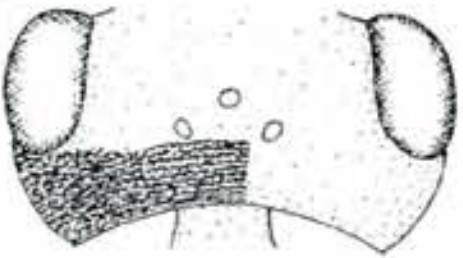
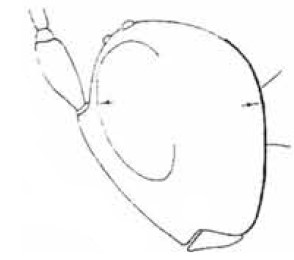
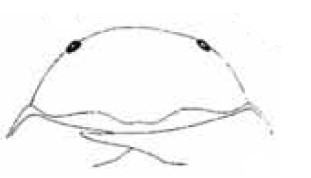
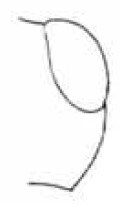
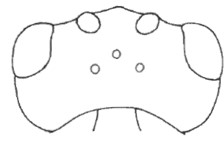
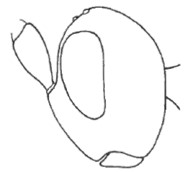
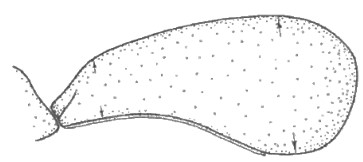
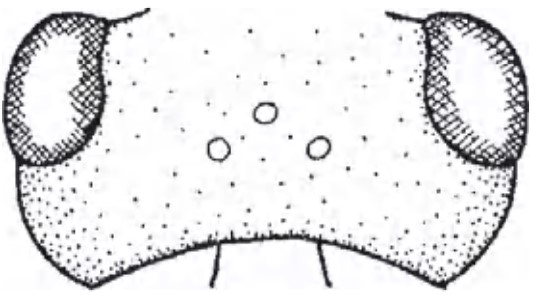
shapeHead in dorsal view (Fig. 1) transverse, 1.85 times as broad as long, eye 1.3 - 1.6 times as long as temple, temple receded, occiput excavated. Ocelli small, round, OOL one-fourth longer than POL. Eye in lateral view twice as high as wide, temple beyond eye wider than eye (Fig. 2, see arrows). Malar space just longer than basal width of mandible. Face twice as wide as high, inner margin of eyes just converging. Clypeus 2.2 times as wide below as high medially, its lower margin medially slightly excised (Fig. 3) [P7]. Head in dorsal view 1.9x as broad as long [P2]. Head transverse, roundly narrowed behind eyes. vertex is uniformly raised, frons sunken [Zh1].
sculptureFace rugose, clypeus fairly densely punctate: interspaces about as long as punctures. Vertex and occiput[?] rugose-striate (Fig. 1), temple rather rugose [P7]. Temples roughly reticulate-rugose, vertex with interlaced horizontal rugae; frons with rough rugae; face roughly reticulate-rugose; clypeus with white pubescence and with very fine punctures, smooth and shiny [Zh1].
colorPalpi dark brown. Mandible yellow, apically blackish [P7].
antenna
shape ♀22-segments [S2]. Antenna as long as head and mesosoma combined and with 22 segments. Third antennal segment clearly twice as long as apically broad, flagellum distally slightly thickening and penultimate segment transverse [P7]. Antennae 20-22-membered [Te1]. 22-24 segements, slightly thicker from the middle, and thinner at the ends [Zh1].
shape ♂28-32 segments [P1]. (male unknown [P7]!)
colorScape black with faint brownish tint, flagellum black [P7].
mesosoma
shapeMesosoma in lateral view 1.5 times as long as high [P7]. Propodeum with transverse carina and distinct lateral teeth [Zh1]. Propodeum with a strong transverse carina ending laterally in a pair of small teeth [P7].
sculptureScutellum only in center smooth and shiny [S2]. rugose, mesonotum rugulose with rugose elements, notauli indicated by somewhat rougher sculpture. Scutellum anteriorly almost smooth, posteriorly roughened. Propodeum areolate-rugose [P7]. The scutellum is smooth in the middle [Te1]. Mesonotum densely punctate, matt [T4]. Scutellum rugose [T13]. Pronotum rugose. Mesonotum shiny, reticulate-rugulose, reticulate-rugose before scutellum. Pre-scutellar sulcus is shallow, roughly reticulate. Propodeum roughly reticulate-rugose [Zh1].
color
legs
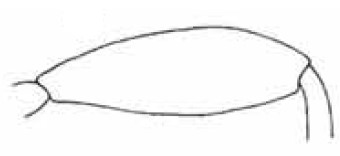
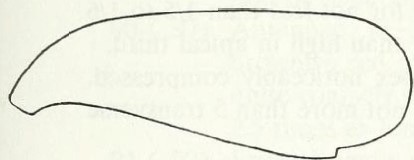
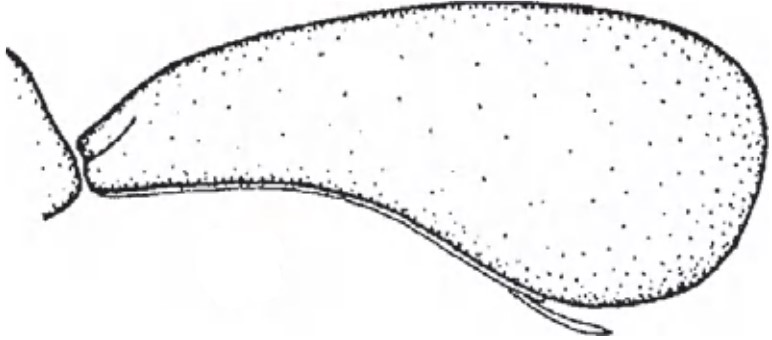
shapeHind femur 3.1 times as long as broad just distally from its middle (Fig. 4). Inner spur of hind leg shorter than half basitarsus. Hind basitarsus as long as tarsomeres 2-4 combined [P7].
sculpture
colorHind femur completely black, middle of tibiae is white, the metatars more or less red [S2]. Legs black with brownish tint; femora apically, tibiae 1-2 and every basitarsi brownish yellow, hind tibia brownish black with a proximal yellow ring, tarsi brownish to brown [P7]. The legs are black; tibiae white in the middle; the metatars is reddish [Te1].
wings
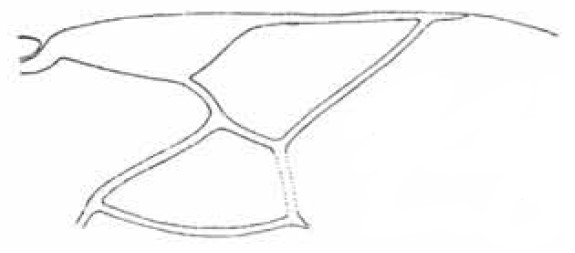
shapeFore wing one-third shorter than body. Pterostigma (Fig. 5) 3.3 times as long as wide, issuing radial vein distally from its middle; 3-SR one-fifth longer than r, metacarp or 1-R1 one-fourth shorter than pterostigma [P7]. SR1 straight [Te1].
colorTegula black. Wings subfumous, pterostigma brown, veins light brown to brown, [meta?]carpal vein yellow [P7]. The wings are slightly smoky; [Te1]. Tegulae blackish-brown [S3]. Pterostigma and apical veins are dark brown. Basal veins are yellowish brown [Zh1].
metasoma
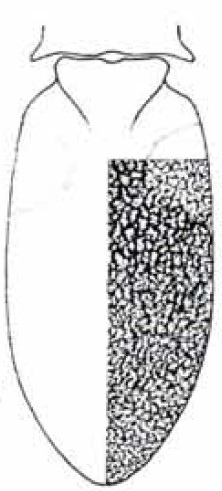
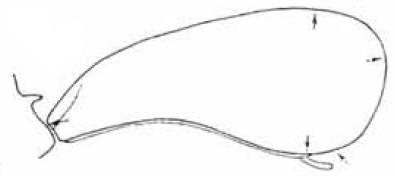
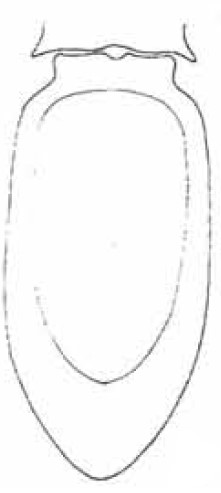
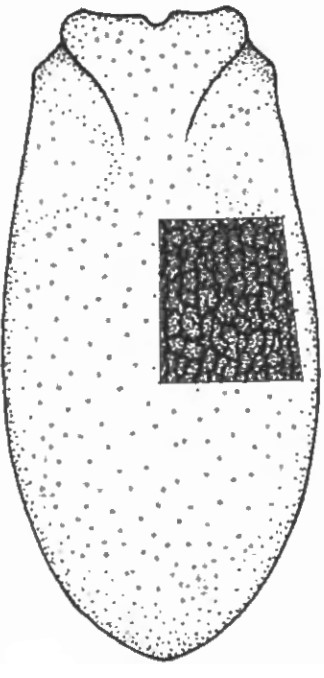
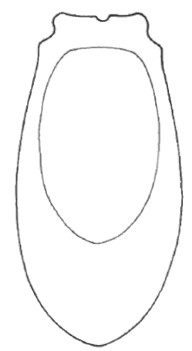
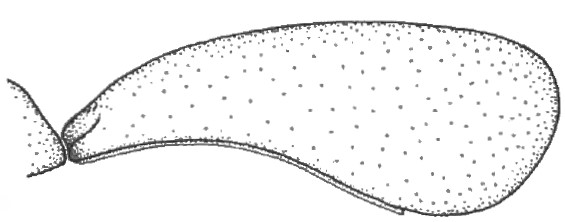
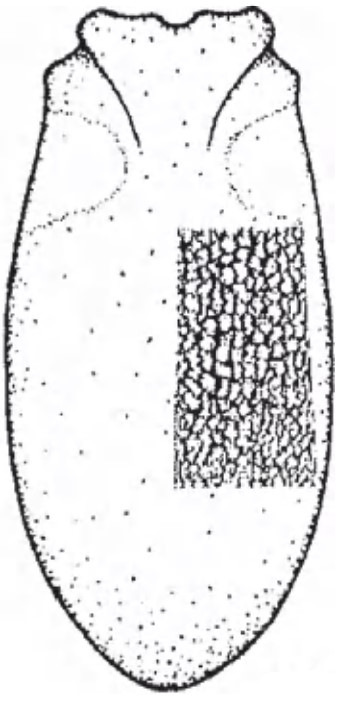
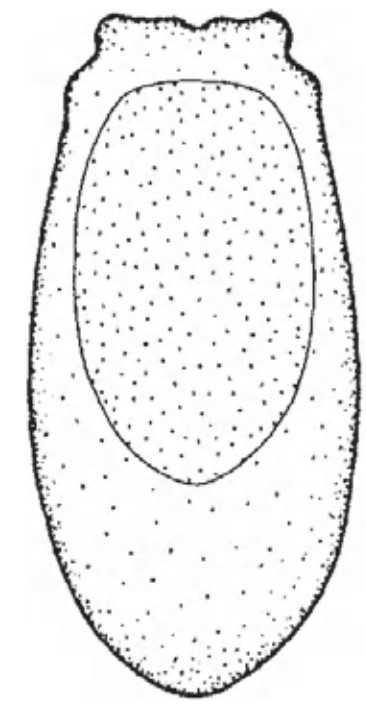
shapeMetasoma as long as head + mesosoma. Basal carinae missing or short [S2][S4]. Carapace in dorsal view (Fig. 6) twice as long as broad posteriorly, apically more or less bluntly pointed and its posterior half laterally somewhat compressed. Pair of basal keels short and rather weak, restricted to declivous basal part of carapace. Carapace in lateral view posteriorly high, 2.3 times as long as high behind and distinctly incurved ventrally (Fig. 7, see arrows). In ventral view aparture of carapce clearly one-fourth shorter than carapace itself (Fig. 8) [P7]. Carapace in dorsal view somewhat more narrowing posteriorly [P2]. The metasoma is almost flat, and as long as the head and mesosoma; not rounded at the top [Te1]. Metasoma curved forward ventrally up to 1/5 to 1/4 its length [T4]. Metasoma 2.5 times as long as high [T13]. In dorsal view oval, obviously contracted at the end, and the apically bent inward. The ventral cavity is about 3/4 of the length of the entire metasoma [Zh1].
sculptureRugulose, only at base grooves [S2]. Carapace on its basal third striate, otherwise rugose to subrugose-rugulose (Fig. 6) [P7]. Clearly visible longitudinal rugae at the base of the metasoma [Te1]. Basal third of metasoma roughly reticulate rugose, the rest finlely reticulate-rugulose [Zh1]
color2 pale spots at base [S2]. Carapace basally with a pair of yellow maculae, or maculae missing [P7]. Metsaoma sometimes with 2 yellow spots at the base [Te1]. The yellow spots on the metasoma are small [S3].
Die Fühler sind 22-gliedrig. Fein-runzlig; die Runzel bilden nur an der Wurzel des Hinterleibes Furchen. Das Schild ist nur in der Mitte glatt und glänzend. Der Hinterleib hat die Länge des Kopfes und mesosoma’s, ist an der Wurzel mit zwei hellen Flecken versehen; die Kanten fehlen. Schwarz und glänzend. Die Schenkel der Hinterfüsse sind ganz schwarz; die Mitte der Schienen ist weiss, das erste Tarsenglied mehr oder minder roth. Länge 4 mm.
Data used in the multi-access key
These data are collected from the species descriptions and redescriptions, from published figures and photographs and from own measureements and observations. For a description of the different variables and value classes see this pdf.
morphology
basic information
female
male
body length (mm):
(3.2) 3.2 - 5 (5.2)
(3.2) 3.2 - 5 (5.2)
number of antennal segments:
(20) 20 - 23 (24)
28 - 32
head, dorsal view
Head width : length
narrow, wide
narrow, wide
Temples narrowing - widening
narrowing
narrowing
Eye length : temple length
1.0 - 1.25, > 1.25
1.0 - 1.25, > 1.25
Roundness temple
medium, weak
medium, weak
POL : OD
3 - 4, > 4
3 - 4, > 4
Ocellar triangle shape
narrow, wide
narrow, wide
Excavation of head
15 - 25%, 25 - 35%
15 - 25%, 25 - 35%
head, lateral view
Head height : length
very short, short
very short, short
Eye height : length
short, long
short, long
Temple length : eye length
short, long
short, long
head, frontal view
Head width : height
---
---
Face width : height
wide
wide
Eyes converging ventrally
distinctly converging, about parallel
distinctly converging, about parallel
EH : MSL
short
short
Clypeus width : height
very transverse
very transverse
Clypeus extending above bottom of eyes
---
---
Tentorial pits
---
---
Shape of lower margin clypeus
slightly excised, sinuous
slightly excised, sinuous
antennae
Antennal shape
slightly widened
filiform, not widened
Segment 3 length : width
short
---
Penultimate segment length : width
short
---
Length of antenna : length of body
2: short
---
mesosoma, lateral view
Length : height
medium
medium
transverse carina
well developed
well developed
lateral teeth
weak, small, short, present
weak, small, short, present
mesosoma, ventral view
Prepectal carina lamelliform
indistinct
indistinct
legs
Hind femur length : width ratio
short, medium
short, medium
Hind tibia length : hind tarsus length ratio
---
---
Hind tibia (longest) spur length : metatars length ratio
short
short
wings
Vein 1-R1 length : pterostigma length
medium, long
medium, long
Vein r length : vein 3-SR length
short
short
Shape vein SR1 (straight / concave / convex)
straight or S-shaped, slightly convex
straight or S-shaped, slightly convex
S-shape vein SR1
apically convex
not S-shaped
cell M : cell Sm2
Sm2 large
Sm2 large
Pterostigma length : width ratio
medium, long
medium, long
Angle between radial vein (r) : vein 1-R1
sharp, medium
sharp, medium
metasoma, dorsal view
Length : width ratio of metasoma
medium, long
medium, long
Shape of metasoma
narrowing to apex, widest in middle
narrowing to apex, widest in middle
metasoma, lateral view
Length : height ratio of metasoma
short, medium
short, medium
posterior : anterior height ratio of metasoma
medium, large
medium, large
Position of maximum height
medium-posterior
medium-posterior, posterior
metasoma, ventral view
Metasoma posteriorly curved forwards
(distinctly) incurved
(distinctly) incurved
male apical aperture
Aperture width : metasoma width
no aperture
no aperture
Aperture shape
n. a.
n. a.
Median process shape
n. a.
n. a.
sculpture
head
general coarseness
medium, coarse
medium, coarse
clypeus
coarseness punctation
punctulate, punctate
punctulate, punctate
density punctation
---
---
face
sculpture type
rugose, reticulate
rugose, reticulate
sculpture direction
---
---
vertex and temple
sculpture type
striate-rugulose, transverse rugulose
striate-rugulose, transverse rugulose
mesonotum
sculpture type
notauli slightly distinct
notauli slightly distinct
scutellum
middle
smooth
smooth
lateral
rugose / striate
rugose / striate
metasoma
base - mid sculpture
(sulcate) / striate, striate-rugose
(sulcate) / striate, striate-rugose
sculpture at apex
rugose, rugulose
rugose, rugulose
coarse / fine boundary
base (to 50%)
base (to 50%)
color
head
mandibles color pattern
dark tip
dark tip
palpi, lightest color
black, dark brown
black, dark brown
antennae
scapus, lightest color
black, dark brown
black, dark brown
segment 3 and 4, lightest color
black, dark brown
black, dark brown
legs
fore coxae lightest colour
dark
dark
fore femur lightest colour
medium light
medium light
fore femur color pattern
entirely dark, tip light
entirely dark, tip light
hind femur lightest colour
dark, medium light
dark, medium light
hind femur color pattern
entirely dark, tip light
entirely dark, tip light
hind tibia lightest colour
light
light
hind tibia color pattern
narrow light ring
narrow light ring
hind basitarsus lightest colour
medium light
medium light
hind tarsus segment 2-3 lightest colour
dark, medium dark
dark, medium dark
wings
middle veins lightest colour
dark, medium dark
dark, medium dark
basal veins lightest colour
medium light
medium light
metasoma
metasoma colour pattern
entirely dark, color only on basal third
entirely dark, color only on basal third
metasoma lightest colour
dark, light
dark, light
metasoma base, colour pattern
entirely dark, 1, 2 or 4 spots
entirely dark, 1, 2 or 4 spots
metasoma base, light spots
n.a., 2 small spots
n.a., 2 small spots
metasoma base, light band
n.a.
n.a.
Chelonus bimaculatus in published keys
T4: Tobias, 1986
Key to the Insects of the European Part of the USSR Volume III. Hymenoptera. Part four. Chapter 16
P7: Papp 2003b
Revision of Szépligeti's Chelonus s. str. species described from Hungary (Hymenoptera: Braconidae: Cheloninae).
P2: Papp, 1997a
Revision of the Chelonus s. str. species described by C. G. Thomson (Hymenoptera: Braconidae, Cheloninae)
P1: Papp, 1995
Revision of C. Wesmael’s Chelonus species (Hymenoptera, Braconidae, Cheloninae).