shape6-7 mill. (= 3.3-4.5 mm?) [Th]. ♀ 4.3-4.8 mm, ♂ 4.7-4.8 mm [P1]. 6-7mm [M2][Te1].
colorblack [Th].
head
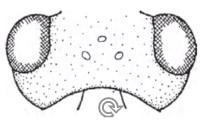
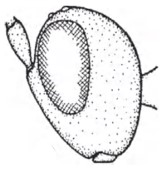
shapeTemples slightly rounded [Th]. Head in dorsal view (Fig. 1) 2x as broad as long, eye 1.4x as long as temple, latter constricted, occiput excavated. Ocelli small, somewhat elliptic, distance between fore and hind ocelli longer than diameter of hind ocellus, POL:OD:OOL as 10:4:14. Eye in lateral view (Fig. 9) 1.75x as high as wide, temple as wide as eye. Malar space 1/3 longer than basal width of mandible. Face just less than 2x as wide as high, inner margin of eyes parallel. Clypeus less wide than face, distinctly 2x as wide as high, distance between tentorial pits 1/6 longer than that between pit and lowest point of eye [P2].
sculptureTemples weakly striate, without rugae [Th]. Face transversely strio-rugose; clypeus medially densely punctate, laterally with more or less confluent punctation, interspaces shiny. Head above rugose, temple striate with anastomosis [P2]. Temple slightly rugose-striate [Te1].
color
antenna
shape ♀Length of antenna exceeding mesosoma, past the middle dilated [Th]. Antenna about as long as head and mesosoma combined, with 28 antennomeres. Third segment 1.6x as long as broad and penultimate segment cubic [P2]. Antennae longer than head and thorax, thickened behind middle, 24-27-segmented [Te1].
shape ♂
color
mesosoma
shapeAnterior margin of acetabulum bidentate and reflexed. Propodeal teeth sharp but short [Th]. ♀ Mesosoma in lateral view 1.66x as long as high. Notaulix distinct by rough sculpture. Lateral pair of propodeum spiky, median pair hardly distinct. Fore acetabulum (close behind fore coxae) unusually emerging lamelliform and slightly denticulate in shape (Fig. 3) [P2][P1]. The lateral margins of the mesosoma, behind the anterior coxae, are raised and bidentate. Propodeum with 2 teeth [Te1]. Teeth of the propodeum acute, but short [M2].
sculptureMesonotum slightly punctured, mesosternum finely and neatly punctured [Th]. ♀ Mesosoma areolate rugose, mesonotum rugose with small smooth and shiny fields, scutellum smooth and shiny. ♂: Scutellum smooth with fine and disperse punctation [P2].
color
legs
shapeHind femur 3.5x as long as broad medially; pair of spurs of hind tibia subequal, inner spur 0.5 as long as basitarsus. Hind tibia and tarsus equal in length, hind basitarsus as long as tarsomeres 2-4 [P2].
sculpture
colorFront femora and tibiae yellow-brown, posterior with brown-black apex and base [Th]. Legs black; femora apically, tibiae and basitarsi yellow, hind tibia basally and apically, basitarsi apically and tarsomeres 2-5 (of every leg) brownish [P2].Legs are black; fore tibia entirely reddish yellow in the middle [Te1]. Apex of hind tibia and a ring near the base blackish [M2].
wings
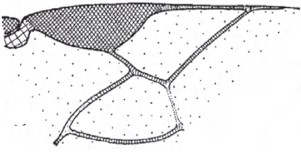
shapeHind wing radius bent [Th]. Fore wing 0.25 shorter than body. Pterostigma (Fig. 4) 2.3 - 2.7 as long as wide issuing radial vein (r) distally from its center, R1 longer than pterostigma; 1-R1 shorter than pterostigma, r somewhat shorter than 3-SR, SR1 almost straight (i.e., indistinctly arched) and ending far before tip of wing. ♂ r almost as long as 3-SR [P2].
colorFore wings before stigma yellowish-brown, ♂ before stigma darker [Th]. Wings subhyaline, pterostigma brown, veins proximally opaque yellowish, distally opaque brownish [P2]. The wings are slightly smoky; the stigma is brown [Te1]. Parastigma yellow-brown [M2]. Tegula brownish black [P2].
metasoma
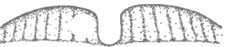
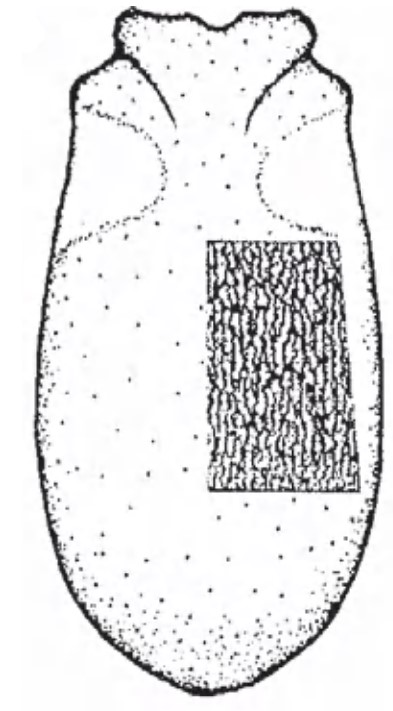
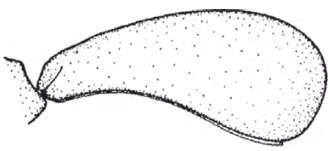
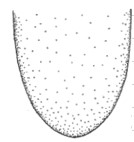
shapeMetasoma sub-oval, apex shortly incurved [Th]. Carapace in dorsal view (Fig. 5) elongate oval, 1.7- 1.8x ,[in figure 5 2.0x!] (♂ 1.8 - 1.9x) as long as broad medially; in lateral view (Fig. 6) 2.3x as long as high posteriorly; in ventral view apically incurved, i.e., ventral opening of carapace shorter than carapace itself (Fig. 7). ♂ carapace somewhat less broadening [P2]. Metasoma elongate-ovate, notched ventrally at apex [Te1]. Fairly elongated carinae [M2].
sculptureCarinae quite long [Th]. Carapace densely-longitudinally rugose (Fig. 5), posterior declivous part rugose to subrugose and here subshiny [P2].
color♀ with large pale yellow-brownish spots on both sides, ♂ without spots [Th][P2]. ♀ Metasoma with yellow spots at the base, ♂ without spots [Te1].
♀ ovipositorOvipositor concealed [Th]. Ovipostor sheath short [P2]. Short and straight [H2].
♂ aperture
other info
distribution
remarksCh. bidentulus Thomson is close to Ch. Bimaculatus [P2].
hosts
figures
fig. 1: ♀ Head in dorsal view (Papp 1997a)
fig. 2: ♀ Head in lateral view (Papp 1997a)
fig. 3: Acetabulum of first leg in postero-frontal view (Papp 1995)
fig. 4: ♀ Distal part of right fore wing (Papp 1997a)
fig. 5: ♀ Carapace in dorsal view with indication of its sculpture (Papp 1997a)
fig. 6: ♀ Carapace in lateral view (Papp 1997a)
fig. 7: ♀ carapace in ventral view (Papp 1997a)
fig. 8: ♂ hind half of carapace in dorsal view (Papp 1995)
5. C. bidentulus n. sp: Niger, acetabulis mesosterni reflexo-bidentatis, genis haud rugosis, tibiis anterioribus totis, posticis medio late testaceis. Long 6—7 mill.
Species ab omnibus acetabulis anticis margine bidentato-reflexo distincta; statura et magnitudo C. annulati, capite genis subbuccatis, subtilius striatis, haud rugosis; mesonoto subtilius punctato; abdomine subovali, macula magna utrinque pallide testacea, carinis sat longis, ano breviter inflexo, terebra retracta; mesosterno subtiliter concinne punctato; metathorace spinis acutis sed brevibus; genubus anterioribus tibiisque testaceis, bis posticis apice lato annuloque prope basin nigro-fuscis; antennis thoracem superantibus, supra medium parum dilatatis; alis superioribus praestigmate testaceo, inferioribus radio flexuoso: mas abdomine immaculato, ano haud longe inflexo, crasso, praestigmato obscuriore.
Sällsynt; funnen vid Ilstorp i Skåne.
Data used in the multi-access key
These data are collected from the species descriptions and redescriptions, from published figures and photographs and from own measureements and observations. For a description of the different variables and value classes see this pdf.
morphology
basic information
female
male
body length (mm):
(4) 4 - 4.8 (5)
(4) 4 - 4.8 (5)
number of antennal segments:
(24) 24 - 28 (30)
(25) 25 - 32 (34)
head, dorsal view
Head width : length
wide
wide
Temples narrowing - widening
strongly narrowing, narrowing
strongly narrowing, narrowing
Eye length : temple length
> 1.25
> 1.25
Roundness temple
weak
weak
POL : OD
2 - 3
2 - 3
Ocellar triangle shape
very narrow
very narrow
Excavation of head
15 - 25%
15 - 25%
head, lateral view
Head height : length
short
short
Eye height : length
very short, short
very short, short
Temple length : eye length
very short, short
very short, short
head, frontal view
Head width : height
---
---
Face width : height
narrow, wide
narrow, wide
Eyes converging ventrally
about parallel
about parallel
EH : MSL
short, long
short, long
Clypeus width : height
transverse, very transverse
transverse, very transverse
Clypeus extending above bottom of eyes
---
---
Tentorial pits
small
small
Shape of lower margin clypeus
---
---
antennae
Antennal shape
clearly widened
filiform, not widened
Segment 3 length : width
short
---
Penultimate segment length : width
short
---
Length of antenna : length of body
2: short, 3: long
---
mesosoma, lateral view
Length : height
long
long
transverse carina
---
---
lateral teeth
weak, small, short
weak, small, short
mesosoma, ventral view
Prepectal carina lamelliform
lamelliform
lamelliform
legs
Hind femur length : width ratio
medium
medium
Hind tibia length : hind tarsus length ratio
---
---
Hind tibia (longest) spur length : metatars length ratio
long
long
wings
Vein 1-R1 length : pterostigma length
medium, long
medium, long
Vein r length : vein 3-SR length
short
short
Shape vein SR1 (straight / concave / convex)
slightly concave
slightly concave
S-shape vein SR1
not S-shaped
not S-shaped
cell M : cell Sm2
Sm2 large
Sm2 large
Pterostigma length : width ratio
short, medium
short, medium
Angle between radial vein (r) : vein 1-R1
sharp
sharp
metasoma, dorsal view
Length : width ratio of metasoma
short, medium
short, medium
Shape of metasoma
widest towards apex
widest towards apex
metasoma, lateral view
Length : height ratio of metasoma
short
short
posterior : anterior height ratio of metasoma
large
large
Position of maximum height
medium-posterior
---
metasoma, ventral view
Metasoma posteriorly curved forwards
(distinctly) incurved
(distinctly) incurved
male apical aperture
Aperture width : metasoma width
no aperture
no aperture
Aperture shape
n. a.
n. a.
Median process shape
n. a.
n. a.
sculpture
head
general coarseness
medium
medium
clypeus
coarseness punctation
punctate
punctate
density punctation
---
---
face
sculpture type
striate, rugose
striate, rugose
sculpture direction
transverse
transverse
vertex and temple
sculpture type
striate (striolate), striate-rugulose
striate (striolate), striate-rugulose
mesonotum
sculpture type
notauli distinct
notauli distinct
scutellum
middle
smooth
smooth
lateral
punctate
punctate
metasoma
base - mid sculpture
longitudinally rugose / rugose-striate
longitudinally rugose / rugose-striate
sculpture at apex
rugose, rugulose
rugose, rugulose
coarse / fine boundary
mid (50 - 70%), apex (>70%)
mid (50 - 70%), apex (>70%)
color
head
mandibles color pattern
---
---
palpi, lightest color
---
---
antennae
scapus, lightest color
black, dark brown
black, dark brown
segment 3 and 4, lightest color
black, dark brown
black, dark brown
legs
fore coxae lightest colour
dark
dark
fore femur lightest colour
medium light
medium light
fore femur color pattern
tip light, base dark
tip light, base dark
hind femur lightest colour
light
light
hind femur color pattern
tip light
tip light
hind tibia lightest colour
light
light
hind tibia color pattern
narrow light ring, wide light ring
narrow light ring, wide light ring
hind basitarsus lightest colour
light
light
hind tarsus segment 2-3 lightest colour
medium dark
medium dark
wings
middle veins lightest colour
medium dark
medium dark
basal veins lightest colour
medium light, light
medium dark, medium light
metasoma
metasoma colour pattern
color only on basal third
entirely dark
metasoma lightest colour
light
dark
metasoma base, colour pattern
1, 2 or 4 spots
entirely dark
metasoma base, light spots
2 large spots
n.a.
metasoma base, light band
n.a.
n.a.
Chelonus bidentulus in published keys
P2: Papp, 1997a
Revision of the Chelonus s. str. species described by C. G. Thomson (Hymenoptera: Braconidae, Cheloninae)
P1: Papp, 1995
Revision of C. Wesmael’s Chelonus species (Hymenoptera, Braconidae, Cheloninae).