Chelonus atripes
authorThomson, 1874
synonyms
body
shape♀♂ 2.9-3 mm [P2]. 2.4 mm [By1]. 2.8 - 3.0 mm [Lo1]. 5-7 mm. [Te1]. 4-5 mill. (2.4-3.0 mm?) [Th]. ♀ 2.3 - 2.5, ♂ 2.8 mm [T13]. ♀ 2.8 - 3.0, ♂ 2.8mm [T14].
colorBody with dense granular sculpture, matte [T13].
head
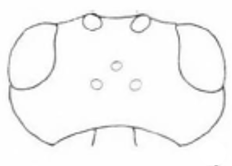
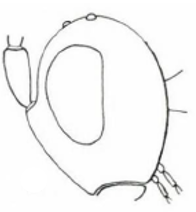
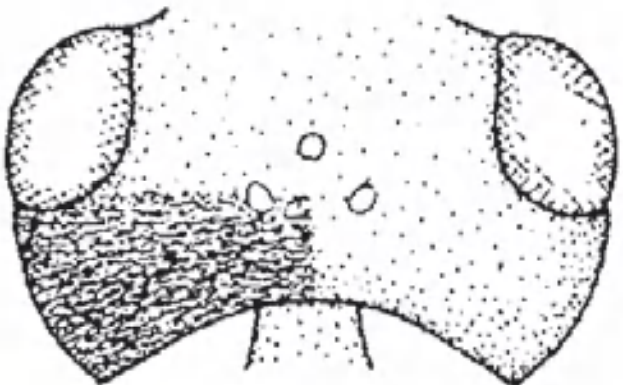
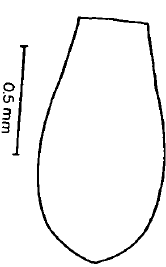
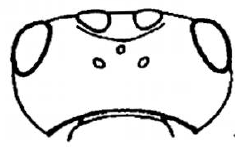
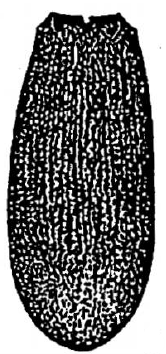
shapeHead in dorsal view (Fig. 1) transverse, 1.8 times as broad as long [P4]. Eye slightly though distinctly longer than temple, latter strongly rounded, occiput moderately excavated. Eye in lateral view almost twice as high as wide, temple somewhat wider than width of eye and not narrowing ventrally (Fig. 2)[P4]. Temple in dorsal view not bulged, i. e., head in dorsal view between temples not broader than between eyes and more rounded (Fig. 3) [P2]. Ocelli small, distance between fore and a hind ocelli twice greater and distance between hind two ocelli three times greater than diameter of an ocellus; POL about one-third shorter than OOL (Fig. 1). [P4]. Face almost twice as wide as high, inner margin of eyes parallel. Malar space 1.5 times as long as basal width of mandible. Clypeus 1.7 times wider between tentorial pits than high medially, its lower margin convex [P4]. Head transverse, narrowed towards the back. Relative proportions of length: width: height as 18:31:25. Shorter diameter of the eyes as long as the width of the temples, malar space almost 3 times as long as the base of the mandible. Eyes oval and 1.7 times as long as wide; OOL longer than POL (6: 5); Maxillary palps shorter than head height (11:25) [By1]. Malar space is about 0.3-0.4 of the longitudinal diameter of the eye [T13, key]. Head roundly narrowed behind eyes, 1.8 times as wide as long, noticeably wider than mesonotum. The temples from above are slightly longer than the eye. The ocelli are small, the distance between the anterior and posterior is 3 times their diameter. POL is one third less than OOL. Width of face twice its height, noticeably less than longitudinal diameter of an eye. Malar space 1.5 times basal width of mandible [T14].
sculptureHead above rather transversely rugulose [P4]. Face concentric striate-rugulose, subshiny [P4]. Face with weak concentric rugae. Vertex weakly transversely rugose behind eyes [T14].
colorOral organ brown [P4].
antenna
shape ♀16 segments [Th]. ♀ Antenna of female with 16 segments [P2]. Antenna somewhat longer than head and mesosoma together. 3rd segment distinctly three times as long as broad, further segments gradually shortening and attenuating so that penultimate segment twice as long as broad. [P4]. Apical antennal segments compressed [T9].Apical antennal segments 1.3-1.5 times as long as wide [not twice, or almost so] [T9, key]. Antennal segments in its apical half flatly compressed laterally, but without depressions [T13]. Antennae slightly longer than head and mesosoma combined; length of 3rd antennal segment 3 times its width, preapical segment twice as long [T14]
shape ♂19 - 20 segments [Th]. ♂ Antenna with 19-20 segments, penultimate segment (1.75)2.1- 2.3x as long as broad [P2]. Antenna about as long as head, mesosoma and two-thirds of metasoma together. 3rd segment three times as long as broad, further segments gradually shortening and attenuating [P4]. Antennae shorter than the body (40: 59), Scapus oval, 2.5 times as long as wide, 3rd segment 4.5 times as long as wide, penultimate segment a little longer than wide (3: 2) [By1]. ♂ Antennae 19-21 segmented, apical segments twice as long as wide [Lo1]. Antennae 19-segmented; 3rd antennal segment 3 times as long as wide [T14].
color
mesosoma
shapeMesosoma in lateral view about 1.5 times as long as high. Mesonotum between tegulae somewhat less broad than head [P4]. Mesosoma 1.3-1.5 times as long as high [T13, key]. Mesosoma length 1.5 times its height. Propodeum with weak transverse carina and small obtuse lateral teeth [T14].
sculptureMesosoma rugose to densely rugose, scutellum rather rugulose [P4]. Mesonotum before scutellum irregularly rugose [T13]. The mesosoma is densely rugose, the scutellum is slightly rugose [T14].
color
legs
shapeHind femur thrice as long as broad, broadest at its middle; hind tibia and tarsus equal in length, basitarsus of hind leg as long as tarsal segments 2-4 [P4]. Legs normal, relative length ratios of the rear coxa: trochanter: femur: tibia: tarsus as 15: 9: 24: 30: 30; Hind femora 3.5 times as long as wide; The spurs of the posterior tibiae are as long as the 4th tarsal segment and shorter than the 2nd tarsal segment (4: 5) [By1]. Hind femur 3 times as long as wide [T14].
sculpture
colorLegs blackish brown, tibiae and tarsi brown, spurs pale. [P4]. ♂: Hind tibia dark brown, with a slightly lighter spot in front of the middle [T13][T14].
wings
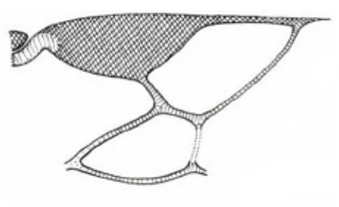
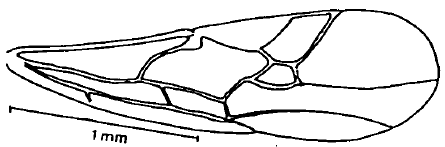
shapeFore wing nearly as long as body. Pterostigma (Fig. 3) 2.3 - 2.6 times as long as wide and 1.75 times as long as R1, issuing radial vein distally from its middle; r somewhat shorter than 3-SR or equal in length, SR1 straight; 2-SR distinctly three times as long as 3-SR [P4]. Fore wing shorter than body (53: 60); SR1 ends far in front of the wing tip, r 0.4 times as long as the width of the pterostigma and shorter than 3-SR (3:4), 3-SR 0.8 times as long as 2-SR and longer than r-m (4: 3), SR1 5 times as long as 3-SR [By1]. 1-R1 shorter than pterostigma [T9]. Marginal cell is twice as large as 2nd submarginal cell [T13, key]. 1-R1 of fore wing 0.75 times as long as pterostigma [T14].
colorWings weakly fumous, pterostigma brown, veins light brown [P4]. Wings smoky, veins and pterostigma blackish brown [By1]. The wings are slightly darkened [T14].
metasoma
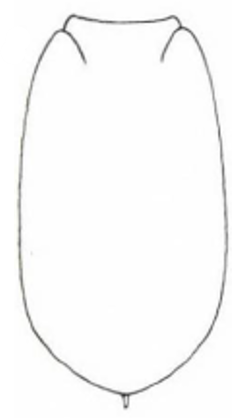
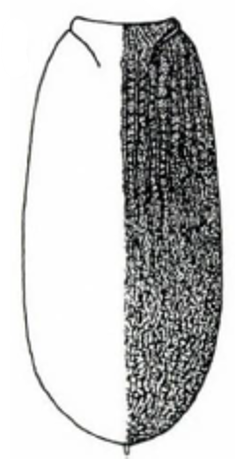
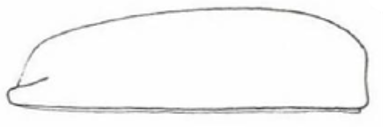
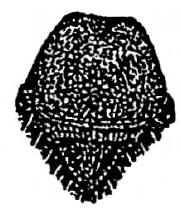
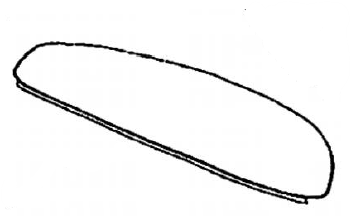
shapeCarapace as long as head and mesosoma together, in dorsal view 1.75 - 2 times as long as broad, slightly broadening posteriorly (Fig. 5); in lateral view almost evenly high (Fig. 8); apically just incurved ventrally. Basal pair of keels short and converging. [P4]. Metasoma oval, longer than the mesosoma (28 : 23) [By1]. Metasoma 1.75-2.0 times as long as wide [Lo1]. ♂ metasoma 2.0 - 2.3 times as long as wide [T13, key]. Metasoma slightly widened posteriorly, 1.75 times as long as wide [T14]. Metasomal length twice its width [T14].
sculptureAnterior third of carapace striate-rugose, posteriorly longitudinally rugose to rugose, interspaces with transverse rugulosity (cf. Fig. 6) [P4]. Metasoma rugose, dull, the rugae form longitudinal striae [By1]. Base of metasoma without sharp longitudinal folds [Te1]. Metasoma with numerous small tortuous and anastomosing rugae reaching its posterior third [T13][T14]. ♂: metasoma weakly longitudinally rugose in anterior half [T14].
colorCarapace with vague brownish hue [P4].
♀ ovipositorOvipositor sheath in lateral view as long as hind tarsal segments 2-3 [P4][T14].
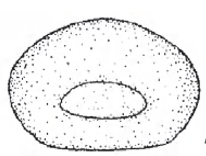
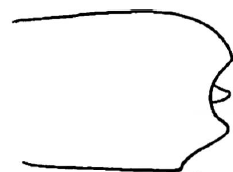
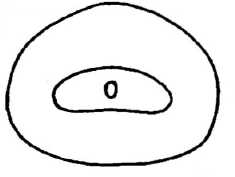
♂ apertureApical foramen 2x as wide as high (Fig. 7) [P2]; large, 3x as wide as high [H2]. Aperture oval, posterior end in rear view about 0.3 of height and 0.7 of width of carapace [Lo1]. The opening is very small and rounded [Te1]. The apical aperture occupies 0.3 times the width of the apex of the metasoma; its width is 3 times its height [T14].
other info
distributionWestern Europe [P4]. BE,DE,NL,SE [FE].
remarks
hosts