Chelonus annulipes
author(Wesmael, 1835)
synonyms
body
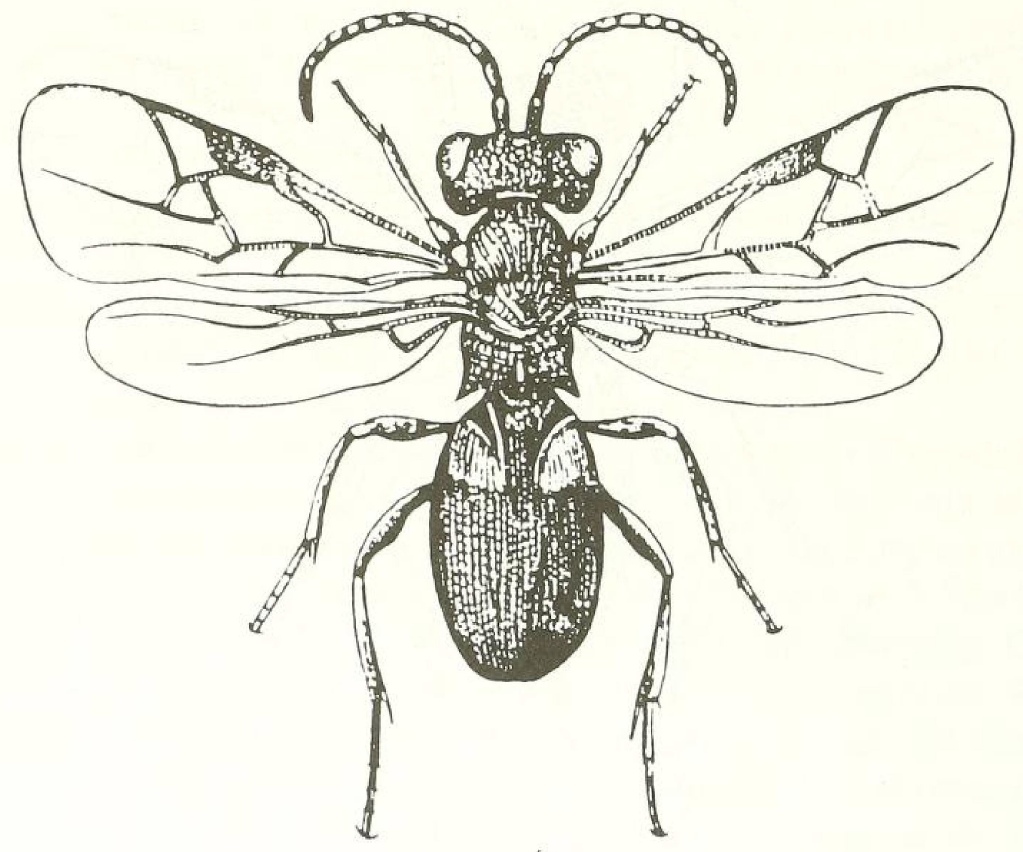
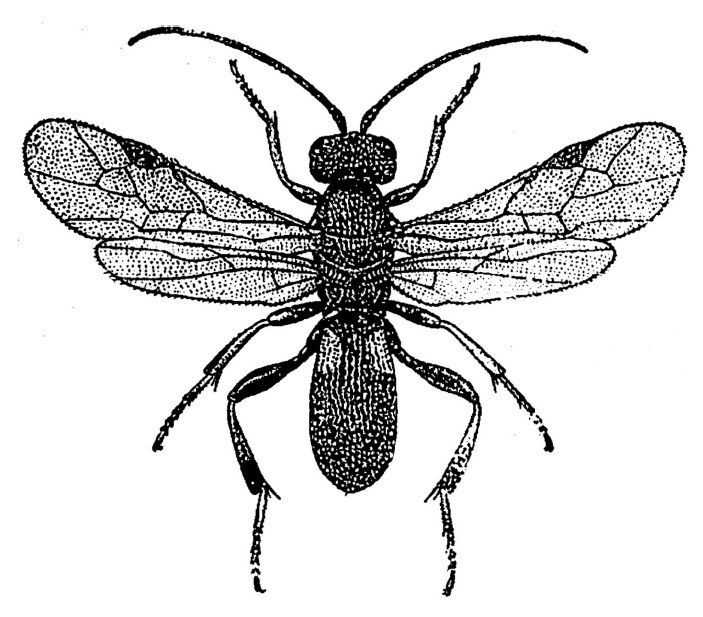
shape4.8 - 5.0 mm, black [P1]. ♀ 3.5 - 5.0, ♂ 4.4 - 4.9mm [Ch]. 4.0 - 5.0 [FTR]. 6 mm [Te1].
colorwhole body is rugose, black and covered with short whitish hairs [W].
head
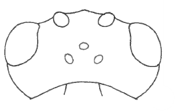
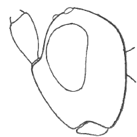
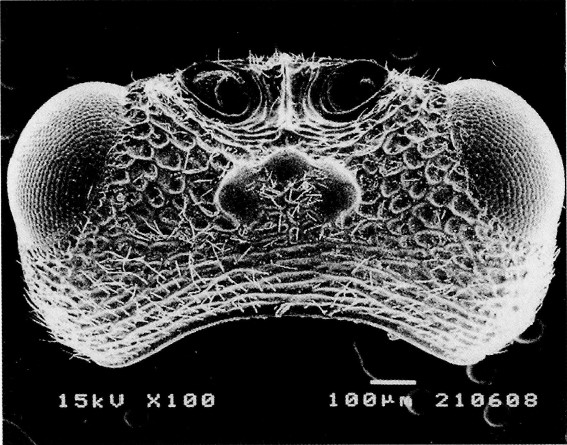
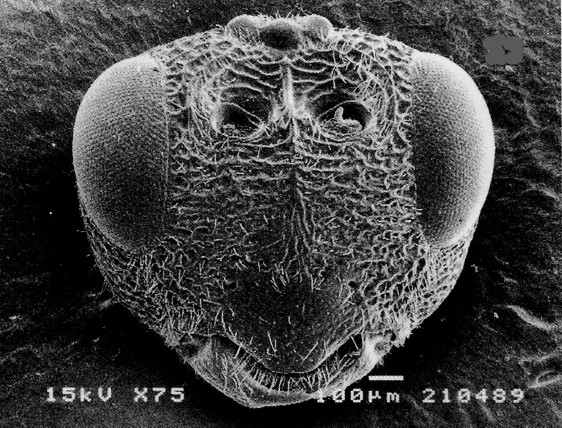
shapeDorsal view (Fig. 1) transverse, 1.9-2.0 x as broad as long, length eye : temple = 1.3, temple either rounded or strongly rounded (Figs l and 3), occiput excavated. Ocelli small, elliptic, POL: OD: OOL as 17: 7: 20, i.e. POL somewhat shorter than OOL. Eye in lateral view (Fig. 2) 1.8 times as high as wide, temple faintly broadening ventrally and as wide as eye. Malar space 1.4 times as long as basal width of mandible. Face 1.6 times as wide as high, inner margin of eyes parallel. Clypeus 1.76 times as wide as high , its lower margin medially truncate [P1]. In dorsal view head width is 1.8 - 1.9 times the head length, head width is 1.2 - 1.3 times the mesosoma width. Ocellar triangle is blunt, in a straight line, OOL: OD: POL = 1.6: 0.3: 1.6 to 2.2: 0.5: 1.5. The temple is slightly rounded and slightly convergent, shorter than the eye; the length of the eye is 1.2 - 1.5 times that of the temple. The center of the face is slightly raised, with a small tubercle, the longitudinal ridge on the frons extends from this tubercle. The width of the face is 2.1 times its height (♂ 1.8 - 1.9 times), the clypeus is slightly higher than the face, and the boundary with the face is not obvious. The clypeus width is 1.6 - 1.7 times its height, 1/2 of the face width. The malar space distance is 1.2 times (♂ 1.0 - 1.1) the mandible base width [Ch]. The face is twice as wide as hight; malar space more than 1/2 of the longitudinal diameter of the eye; temples slightly more than the width of the eye. The ocelli are small; the distance between them and the eyes is 3-4 times OD [Te1].
sculptureRugosities on the face are very fine and seem to be transverse. Those on temples are rather striate and parallel to the eye. Clypeus is finely punctulate, interspaces shiny [W][P1]. On vertex behind ocelli with more than 5 weak transverse rugae [T4]. The forehead is sunken, with large and thick horizontal rugae, shiny, with obvious mid-longitudinal ridges, and thick net-like rugae between the forehead and the eye margin; The face is densely covered with short hair, the middle and lateral sides of the face each have larger, and the lower part has smaller horizontal reticular wrinkles. The clypeus is covered with sparse long hair, densely punctated, and shiny. The temples have dense horizontal reticular wrinkles [Ch]. Antennal fossa on the forehead densely transversely rugose, with a longitudinal carina in the middle [Te1].
colorMandible dark rusty brown [P1], mandibles and palpi black [W]. Mandible tip red and yellow, base black; palpi dark brown [Ch].
antenna
shape ♀♀ Antennal segments a bit compressed from about the middle, hardly longer than wide and very tight [W]. Antenna about as long as body, with 27 - 29 segments. 3rd segment 2.7-3 times and penultimate segment 1.2-1.4 times as long as broad [P1]. The antennae has 24 to 26 segments and is shorter than the body length. Its middle part is enlarged, slightly laterally flat. The scapus is thick. The length of the scapus, the 3rd segment and the subterminal segment are respectively 1.1 - 1.6 times, 2.7 - 2.8 times, 2.5 - 3.2 times and 1.0 - 1.3 times the width [Ch]. Antennae ♀ longer than head and thorax, noticeably compressed behind middle, 27-segmented [Te1]. 24 segments [Zh1].
shape ♂Almost as long as the body, with 32 segments (1 ind.) [W][M2]. The antennae have 29 - 30 segments, are shorter than the body, and gradually become thinner. The length of the scapus, 3rd, 4th and penultimate segment is respectively 2.1 - 2.5 times, 3.1 - 3.2 times, 2.1 - 2.2 times and 1.7 - 2.0 times the width [Ch]. Antenna of male distinctly shorter than body [FTR]. Equal to body length, filiform, 30 segments [Te1].
colorScape dark rusty brown [P1]. ♂ antennae black, setacious [W]. Antennae dark brown [Ch].
mesosoma
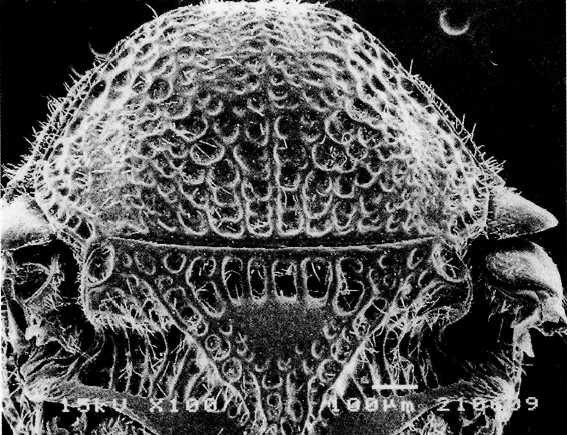
shapeMesosoma in lateral view stout, 1.3 times as long as high [P1]. Propodeum with two pointed teeth [W]. Scutellar sulcus with 6 wide and deep holes. Propodeum with mid-longitudinal ridges, clear lateral ridges at the ends, truncate porteriorly, with 4 teeth, very small mid-teeth, and large lateral teeth [Ch]. The prescutellar sulcus is equal to 1/2 the length of the scutellum, sharply crenulated. Propodeum with 2 teeth on the sides, with a sharp transverse ridge in the middle [Te1].
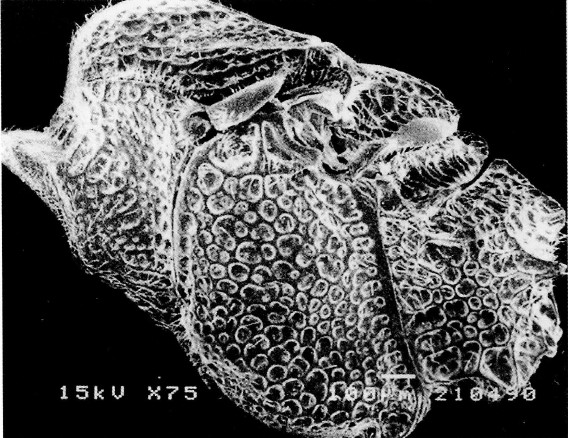
sculptureMesosoma rugose, mesonotum rugulose and subshiny, notauli distinct by rougher sculpture, scutellum with rugulae, interspaces shiny [P1]. Mesonotum coarsely rugose, with sharp longitudinal rugae in front of scutellum. Fig. 10 [T4]. Scutellum only rugose on the sides, disc shiny, slightly punctated [W]. The center of the scutellum is raised, smooth and shiny, with reticulated dimples on both sides. The mesopleurae are densely covered with short hairs, with reticulated dimples [Ch]. The mesosoma and propodeum are roughly rugose. The notauli are unclear. Median lobe of mesonotum densely punctate, with a coarsely rugose longitudinal groove in the middle [Te1].
color
legs
shapeHind femur length : width=3.4. Pair of spurs of hind tibia unequal, inner spur just less than half as long as hind basitarsus. Hind basitarsus as long as hind tarsomeres 2-4 combined [P1]. The length of the hind femur, tibia, and metatars are respectively 3.3 to 3.5 times, 5.5 to 6.0 times, and 6.1 - 6.2 times the width; the ratio of the length of the hind tarsi segments is 3.7: 1.4: 1.2: 0.9: 1.0 to 4.9: 2.0: 1.4: 1.1: 1.4; The length of the inner spur of the hind tibia is half as long as the metatarsus; the tarsal claw is large; the middle protrusion is large [Ch]. Hind tibia spurs equal to 1/2 of the metatars [Te1].
sculptureHind coxae rugose [Te1]. Hind coxae with dense thin transverse striae [?] [Ch]
colorCoxae and trochanters are black. Fore femur brownish-yellow with black base, middle femur black with brownish-yellow tip and back femur blackish at base and tip. Fore- and mid tibiae are brownish-yellow, hind tibiae blackish at the base, whitish in the middle and black towards the tip. Front and middel tarsi are brownish-yellow with a dark tip, hind tarsi blackish, with the base of the metatarsus whitish [W]. Legs yellow, coxae, trochanters, basal half of middle femur and entire hind femur brownish black, tarsi dark-brownish [P1]. Legs black, with the apex of the fore femur for 2/3, the apex of the mid femur for 1/2, and the fore and mid tibia and tarsi yellow-red. The base of the hind tibia for 2/3, and the hind tarsi brown, with the base of the metatars light yellow-brown [Ch]. Hind femur black [FTR]. ♀♂. The body and legs are black; fore tibia entirely, middle tibia in hind tibia in middle and base of hind tarsus reddish [Te1].
wings
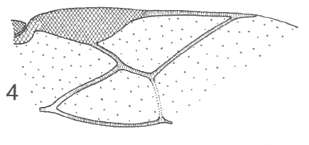
shapeFore wing one-fifth shorter than body, pterostigma 3-3.5 times as long as wide, issuing radial vein distally from its middle; r as long as 3-SR, SR1 somewhat arched and ending far before tip of wing. 1-R1 + 2-R1 somewhat longer than pterostigma, 1-R1 a bit shorter than pterostigma [P1]. Fore wing length ♀ 2.7 - 3.8 mm. Pterostigma length is 3.2 - 3.7 times the width; 1-R1 vein is shorter than pterostigma; r vein extending from the middle of pterostigma, r: 2-SR: 3-SR: SR1 = 0.8: 2.5: 1.1: 4.0 to 1.5: 3.3: 1.5: 5.8; 1-CU1: 2-CU1 = 1.2: 3.0 to 2.0: 4.0; The length of the M+CU vein in the hindwing is the same as the 1-M vein. ♂ Fore wing 3.7 - 3.8 mm. The length of the pterostigma is 3.0 - 3.5 times the width; r: 2-SR: 3-SR: SR1 = 1.2 : 2.8 : 1.5: 4.8 to 1.6 : 3.0 : 1.4 : 6.0; 1-CU1: 2-CU1 = 1.6: 3.3 to 1.9: 4.0 [Ch]. Vein r shorter than 3-SR and r-m. SR1 4 times as long as 3-SR, slightly curved. 2-SR almost 2 times as long as 3-SR. 1-R1 is equal to the length of the pterostigma. 1-CU1 = 0.5 2-CU1 [Te1].
colorThe wings are transparent with a very light ashy tint. The stigma is black [W]. Wings brownish fumous, pterostigma opaque brown, veins proximo-distally yellowish to brownish [P1]. Tegulae dark rusty brown [P1]. Wing smoky brown, base dark brown, veins C+SC+R and parastigma red and yellow, pterostigma brown, the veins are light brown [Ch]. The wings are slightly smoky; tegulae and pterostigma black; the main segment of the medial vein and the basal vein are yellow [Te1].
metasoma
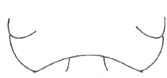
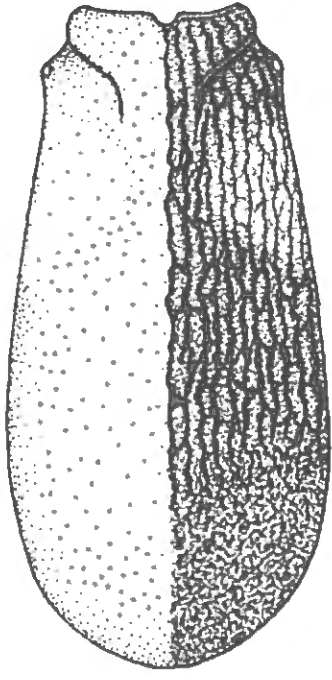
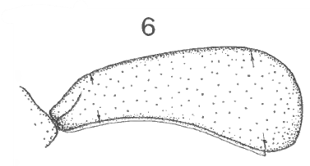
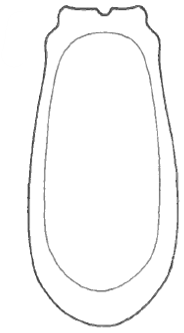
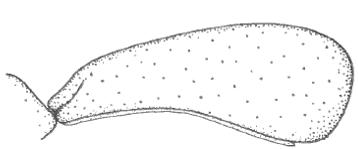
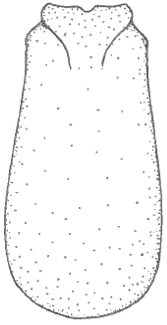
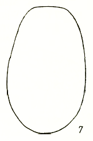
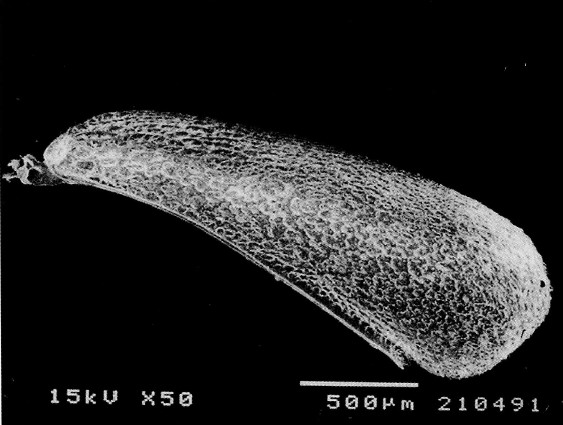
shapeCarapace in dorsal view 1.9-2 times as long as broad posteriorly, faintly broadening posteriorly; in lateral view (Fig. 6) 2.5-2.6 times as long as high behind, twice higher behind than basally (see arrows in Fig. 6). Carapace apico-ventrally somewhat incurved (Fig. 7), i.e. ventral opening of carapace nearly as long as carapace itself. [P1]. Metasoma 1.5 times as long as its width in middle (fig 11) [T4][Ay2]. The length of the carapace in the dorsal view is equal to the length of the head and mesosoma. The length is 1.8 to 1.9 times the width. The widest point is at the end 1/3. The apex is obviously arched and slightly truncated in lateral view, and the ventral cavity extends almost to the end or is even as long as the carapace [Ch].
sculptureRugosity longitudinal striate near base [W][P1]. Pair of converging keels short and restricted to declivous part of carapace. Carapace longitudinally striate with anastomosis, interstriations transversely rugulose, posterior declivous part of carapace rugose (Fig. 5) [P1]. The base 2/3 thickly longitudinal reticulate rugose, and the rest with small longitudinal rugose-like depressions [Ch].
color♂ At the base on each side a triangular whitish spot. ♀ Pale spots can be very large, only separated by a narrow black line [W]. Carapace with faint brownish tint, basally with a pair of yellow maculae [P1], ♂ with a small dark red spot near the center of the side, ♀ without maculae [Ch]. Yellowish spots of carapace rounded (photo 1) [FTR]
♀ ovipositorthe ovipositor sheath is 0.4 - 0.6 times the hind metatars [Ch]. The ovipositor is short, straight [Te1].
♂ aperturen.a.
other info
distributionBE,CH,DE,FR-F,NL,PL [FE]
remarks
hostsAnthonomus pomorum L., Ostrinia nubilatis ( Hübner) Loxostege sticticalis L. ,Eublema pannonica Fr. , Diatraea saccharalis F.,Sesamia sp. , Corcyra cephalonica Staint, Diatraea grandiosella Dyar, Agrotis segetum Schiff, Carpocapsa Pomonella L, etc. [Ch].