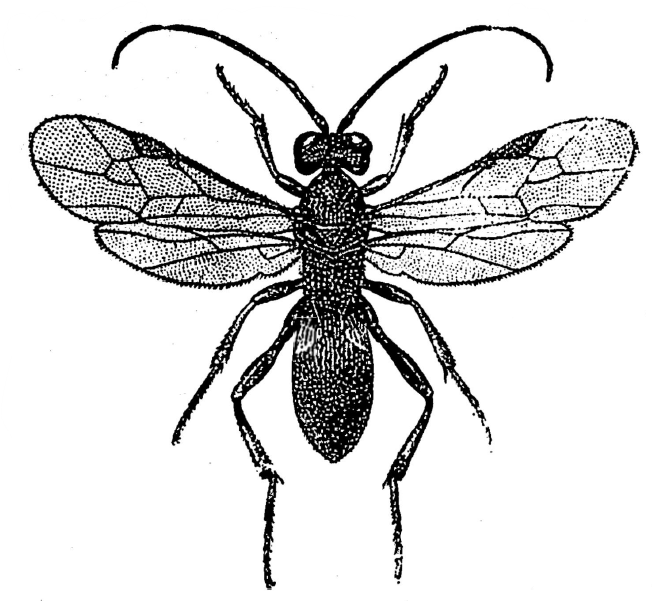
Chelonus annulatus
author(Nees, 1816)
synonymsCh. maculatus Szepligeti, 1896 [P7]
body
shapelong lin. 2. (5 mm) [N]. 3.0 - 5.0 mm [P1][T4][H2]. 4.0 - 5.5 [T3]. 4mm [M2] 5mm [Te1]. 3.2 - 5.0 mm [P7]. ♂ 4.5-5 mm [P12].
colorBlack [Te1].
head
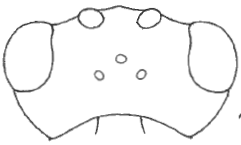
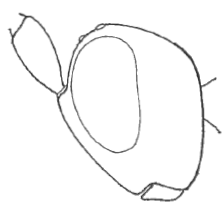
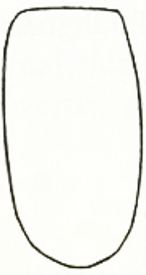
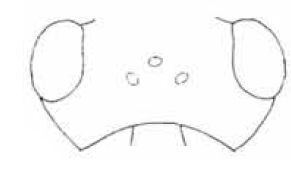
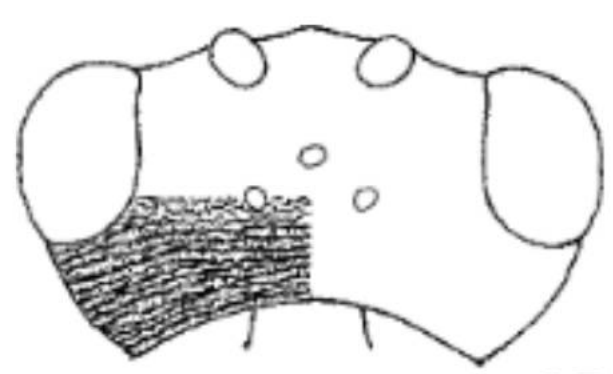
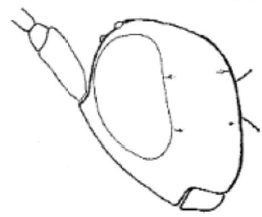
shapeHead transverse, a little wider than mesosoma, vertex narrow [N]. Temple in dorsal view (fig.1) roundly contracted behind the eyes [M][T3][P1], in lateral view (Fig. 2) at most as wide as eye [P1]. The head recedes linearly behind the eyes [Zh1]. Head 1.3 times as wide as mesoscutum, strongly roundly narrowed behind eyes; its width 2.1 times its length and 1.3 times its height. Temples 0.67 times as long as transverse diameter of eye. Base of ocellar triangle as long as OOL; POL 4.0 times ocellus diameter. Longitudinal diameter of eye nearly twice exceeding transverse one, 3.0 times height of malar space. Width of face twice its height. Proboscis not projecting. Length of maxillary palpi strongly exceeding height of face with clypeus [T3]. The head is transverse, markedly narrowed posteriorly. The face is twice as wide as high; malar space slightly less than 1/2 of the longitudinal diameter of the eye; temples no more than the width of an eye. The ocelli are small; the distance between them and the eyes is 4 times the diameter of the ocellus [Te1]. Temple receded in dorsal view (Fig. 9) [P7]. ♂ Eye 1.8 times as long as temple in dorsal view. Temple in lateral view at most as wide as eye (Fig. 14, see arrows) [P12].
sculptureHypostoma [face!] transverse rugulose-striate, in middle carinate [N]. Clypeus punctulate, shining [M], only weakly punctate in median part [T3]. Head reticulate-rugose, orbits and cheeks striolated, the face transversely striolated [M], concentric striae on vertex [N]. frontal fovea small, shining, somewhat rugulose [M]. Face with rough net-like rugae, frons rugose [Zh1]. Vertex behind ocelli with transverse rugae curved to run downwards onto temples; face with less strongly undulate transverse rugae [T3]. In ♀, the head, except for the clypeus, is wrinkled and striated, in ♂ it is irregularly wrinkled. Clypeus gently punctate, shining [Te1]. vertex relatively less strongly rugo-striate (Fig. 11)
colorBlack [N]. Palpi and tips of mandibles orange-brown, the former darker at the base [M].
antenna
shape ♀(27-)33-34 segments [P1][T4]H2][N]. As long as body, straight, setaceous, not so much suddenly decreasing towards the tip [N]. Antennae not thickened behind middle [T3], last 10-12 segments much thinner than others [T4], tip curved [H2]. The antennae are slender, long, 32-36 segments, and the ends of the antennae are curled after death [Zh1]. Antennae much shorter than body, number of their segments ~ 30. Length of 1st antennal segment 2.5 times its width, segments in apical part of antenna 1.5–2.0 times as long as wide [T3]. Filiform, not compressed closely, reach the middle of the abdomen, 27-33-segmented [Te1]. Antenna with (30-)33-34 segments [P7]..
shape ♂33-38 segments [P1]. 35 segments [Zh1]. Equal to body length, 29-33-segmented [Te1].
colorblack [N].
mesosoma
shapeLength of mesosoma 1.3 times its height. Propodeum with weak transverse carina and with small lateral teeth [T3]. Propodeum short, truncate, on both sides acute teeth [N]. Propodeum corners quite strongly pointed backwards, transverse carina strong, 2 or 3 longitudinal carinae weak [H]. Scutellum raised [T4]. Propodeum with transverse carina and tooth-like corners [Zh1]. Notauli poorly visible. Propodeum in the middle with a weak transverse ridge and with 2 short blunt teeth on the sides [Te1].
sculptureMesosoma rugulose-punctate, propodeum rugulose [N]. Scutellum weakly punctate, almost smooth, shiny [T4][H]. Mesonotum reticulate-rugose, coarser before scutellum. Propodeum reticulate-rugose [Zh1]. Mesoscutum rather coarsely rugose-punctate, with prevalence of coarse punctation; scutellum with smoothened sculpture. Mesopleura and propodeum areolate-rugose [T3]. Scutellum almost smooth towards the base, finely punctuated towards the end [M2]. Mesoscutum slightly rugose, shining. Scutellum smooth, rugose along margins. The sides of the mesothorax and the propodeum are roughly rugose [Te1].
color
legs
shapeLength of hind femur 3.5 times its width. Hind tibia slightly shorter than hind tarsus, its inner spur half as long as hind metatarsus. 5th segment of hind tarsus longer than 3rd, but shorter than 2nd [T3] .Hind tibia spurs equal to 1/2 of the metatars [Te1].
sculptureHind coxae almost smooth, shining [Te1].
colorLegs deep orange-brown, coxae and trochanters black. Fore- and middle femora at the base black. Hind femora black except the tip. Tip of hind tibiae broadly black, base dark, middle whitish, forming a ring. Base of tarsi black. [N][P1][T3][T4]. Fore femur (except for base) and tibia, and also apices of middle and hind femora brownish yellow, middle tibia yellowish brown; hind tibia brown, with yellowish band in basal third [T3]. The legs are black; fore and middle tibiae entirely, middle of hind tibia and often apex of all femora red [Te1]. Hind femur almost reddish yellow to almost black [P7].
wings
shapeMarginal cell twice as large as 2nd submarginal cell, 1-R1 as long as pterostigma;3-SR much longer than r, 0.4 times as long as SR1, and 0.67 times as long as 2-SR [T3]. Vein r is equal to 3-SR and r-m; SR1 slightly curved, three times as long as 3-SR. 1-R1 equal to pterostigma length. 1-Cu1 > 0.5 times 2-CU1 [Te1].
colorWings dark transparent [N], veins of fore wing yellowish in basal half [T3], radius brown [H]. Tegulae yellowish [T4], Tegula entirely to partly yellow [P7]. Tegulae usually dark but occasionally yellow. Pterostigma brown, wings weakly infuscate [T3].. Wings light, slightly smoky towards apex; tegulae are usually white; the pterostigma is brown [Te1]. Tegula entirely to partly yellow [P7].
metasoma
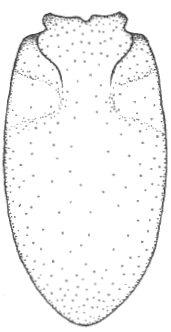
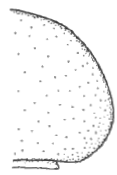
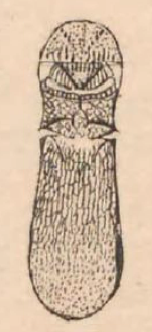
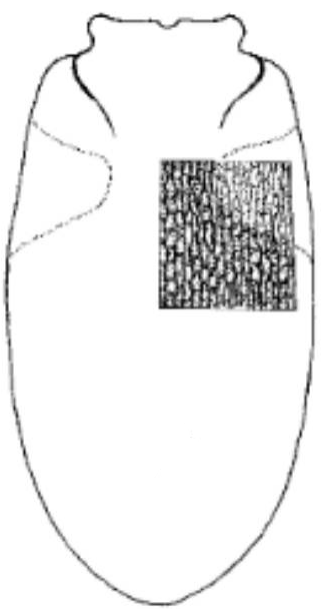
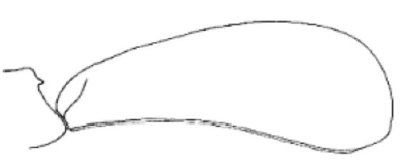
shapeMetasoma as long as head + mesosoma, oval, sides gently curved [N]. In dorsal view (Fig. 3) [P1] bluntly pointed [P1][AY2]. In lateral view behind as in Fig. 4 [P1]. Metasoma with 2 short, converging carinae at base [H]. The metasoma is oval, obviously contracted at the hind 1/3; the metasomal cavity is about 3/4 of the length of the metasoma. The end of the metasoma is curved inwards. Length of metasoma of Chelonus annulatus annulatus is 1.8-2.0 times width, in Chelonus annulatus asiacola, the metasoma is 2.0-2.1 times its width [Zh1]. Metasomal carapace oblong-oviform, almost not incurved forwards apically; length of carapace 1.8–2.0 times its width and 3.0 times its height in apical third. Metasoma more strongly narrowed towards apex than towards base (in dorsal view). Height in apical third only slightly exceeding that in basal part[T3]. Metasoma slender, narrower and longer than mesosoma, slightly compressed laterally at apex [Te1]. Carapace less incurved in lateral view (Fig. 10, see arrows) [P7]. Carapace in dorsal view (Fig. 12) apically bluntly pointed, in lateral view (Fig. 13) somewhat less rounded [P12].
sculptureReticulate-rugulose [N]. Covered with the usual oblong reticulations becoming finer posteriorly [M]. Hind third to fourth of carapace with weakening sculpture, here frequently uneven to almost smooth and more or less shiny [P1][M]. The metasoma has rough and irregular reticular rugae, but the apex is completely smooth and shiny [Zh1]. Metasoma with numerous longitudinal rugae gradually weakening and reaching its apical third; apex of carapace punctate, with more or less smoothened sculpture apically [T3]. Base of metasoma longitudinally rugose, [apex?] almost smooth, shining [Te1]. Hind third to fourth of carapace with weakening sculpture, carapace here frequently uneven to almost smooth and more or less shiny (Fig. 8).
colorBlack, near base on both sides often with triangular yellowish-transparant spots [N][M][P1][T4]. Ventral margin of carapace with yellow or brownish semitransparent edging [P1][T4]. ♂ all black or the spots at the base are smaller than the female [Zh1]. Metasoma usually with yellow basal spots but occasionally entirely dark [T3]. Metasoma sometimes with 2 yellow spots at the base [Te1]. ♂ Carapace black with a pair of basal yellow maculae [P12].
♀ ovipositorOvipositor sheath straight, black, relatively shortly projecting [N][T3] or concealed [T3]. The ovipositor is short and straight [Te1].
♂ aperture
other info
distributionWestern Europe [T4]. AT,CH,DE,FR-F,GB-G,IE,NL,PL,SE [FE]
remarksCh. annulatus is easy to recognize by its apically somewhat pointed carapace in dorsal view as well as by its antero-posteriorly weakening sculpture of carapace (Fig. 8) [P7].
hostsChrysoclista linneella (Clerck) (Agonoxenidae); Batia lambdella (Don.), Epicallima formosella (Den. et Schiff.) (Oecophoridae); Yponomeuta malinella Zell., Y. padella (L.) (Yponomeutidae); Narycia duplicella (Goeze) (Psychidae); Recurvaria nanella (Den. et Schiff.), and Parachronistis albiceps (Zell.) (Gelechiidae).